Fuel crisis blues: How price hikes are triggering pressure on the economy
/ 5 min read
India’s crude basket, nearly 85% of which is imported, averaged around $107.96 per barrel during May, reflecting higher benchmark premiums and landing costs.
Credits: Saurabh Singh
This story belongs to the Fortune India Magazine june-2026-indias-most-valuable-celebrities issue.
AS THE THREE-MONTH-OLD West Asia conflict continues to put pressure on global economies, India has started feeling the impact, despite handling the fuel supply crisis better than many other nations.
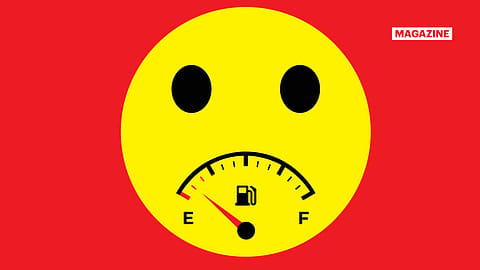
India’s public sector oil-marketing companies have raised petrol and diesel prices four times within 10 days — by ₹3 per litre on May 15, around 90 paise per litre on May 19, 91 paise per litre on May 23, and petrol by ₹2.61 per litre and diesel by ₹2.71 per litre on May 25, resulting in a cumulative increase of nearly ₹7.50 per litre.
The latest hike marks the first major increase in petrol and diesel prices since April 2022, when prices were raised by about ₹10 per litre during the Russia-Ukraine conflict.
Industry experts point out that India has so far managed to maintain adequate fuel supplies while cushioning consumers and businesses from the full impact of surging international crude oil prices following the escalation of tensions in West Asia.
According to Sujata Sharma, joint secretary in the Union petroleum ministry, public sector oil marketing companies — Indian Oil Corp. (IOC), Bharat Petroleum Corp. Limited (BPCL) and Hindustan Petroleum Corp. Limited (HPCL) — were incurring monthly losses of nearly ₹30,000 crore on the sale of petrol, diesel, and liquefied petroleum gas (LPG) because of the crisis. A May 15 research note by Nomura Holdings stated that the recent fuel price increase would offset only about one-tenth of refiners’ under-recoveries.
Global crude oil prices have remained volatile and elevated over the past three months, consistently staying above the $100-per-barrel mark — about 45% higher than three months earlier — driven by U.S.-Iran tensions and supply disruptions through the Strait of Hormuz. India’s crude basket, nearly 85% of which is imported, averaged around $107.96 per barrel during May, reflecting higher benchmark premiums and landing costs.
Despite the hike in retail prices of auto fuels, oil marketing companies’ under-recoveries remain stubbornly high due to increasing losses in domestic LPG sales and a high premium to the crude marker. “At a crude price of $120-125/barrel and considering the past 10-year average crack spreads of auto fuels, oil marketing companies are incurring a loss of about ₹700-800 crore daily on the sale of auto fuels and domestic LPG, even after factoring the fuel price hike. This high level of under-recoveries is unsustainable,” says Prashant Vasisht, senior vice president and co-group head, corporate ratings, ICRA Limited.
More Stories from this Issue
Various analysts’ reports also say that if crude prices continue to remain above $100 in the coming months, OMCs will have to continue increasing retail prices to bridge the gap. However, there are indications of Hormuz reopening in the near future and Iran and the U.S. nearing a truce.
“The West Asia crisis is not only a diplomatic and geopolitical issue. For businesses and common people, it can mean higher fuel costs, delayed cargo, costlier shipping, shortage of inputs, pressure on working capital, and uncertainty in export orders. The government’s approach is to protect citizens, support MSMEs, safeguard exporters and keep supply chains moving,” finance minister Nirmala Sitharaman said at an event on May 25.
“Persistently high global crude oil prices make pass-through to domestic cooking and transportation fuel prices imperative, and the government has raised the cost of petrol and diesel. A depreciating rupee also adds to the cost of imported inputs,” says Dharmakirti Joshi, chief economist, Crisil.
Analysts believe the marginal increase is unlikely to significantly affect fuel demand, though inflationary pressures are expected to rise. “Because of some of the recent changes to excise duties, part of the price shock will be absorbed by the government instead of being fully passed on to consumers. The real drop in demand will come only if the government and companies implement partial work-from-home measures,” says Premasish Das, executive director for oil analytics at S&P Global.
{{#most-powerful-women-snapshot-individual.slug}} {{/most-powerful-women-snapshot-individual.slug}} {{^most-powerful-women-snapshot-individual.slug}} {{/most-powerful-women-snapshot-individual.slug}} {{#showRanking}} {{current-rank}} {{/showRanking}} {{#photo.0.url}}
{{name}}
BPCL says it has intensified fuel supply and distribution operations across smaller towns, semi-urban markets, and regional geographies to ensure uninterrupted availability amid the recent spike in demand. Between May 1 and May 20, 2026, BPCL recorded petrol sales volumes of 1,005 thousand kilo litres (TKL), up 16.38% from 864 TKL during the corresponding period last year. Diesel sales during the same period stood at 1,677 TKL against 1,437 TKL last year, reflecting a growth of 16.69%.
However, the broader economic effects of rising fuel prices are beginning to emerge. Consumer price index (CPI)-based retail inflation stood at 3.48% in April, while CPI-based food inflation was 4.20%. Analysts now expect headline CPI inflation to rise by 15-25 basis points during the fiscal, potentially nearing 5%.
India has so far managed to maintain adequate fuel supplies while cushioning consumers from the full impact of surging crude oil prices. | Credits: Sanjay Rawat
Higher petrol, diesel, and CNG prices are already increasing transportation costs, pushing up freight rates, raw material prices, construction input costs and prices of everyday consumer goods. The impact is particularly visible in perishables such as vegetables and milk, adding pressure on household budgets.
ICRA expects raw material cost pressures and supply constraints to weigh on the profitability of downstream sectors such as oil marketing, fertilisers, chemicals, and city gas distribution in FY27.
A Crisil analysis of 32 stress sectors says the ceramic sector will be the hardest hit due to supply-side disruptions caused by gas shortages in certain areas, which could reduce revenue by a third and profitability by half during the year. The airline sector will be impacted by airspace closures, higher fuel costs, and rupee depreciation. Crude-linked sectors, including polyester textiles, specialty chemicals, and flexible packaging manufacturers, would be able to only partially pass on higher costs — that too with a lag. Auto component makers will have limited flexibility to pass on higher production costs in the aftermarket and could see a lagged pass-through of higher input and freight costs. For diamond polishers, sourcing through alternative hubs will increase procurement costs and affect operating profitability. Basmati rice exporters would see lower offtake from key markets, impacting revenue and operating efficiency.
“Of the 34 sectors stress-tested, 22 would see operating profitability being culled by more than 10% due to higher inventory costs and inability to fully pass on the burden to consumers immediately,” says Subodh Rai, managing director, Crisil Ratings.
ICRA maintains a stable outlook for the crude oil refining segment, supported by healthy refining margins and product cracks, while the outlook for fuel retailing remains negative because of sharply adverse marketing margins on auto fuels. The fertiliser, petrochemical, and basic chemicals sectors also continue to face pressure from elevated raw material costs, subsidy concerns, and global oversupply.
The government, however, maintains that the situation remains under control. Officials say all refineries are operating at high capacity with adequate crude inventories, while sufficient petrol and diesel stocks are being maintained across the country. Domestic LPG production from refineries has also been stepped up to support consumption needs.
During May, refineries in Mumbai, Kochi, Vizag, Chennai, Mathura, and Gujarat supplied around 10,600 MT of key feedstock chemical molecules — including propylene and butylene — and about 3,940 MT of butyl acrylate to the chemical, pharmaceutical, and paint industries.
So far, India has managed to navigate the global energy crisis emerging as a result of the West Asia conflict. But things could get difficult now on, if the crisis continues.
Follow Fortune India
NEXT STORY