How SVF went from a single film studio to a Bengali entertainment powerhouse
/ 11 min read
For decades, SVF has built ecosystems instead of standalone businesses. Now, a larger canvas awaits.
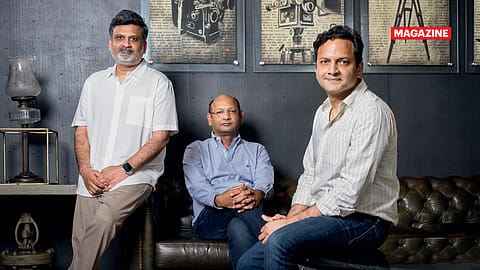
(From left) SVF co-founders Mahendra Soni, Shrikant Mohta, and Vishnu Mohta. | Credits: Somnath Roy
This story belongs to the Fortune India Magazine june-2026-indias-most-valuable-celebrities issue.
THERE IS A MOMENT in Autograph — Srijit Mukherji’s reinterpretation of Satyajit Ray’s iconic film Nayak — when Arun Chatterjee, the ageing superstar played by Prosenjit Chatterjee, slowly realises that the world around him is changing faster than legacy can keep up with. As Subho — a young filmmaker played by Indraneil Sengupta — reinterprets his story for a new generation, Subho’s girlfriend and theatre actress Srinandita — essayed by Nandana Sen — watches a quiet conflict between nostalgia and reinvention unfold in the background.
The 2010 film, produced by SVF Entertainment, was about cinema and stardom on the surface. Years later, SVF’s own journey resembles the arc of Autograph itself — a legacy institution trying to reinvent itself without losing the cultural instincts that made it relevant in the first place.
For nearly three decades, SVF — which reported standalone sales of ₹216.7 crore in FY24, according to data from Tofler — has been one of the biggest forces in Bengali entertainment. It operates across Hoichoi and Hoichoi Studios for digital content, SVF Films for cinema, SVF Music, Sangeet Bangla, Hoichoi FM and LiveLocal for music, enabling integrated creation and monetisation across platforms. Today, Hoichoi has 600+ films and 200+ originals such as Guptodhoner Sondhane, The Eken, Byomkesh, and Feludar Goyendagiri.
Now, the company is entering a new phase that goes beyond Bengal. Hindi adaptations, Punjabi tie-ups, Gujarati projects, Telugu collaborations, and multilingual partnerships are becoming a bigger part of its strategy. Chiraiya, the Hindi adaptation of the Bengali series Sampurna, became one of the most visible examples of this shift when it premiered on JioHotstar.
This diversification makes perfect sense, according to Ashish Pherwani, partner and leader, Media & Entertainment Sector, EY India. Given that the majority of consumption on OTT is now not in Hindi but in regional languages, there is a dual economic model that will exist, he says. “On one hand, large national platforms with five to eight regional languages will provide a more well-rounded content palette; on the other one to two regional OTTs per language will provide depth and life to hyper-local culture and storytelling.”
Inside SVF, however, this shift is seen less as diversification and more as a continuation of the company’s long-standing strategy: build ecosystems instead of standalone businesses.
“We started this company (Shree Venkatesh Films or SVF) around 1995,” recalls Mahendra Soni. “Shrikant [Mohta] and I had just graduated from college. We had no background in entertainment, no formal training. We were just commerce students trying to build something exciting.”
More Stories from this Issue
That lack of institutional backing would eventually shape SVF’s culture. For nearly six years, SVF struggled with losses and failed projects before finding success with Sasurbari Zindabad (2000). Soni still remembers telling Prosenjit Chatterjee, the leading man, that the film would likely decide whether the company survives or not. “We told him this is probably our last film,” Soni recalls. “If it works, fine, otherwise we go back to our family businesses.” Instead, the film became a major commercial turning point — not just for SVF, but for Bengali mainstream cinema as well.
BUILDING INFRA
Those early struggles shaped a philosophy that still defines the company today: build the ecosystem if it does not exist. “The problem with Bengal was that nobody was going to come and build the infrastructure for us,” says Soni. “So every time we faced a challenge, we went deeper and tried to solve it from the ground up.”
That instinct pushed SVF into areas many considered too risky or too early. At a time when Bengali films were still being shot mainly for small-format theatrical projection, SVF pushed for Cinemascope releases even though many theatres lacked the right systems. The same mindset later shaped the company’s move into digital exhibition through its partnership with Qube Cinema, a provider of end-to-end digital cinema technology and solutions. Long before digital cinema became common across India, SVF helped convert theatres across Bengal into digital screens. “We had already failed once trying something similar,” Soni says. “But we knew this was the future. We partnered with Qube and converted every major theatre in Bengal to digital within two years.”
{{#most-powerful-women-snapshot-individual.slug}} {{/most-powerful-women-snapshot-individual.slug}} {{^most-powerful-women-snapshot-individual.slug}} {{/most-powerful-women-snapshot-individual.slug}} {{#showRanking}} {{current-rank}} {{/showRanking}} {{#photo.0.url}}
{{name}}
Today, SVF Cinemas operates around 65 screens across 19 districts in West Bengal, including Bardhaman, Durgapur, Cooch Behar, Krishnanagar and Asansol. “When PVR and INOX were coming to Bengal, they were looking only at Kolkata as the market,” says Shrikant Mohta. “But we always knew there’s Bardhaman, there’s Durgapur, there’s Cooch Behar, there’s Asansol — and nobody is going to make theatres there.”
That belief in untapped regional audiences translated into a larger vision — building the infrastructure needed to sustain and scale the industry itself. “Infrastructure is the base of everything, right? Unless you have studios, unless you have cameras… so we made ourselves infrastructure-heavy,” says Soni. “On the outside it looked like we made so many films, web series and all of that, but in the backend, all we were doing was trying to build that infrastructure.”
“Our target,” adds Mohta, “Is to go to every large town in Bengal and make sure there’s a theatre where people can watch films.”
That infrastructure-first mindset also explains the company’s expansion into television and streaming.
In 2008, SVF partnered with Star India to strengthen Bengali television programming, at a time when national broadcasters were still paying limited attention to regional markets. Nearly a decade later, the company saw a similar opportunity in OTT.
“When Netflix came to India, we felt the same thing again,” Soni says. “If we waited for somebody else to build Bengali OTT, it would take another 10-15 years, so, we grabbed the opportunity.”
That urgency led to the launch of Hoichoi in 2017. Then, regional OTT platforms barely existed, and most of the industry believed Indian audiences would not pay for streaming content. Vishnu Mohta, who now leads Hoichoi, says, “In 2017, paid regional OTT looked like a niche within a niche.”
HOICHOI AND MORE
Most streaming platforms at the time were focussed on scale, spending heavily and prioritising growth over profits. Hoichoi chose a different route. “The tendency earlier was to acquire market share, even if content acquisition cost was extremely high, justified by lifetime value over three-four years,” says Vishnu. “But our belief was that if, at the transaction level, the first transaction is not a net positive, you don’t know what the customer will do later. If R2 (when the user renews or pays after the first cycle) is lower than CAC (customer acquisition cost), then there is a problem. You cannot build a long-term business only hoping the customer stays forever.”
Unlike many streaming platforms that depended heavily on advertising, Hoichoi focussed on subscriptions. “It’s only SVOD,” says Vishnu. “We never really saw the business logic of AVOD in India because the CPM (cost per minute) economics are too weak unless you operate at a massive scale.”
The company also avoided competing only on low pricing. “Hoichoi was never the cheapest platform,” Vishnu says. The subscription fee has remained ₹999 per year since launch. “From Day One, the idea was that the business has to make money.”
That discipline helped Hoichoi cross ₹100 crore in revenue in FY26 and become profitable, say industry estimates. Revenue had grown from ₹25.5 crore in FY20 to ₹84.9 crore in FY24, according to Tracxn data. Around 40% of the revenue comes from audiences outside India, including Bangladesh, the U.S., and Europe.
It also began recognising the limits of premium OTT in India. “OTT has limitations,” Vishnu says. “We are close to the limitation. OTT is still probably a top 3-5% market.”
For him, the next phase lies not in competing directly with platforms like Netflix or Amazon Prime Video, but in adapting digital storytelling for India’s much larger TV audience. “To go beyond that 5%, you have to tap into people’s daily habit,” Vishnu says, “which is television in their living room”.
That thinking eventually led to the TV-plus model (Hoichoi TV+). “It was automatic to us,” Mohta says. “We were already making content that sat somewhere between television and OTT.”
Unlike streaming dramas built around binge-viewing, TV-plus content borrows heavily from television grammar: longer episode runs and habitual consumption. The model offers a “form of free trial” where initial episodes are free to attract TV-first audiences before a paywall.
“It uses longer, TV-like formats (24–30 minute episodes) and relies on value engineering in production to manage higher content volume more efficiently. It is closer to premium television than OTT, and success depends on scaling volume, testing formats, and learning from early results over time,” says Vishnu. “We have done one (Shakha Proshakha) and are looking at two more,” he adds.
CONTENT and AI
For SVF, the challenge is no longer digital access. It is audience behaviour. “You have to build for how India already consumes content,” Mohta says. “You cannot suddenly expect everybody to sit and watch only edgy prestige dramas.” That shift says as much about SVF’s understanding of India’s content market as it does about Hoichoi itself. While much of the OTT conversation focussed on urban premium consumers, SVF increasingly began thinking about what comes after streaming saturation. For Mohta, the answer lies in affordable, long-form storytelling designed for daily viewing. “I am very bullish on long-form content,” he says. “Any format that gives audiences daily doses of content at low cost will work.”
That philosophy is now shaping SVF’s AI strategy as well. In recent months, Hoichoi partnered with Logline AI to explore AI-assisted production systems. Internally, however, Logline is viewed less as a standalone AI firm and more as a future media infrastructure layer. “We are trying to build from an orchestration layer point of view,” Vishnu explains. “The foundational AI layer is already being built elsewhere. The real opportunity is the application layer.”
For SVF, the key insight is that entertainment workflows are repeatable.
“Content creation is largely workflow-driven,” Vishnu says. “How do you get from prompt to output in the most realistic production environment possible?” That understanding comes from SVF’s unusual position within the entertainment ecosystem. “Across content types — from a two-minute ad to a two-hour film to a 2,000-episode television series — we have created content somewhere across that spectrum,” says Vishnu. “That hybrid between technology and content is where some of the magic is.”
Internally, SVF and Logline are exploring a three-part AI strategy.
The first is work-for-hire production: using AI-assisted systems to execute projects for brands, broadcasters, and creators. “There is a Star Plus show coming up where we worked on certain parts,” Vishnu says. “We have also done things for a company in Europe.” He describes the model almost like an AI-native production studio. “You come with a problem statement, we substitute it into our engine and deliver the output.”
The second layer is tech licensing: turning internal AI systems into software infra that other studios can use. “The engine starts understanding how you work,” Vishnu says. “Then it becomes a production operating system.”
The third and most ambitious layer is AI-native IP creation. “We are reaching a stage where long-form IP is now largely software,” he adds. “Consistency and costs were among the early challenges. But with every passing day that gap is reducing… All these are go-to-market strategies. We have to see which one becomes the right product-market fit. Hopefully, all three will.”
That shift is visible inside SVF’s productions. Mohta reveals that parts of Raghu Dakat (2025) were created entirely through AI-assisted workflows. “There were a few shots which were made through Logline AI.”
SVF is also developing a fully AI-generated web series. “We originally wrote it for live action,” says Vishnu. “Later we realised the characters, the lens — everything could be controlled better through AI.”
For SVF, AI is not just a cost-saving tool. It is a way to tell stories that regional industries may not otherwise afford to make at scale. “In Bengal there are many stories which were never made because the market was too small,” Mohta says. “AI enables us to tell those stories now.”
Soni believes SVF’s decades of production experience now acts as a quality filter for AI outputs. “We have the lens to understand what feels real and what doesn’t. If somebody pitches us something in AI, we know whether it works or not.” He believes instinct may eventually matter more than the technology itself. Vishnu agrees. “The same models are available to everybody. The difference comes from understanding storytelling instinctively,” he says.
SVF is also experimenting with AI-native micro-drama production through Sooper, a multilingual short-form storytelling platform. “We saw that with AI it becomes possible to make content at scale across languages,” says Vishnu. “Micro-drama is low on innovation but high on volume.” For him, China remains the benchmark. “They are producing 2,000 series from a single facility,” he adds. “India is nowhere close yet.” Still, SVF is moving carefully. “We are letting other people do thousands of experiments first,” says Vishnu. “We’ll learn from that instead of burning our own money.”
That caution exists alongside a much larger ambition.
BEYOND BENGAL
Over time, SVF has stopped thinking of itself simply as a Bengali film studio or even a streaming company. Instead, it increasingly sees itself as a content operating system spread across multiple verticals.
Films feed television. TV feeds OTT. OTT creates characters that become theatrical franchises. Music amplifies films. Cinemas deepen local market reach. AI reduces production bottlenecks. Brand solutions monetise trends and insights.
Soni says the prioritisation process is largely intuitive because SVF understands every layer of the ecosystem — from ticket pricing and digital subscriptions to “Facebook monetisation and CPM”. “Most of it is organic… we have all the data points, so decision-making becomes very automatic.”
“People call it backward integration; we see it as forward integration,” he adds. “At the core, it’s simple: create content people want and monetise it across platforms. Earlier, we were largely a B2B company, servicing theatres, satellite channels, and partners. But with cinemas and Hoichoi, we now directly engage with consumers also. That creates multiple philosophies within one ecosystem — partner-led, customer-led and brand-led businesses. Yet content remains the common layer.”
SVF recently tied up with hip-hop artists Raftaar and KR$NA for India’s first hip-hop digital show. “Many would say it doesn’t fit conventionally, but for us, strong content is the unifying force,” says Soni.
That interconnected structure is now becoming central to SVF’s expansion strategy. “At the core, we are still a content company,” says Mohta. “But over the last 10 years we have also become a platform company.” That thinking enables SVF to work with competing broadcasters and streamers at the same time. In fact, SVF forayed into the Hindi GEC space in 2024 with Dil Ko Tumse Pyaar Hua (Star Plus), followed by Aami Dakini (Sony TV) and Sampoorna (Star Plus) in 2025.
The cross-language flexibility has also shaped SVF’s evolving relationship with Jio Studios and the larger Jio ecosystem. SVF has collaborated with Jio Studios on several Bengali films, including Shontaan (2024). “We did five-six films with Jio Studios,” Soni says. “We are in talks with them for multiple projects.”
It also entered the Telugu OTT space with two original series for JioHotstar — Dayaa and Vadhuvu.
“Today the better version of Hoichoi is to dub its content and license it to some partners and make money out of it, as opposed to recreating that [in other languages] because it is cost effective,” adds Vishnu.
That openness reflects SVF’s larger philosophy: content should travel wherever audiences already exist.
Chiraiya became one of the strongest examples of that idea. It became one of the most-watched Hindi shows on JioHotstar during the IPL window despite lacking marquee Bollywood stars. For Mohta, the success reinforced SVF’s belief that emotional universality matters more than language. “Marital rape is not a Bengali issue. It’s a human crisis,” he says.
“We don’t want remakes,” Mohta says. “We want adaptations.” That distinction shapes SVF’s creative philosophy. When adapting Bengali IP into other languages, it works with local writers, directors and actors instead of simply transplanting Bengali storytelling into another setting. “We give them the subject, and say, you adapt it according to your culture, your location, your world,” he says.
For SVF, the future lies in creating modular IP ecosystems that can travel across languages, formats, and revenue streams. Hoichoi itself is becoming a part of that system through Hoichoi Studios. Instead of separating theatrical and OTT content, the company now treats successful streaming IP as potential film franchises. “If audiences already love characters like Eken or Gora, why can’t they become films?” asks Mohta. “We make digital-friendly films, not theatre-first, but sometimes they also find a theatrical market.” That blurring between platforms reflects a deeper shift in Indian entertainment.
Coming to music, the recently launched Music Network India (MNI), positioned at the intersection of platforms, creators, networks, and brands, handles all its businesses in the field.
Soni believes India’s entertainment future will not be defined by “regional content” but by multiple strong language markets operating at the same time. He says one of the industry’s biggest mistakes has been reducing India into a simple binary of “Hindi” and “regional”.
SVF Films is making its Punjabi debut with Singh Vs Kaur 2 later this year, and has already forayed into Gujarati Cinema with Jai Kanhaiyalall Ki. It has also co-produced Bangladeshi titles, including Toofan, Tandob, Daagi and Domm.
“Every language has its own economics, culture, and emotional grammar,” says Soni. “India is not one market. It is multiple language markets.” The strongest stories, he believes, will travel across them. It is the larger idea connecting everything the company is building — from Hoichoi and TV plus to Logline AI, Sooper and multilingual adaptations. Content is no longer tied to a single screen, a single format or even a single language.
And SVF’s bet is that the companies that survive the next phase of entertainment disruption will not simply produce stories — they will build systems capable of taking stories everywhere.
Follow Fortune India
Sign in to read full story
To access our exclusive magazine content, sign in to your Fortune India account.
Sign In NowNEXT STORY