If you work for excellence, profit becomes a byproduct: Shree Cement's Hari Mohan Bangur
/ 10 min read
Shree Cement's chairman shares leadership lessons and insights into why capacity addition in the cement industry has shades of grey.
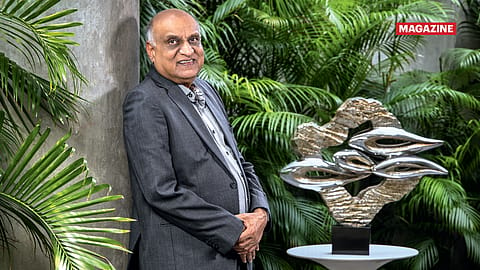
Hari Mohan Bangur: “The average Indian works hard, which is why we’re outperforming Europeans and Americans—our ‘eight-hour day’ really runs from 8 in the morning to 8 at night.” | Credits: Sanjay Rawat
This story belongs to the Fortune India Magazine september-2026-indias-top-100-billionaires issue.
Given the current geopolitical and structural cyclicals are concurrently coinciding, how do you view India’s current industrial landscape?
Industrialists need to take a view… nothing is crystal clear yet... When businessmen make decisions, it is always in a grey area, because anything that reaches me has already been filtered three or four times by senior executives who’ve worked out everything that’s logically and mathematically possible. I can’t add much value at that stage. The real judgment lies in making decisions like: should we invest in a new factory that will take three to four years to come online, when we don’t know what the state’s economy or the political situation will look like? But one must take a view. In Bihar, for example, when we set up a plant, there wasn’t a single cement unit there. It was considered the worst place to invest, but we took a view, and our factory did very well. You take a call and live with the consequences.
How do you assess risk in such a case?
My philosophy is to take a risk big enough so that, in the worst case, you’re set back by about a year, but your existence should never be in question. You might risk something like a year’s profit, or eight months’ profit, that’s the scale of risk you should take.(1)
So you take a calibrated risk?
Yes. But in general, if you take a positive view on India, the odds of being wrong are very low. India is growing, and Indian aspirations have grown manifold. People no longer just want the cheapest option; premiumisation is now the trend. It’s not about things getting cheaper; people have more money because they’ve started working harder. Just compare the lifestyle of today with that of 20 years ago. This prosperity comes from hard work. The average Indian works hard, which is why we’re outperforming Europeans and Americans — our ‘eight-hour day’ really runs from 8 in the morning to 8 at night... while in the West people debate how many hours a week they’ll work, and how many of those they can work from home. Work culture in India remains strong, and I don’t think governments elsewhere are truly rewarding hard work the way ours does.
I believe you need 10,000 hours of work before you can become an executive, a senior executive, and 20,000 hours before you become a master capable of heading a department. If you put in 4,000 hours a year it takes five years to get there, at only 2,000 hours a year, it takes 10 years. N.R. Narayana Murthy wanted people to rise faster, which is why he said if you want a lot of leisure in life, your growth will be slower. In western corporate culture, none of these conditions favour hard work, yet despite that handicap, many people from these cultures still rose to great heights because at some point work itself becomes your life, not just a means to an end. If you can’t enjoy that — if work isn’t your life — you won’t get there.
More Stories from this Issue
When you talk about enjoying work, you’ve also enjoyed that compounding of success into real wealth. But not everyone is Mr Bangur. For someone who’s just working, it’s harder to see the same payoff. In a sense….
They’re working towards someone else’s profit. Is that what you’re alluding to?
Yes
If you work purely for profit, the profit won’t come.(2) You have to work for excellence, and profit becomes a byproduct. That’s why Shree Cement has done so well. We’ve never focussed on profit itself, and we don’t even have a culture of yearly budgeting. Instead, we tell people to put in their best effort and allow them to make mistakes; efficiency naturally follows from that. We’re the most energy-efficient cement company in the world, and that’s built on a mountain of failures... In our experience, at least 80% of new initiatives fail. So, for every success, there are roughly four failures.
{{#most-powerful-women-snapshot-individual.slug}} {{/most-powerful-women-snapshot-individual.slug}} {{^most-powerful-women-snapshot-individual.slug}} {{/most-powerful-women-snapshot-individual.slug}} {{#showRanking}} {{current-rank}} {{/showRanking}} {{#photo.0.url}}
{{name}}
Our culture actively encourages failure: if your department isn’t failing at anything, it means you aren’t trying hard enough or being innovative. My philosophy is that if you place 10 bets of ₹10 each, maybe one or two will succeed, but each success can return ₹300. You don’t know upfront which ones will pay off, but out of ₹100 risked, if two bets return ₹500-600 combined, that’s a very acceptable outcome, then every company can absorb that level of failure. What’s harder to absorb is for the individual executive responsible — if he tries five things and all five fail, it becomes difficult for him to retain his sense of self-respect, even if the company survives. So, my philosophy is: every failure is mine, every success is yours.(3) He [the executive] should never feel like the failure was his department’s or his own. Ultimately, I own it. That way, it doesn’t hold him back.
Has that philosophy evolved over time? Were you less accommodating of failures early in your journey than you are today?
It’s something I learnt a long time back. And going back to what you said — that people don’t work for someone else’s profit — that’s right. The real goal is never profit itself. Our goal, for example, is: we currently consume 700 calories of energy per unit of output, down from 860 earlier; the world’s second-best benchmark is 720, so our gap is just 20 calories. How do we get that down to 680? That’s the question that keeps people engaged. They work constantly for prestige, excellence, self-achievement. Working purely for profit isn’t good enough to sustain that drive.
That’s where the whole idea of work-life balance comes in. In the Army, people are willing to lay down their lives for their country, for their work because it’s their duty is to protect the country but the love is for the motherland. The recognition — stars, stripes, and rankings, are incidental. Even in peacetime, if you perform excellently, you earn these markers of recognition, and those rankings are never handed out cheaply... That recognition is powerful enough to motivate people to risk their lives. In the same way, fairness and genuine recognition of talent drive excellence in industry. Being told you’re ‘the best coal buyer in India’ isn’t enough; being known as the best coal buyer in the world is what motivates people. That’s how you build a strong procurement culture. To this day, we have no employee stock option scheme, fixed salaries only, and yet everyone is deeply committed.
CEMENTING GAINS
Over the years, the cement industry has gone through cycles of consolidation and cyclicality. Today you’ve got structural and cyclical shifts converging, with players such as UltraTech, Ambuja, and Adani all pushing to consolidate and grab market share. What will a steady state look like for the cement industry?
Compare it with Europe, where France, Germany, Switzerland, and several other countries put together consume less cement than India does. India is equal to five countries when it comes to cement. In the North, consolidation is high but North and South don’t really compete as cement from the North will never move South and vice versa, purely because of logistics costs. For each regional market you’ll see 80-90% of capacity concentrated among four to five players. Even in Europe, if you put all those countries together, the consolidation level is lower than India’s. UltraTech and Adani today are present across four to five of these regions; others such as Madras Cement, are very strong in one or two regions. But in regions where the big players aren’t dominant, there’s still room for other players.
In the case of Shree Cement, you’ve spoken about striving for excellence and efficiency, but in some ways, it is also about protecting your competitive moat.
Cement was always treated as a pure commodity, until Mr [Narotam] Sekhsaria made it a brand when he started Ambuja Cement. He was the first to say cement isn’t a commodity, it’s a brand. He could deservedly be called the father of the modern cement industry. Today, the industry spends heavily on advertising, maybe ₹800 crore a year, and that’s made a real difference. Shree Cement’s approach has been a bit different: when you acquire capacity through consolidation, you’re not just buying tonnage, you’re buying market share along with it.
It’s especially true when the market is highly saturated.
Exactly. There’s no more pent-up demand. In most of Europe, the U.S., and Japan, too, market size stays roughly flat year after year, so building new capacity for growth doesn’t make sense, because consumption simply isn’t rising. In India, consumption is still growing at around 7% a year, so the market can absorb a large amount of new capacity — around 40 million tonne a year.
Currently, at what rate is the sector adding new capacity?
Capacity addition is happening at an even higher rate. Cement will never really be in shortage in India. So, both routes — consolidation and adding new capacity — remain viable for growth. Adding new capacity has a downside: it takes time to build, and then you need time to develop the market for it. Against that, the advantage is that a new plant is more future-proof over the long run, and it’s simply cheaper. Incrementally, building a new plant costs less than buying an existing one.(4)
And presumably your cost of production is lower too, since you’ve always invested in the newest technology.
Yes, our plants are more modern compared to many competitors who’ve grown by acquiring older plants. Their growth is faster, no doubt, but their efficiency is inherently lower and that’s not because they’re badly run, but simply because of the vintage of the assets.
So, if plant efficiency is lower and yet you are paying 40-50% acquisition premium, then market share growth comes at the cost of profitability. That’s not a highly margin-accretive way to grow.
That’s the reason why Shree Cement has the highest per-tonne profit in the industry at around ₹1,100-1,200 currently.(5) Ambuja and UltraTech have similar margins, too, but theirs come from heavy investment in branding — UltraTech alone spends roughly 60% of the industry’s total advertising spend, with the rest of the industry combined making up the other 40%. So, they benefit from their brand strength, and we benefit from our efficiency.
Have you ever been tempted to ramp up brand spend?
Building a brand takes patience. Brands aren’t built cheaply or in a year, it takes five years minimum. One needs to make that call and live with the consequences. If the brand doesn’t land, that money is essentially gone. It’s not a one-year decision, it’s a five-year one, and different companies choose differently.
Would you admit that the payoff from brand-building gives you a higher return than from efficiency gains?
Higher or lower isn’t really the point — both are valid paths. Just look at what’s happening in the industry: ACC and Ambuja were both big, established names, and Adani is now rebranding them both to ‘Adani Cement’... this rebranding exercise only started about a year ago, so it’s hard to predict the outcome. It might strengthen the brand, or it might not — every few months the size of the ‘Adani Cement’ logo on their packaging seems to change. What their long-term plan is, I don’t know, but the rebrand is clearly happening, and maybe it’ll pay off. But I’m not in a position to judge that.
Internally, has there been debate or consultation around Shree Cement’s own brand-building efforts?
Yes, that’s being done — our spend on this has increased significantly compared to the past. Years ago, we brought in Alyque Padamsee to advise us, and he created the ‘Bangur Cement’ brand — but every agency eventually argues that the old identity isn’t good enough anymore and pushes for new logos. For premium branding, we play on the idea of extra strength — your normal cement is perfectly adequate, but a higher grade of cement sells for an extra ₹50-70 a bag.
It’s a bit like, in your childhood, having a 10-band radio versus a 2-band one — you were always really only listening to one or two bands, but there was pride in owning the 10-band set. That’s what’s happening here. The cement really is very good, but whether you need cement that good is a question; your architect designs based on standard cement specs anyway, and extra strength beyond that doesn’t change much in practice. Still, that’s the direction the whole industry is moving in — better and better cement.
Does the premiumisation story work in a commodity business like cement?
Think of it as a soap — Lifebuoy versus Dove might differ five times in price, but ultimately the core product isn’t that different; each brand just targets a specific need — one for the face, one marketed as a ‘body’ product, and so on. It’s similar in cement — everyone wants better quality, and premiumisation is growing very fast across the industry. When we started, premium cement was maybe 2% of our sales; three years back, it was still low, and today premium cement makes up 25% of our sales.(6) The margins are higher, but so are the costs — whether the consumer actually gets that much extra benefit isn’t entirely clear.
What’s your overall philosophy on capacity expansion?
India’s cement demand is growing at roughly 7% a year, and our own capacity expansion has generally run at about 8%, a bit ahead of the industry average. In some years it may touch a lower, but broadly we gain a small market share every year, that’s really it. We don’t try to grow at 10-12%, well above GDP growth, because the industry growth is closely tied to GDP growth.
Cement demand used to be about 1.3 times GDP growth; but as the economy shifts increasingly from manufacturing towards services, that ratio has come down closer to 1x, because services simply don’t require the same infrastructure build-out, and the services sector itself is now growing faster.
Cement plants today run at around 70% capacity utilisation, and we’re still comfortable investing, because of the underlying 7% growth expected next year. The economics still work even at 70-75% utilisation.(7) That’s simply become the new normal capacity level for the industry, and it’s likely to stay that way. You still must plan ahead and stay a bit paranoid about capacity, because if you don’t commit to a new plant today, it’s quite likely in four years that the window has closed, and you’ve missed the opportunity entirely.
This dynamic applies across every commodity. You must plan for it. Waiting around for a genuine shortage to develop simply isn’t realistic anymore.
Follow Fortune India
NEXT STORY