India's Top 100 Billionaires 2026: Kumar Mangalam Birla, reinventing legacy
/ 7 min read
No. 9 on Fortune India's 2026 study of India's top 100 billionaires with a net worth of ₹2,14,967 crore, Birla has built on generations of legacy, strengthening established businesses, while creating new engines of growth and wealth.
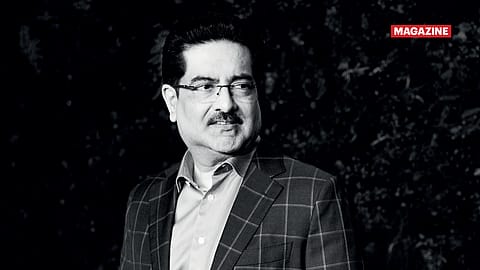
Kumar Mangalam Birla, chairman, Aditya Birla Group. | Credits: Getty Images
This story belongs to the Fortune India Magazine september-2026-indias-top-100-billionaires issue.
GETTING TO KNOW a father through his son’s eyes can sometimes offer revealing insights. For Aryaman Vikram Birla, the defining quality of his father, Aditya Birla Group chairman Kumar Mangalam Birla, is not merely his willingness to take big bets. It is the composure with which he takes them.
“He has been resilient and unflappable, through circumstances good or bad,” says Aryaman, describing a leader who has spent three decades navigating commodity cycles, acquisitions, and economic downturns, while transforming a largely industrial group into a diversified, consumer-focussed global conglomerate.
“My father, for the last 30 years, built companies that have global scale. That sort of sets the vision and ambition for us as the next generation,” says Aryaman.
Birla took over as chairman at 28 in 1995, following the unexpected death of his father, Aditya Vikram Birla. He not only preserved the businesses built by previous generations, but expanded them, made them more competitive, and created new engines of wealth as the economy grew.
The scale of that transformation is striking. The group, which had around 40 manufacturing units in 1995, now has more than 600. Its footprint has expanded from India and Southeast Asia to 41 countries across six continents. Cement capacity has increased 20-fold and metals capacity 15-fold.
The financial transformation is equally significant. The group’s revenues increased from $2 billion to $72 billion. Market cap scaled to $120 billion. From almost nil, consumer businesses now account for 21% of the group’s revenues, with over 30 flagship brands reaching about 250 million people.
Wealth-creation strategy
Yet the numbers tell only a part of the story. Behind them lies a clear wealth-creation strategy: using the scale and cash flows of established businesses to fund expansion while building new businesses that can themselves become large and valuable platforms. Birla has been ranked ninth with a net worth of ₹2,14,967 crore ($22.58 billion) in 2026, against ₹2,09,166 crore ($24.39 billion) in 2025, according to Fortune India’s study of India’s Top 100 Billionaires.
More Stories from this Issue
According to Kumar Birla, the past decade has been transformational for the group. “[It’s] a journey that has closely mirrored India’s own economic boom. We have grown with India, invested alongside its ambitions, and drawn enormous strength from the opportunities our economy continues to create,” he said at an event recently.
That approach has meant simultaneously strengthening the businesses Birla inherited, and creating new engines of growth. The next phase, therefore, is not simply about adding businesses. It is about investing on two fronts — making traditional businesses bigger and globally competitive, while creating new consumer- and technology-led growth engines.
So, while UltraTech and Hindalco are entering another investment cycle, Birla Opus, Indriya, and Birla Pivot are being scaled. The group also faces the difficult task of turning around Vodafone Idea. The approach is characteristic of Kumar Birla: strengthen what works while placing researched bets on what could become the next engine of growth.
The established businesses remain central to the wealth-creation equation. UltraTech Cement is a testament to Birla’s strategy. As domestic demand expanded, the company’s cement capacity crossed 200 million tonnes per annum (MTPA) in April. It currently stands at 205.5 MTPA, compared with 133 MTPA three years ago. The company is targeting more than 240 MTPA by March 2028, anticipating a construction-led demand surge.
{{#most-powerful-women-snapshot-individual.slug}} {{/most-powerful-women-snapshot-individual.slug}} {{^most-powerful-women-snapshot-individual.slug}} {{/most-powerful-women-snapshot-individual.slug}} {{#showRanking}} {{current-rank}} {{/showRanking}} {{#photo.0.url}}
{{name}}
The significance goes beyond capacity. Scale creates operating leverage, strengthens market position, and gives the group a larger platform to capture the broader construction opportunity. Competition has intensified in cement, particularly after the Adani Group’s acquisition of ACC and Ambuja.
Investment key to growth
Birla, however, has continued to invest. UltraTech reported a consolidated profit of ₹8,188 crore in FY26, an all-time high, and up 36% year-on-year. Consolidated net sales rose 17% to ₹88,512 crore, driven by volume growth and cost discipline. The company is also moving into adjacent building materials, with a planned investment of ₹1,800 crore in wires and cables, and the acquisition of Rajasthan-based manufacturer of white-cement-based wall putty and surface finishing products Wonder WallCare.
Hindalco follows a similar strategy. The firm is investing $10 billion to expand its businesses in India and North America through its subsidiary Novelis. It reported consolidated revenues of ₹2.75 lakh crore in FY26, up 15% YoY, and Ebitda of ₹38,097 crore, up 7.3% compared with ₹35,496 crore in the previous fiscal, while outlining a multi-billion-dollar investment programme across aluminium and copper. The objective is not merely to add capacity but strengthen the group’s position across the metals value chain, including recycling and downstream products.
The same strategy extends to chemicals. Aditya Birla Chemicals’ acquisition of Cargill’s specialty chemicals facility in Georgia adds to the group’s global chemicals platform. In cellulosic fibres, Grasim is preparing 110,000 tonnes per annum of Lyocell capacity at Harihar in Karnataka, with the first 55,000-tonne phase planned for mid-2027.
Financial services has become another important part of the portfolio. Aditya Birla Capital’s combined lending portfolio crossed ₹2 lakh crore by the end of FY26, while the merger of Aditya Birla Finance into the listed financial-services platform helped simplify its corporate structure.
Grasim, meanwhile, reported its highest-ever FY26 revenue of ₹1.75 lakh crore and Ebitda of ₹25,872 crore. The annual profit for the year increased 33% to ₹10,300 crore, from ₹7,756 crore in FY25.
These established businesses remain central to the wealth-creation equation because they provide scale, cash generation, and organisational capabilities to finance the next wave of expansion. They are not simply the legacy of the past; they are the financial foundation for the future.
But Birla’s strategy is not just about deploying capital. It is also about building an organisation capable of handling that scale. For Aryaman, the organisational architecture supporting this growth is one of his father’s biggest lessons.
“Another learning is that you have to have good people around you, who are very intelligent, honest, and willing to take consequential decisions. You have to trust good professionals to take decisions of consequence,” he says.
“I think he (Kumar Birla) did that very early in his career. He realised that to be able to grow well and grow fast, you have to have really good professionals,” Aryaman adds.
That professionalisation has allowed Birla to pursue scale without attempting to personally manage every business. Capital can move across the portfolio while decision-making remains distributed among professional teams.
That combination of professional management and calculated risk-taking has allowed Birla to move into businesses far removed from the group’s traditional industrial base. The group is no longer relying only on scaling legacy businesses. It is also actively creating new ones. Birla’s approach is clear: take bold bets, but only after thorough diligence. “I haven’t seen him rush into taking any decision,” says Aryaman. “Yet, he doesn’t shy away from taking big decisions.”
“I have never seen him dictated by anyone’s timelines [either]. He does a lot of diligence, makes sure that we are robust in our preparation, and then trusts that preparation and believes in the conviction,” he adds.
Paints is the most ambitious example. Birla Opus was conceived as a scale play in a market dominated by established players. Under Grasim, it has commissioned five greenfield plants since the first plant at Panipat in Haryana in February 2024. Total installed capacity has now reached 1,332 MTPA, and the company has become the No. 3 player by market share in the organised decorative paints segment. By the end of FY26, its distribution network had crossed 50,000 dealers across more than 11,500 towns, supported by about 4.5 lakh active contractors and painters.
The bet works because Birla is leveraging existing group capabilities in a new consumer category. “The knowledge of construction, distribution, procurement, and dealers built over decades is being transferred into a new category. The wealth-creation opportunity lies in turning those capabilities into a new large-scale consumer franchise,” says Sunil Chandiramani, CEO, Nyka Advisory Services.
Birla Pivot applies the same logic digitally. The B2B e-commerce platform uses the group’s knowledge of construction materials to build a technology-led procurement marketplace. It crossed ₹1,000 crore in revenues in its first year and aims to reach about $1 billion through expansion across categories, customer acquisition, credit, and logistics.
Jewellery business Indriya, launched in July 2024, has crossed 85 stores and is moving towards its 100-store target. The ambition is to build a scaled branded jewellery platform rather than a niche luxury business.
Fashion, hospitality, real estate, and new-age ventures add further layers. Birla Estates has crossed ₹80,000 crore in gross development value and ₹8,000 crore in sales bookings. Aditya Birla New Age Hospitality has expanded to nine brands across 12 locations in three cities. Aditya Birla Ventures has invested in businesses such as Stable Money, FinBox, and First Club.
But the willingness to take big bets inevitably brings its own set of challenges. Birla’s daughter Ananya recently told Fortune India that her parents taught her not to take success or failure too seriously. The principle captures the broader Birla approach: build patiently, accept setbacks, and keep moving. The mindset is particularly relevant as the group attempts to build several new businesses simultaneously, knowing that not every bet will deliver at the same pace.
The same willingness to reshape businesses is visible in fashion and lifestyle. Birla executed the demerger of the business into Aditya Birla Fashion and Retail (ABFRL) and Aditya Birla Lifestyle Brands (ABLBL), giving the two businesses greater focus. ABFRL ended FY26 with 1,273 stores across 7.9 million sq. ft. It reported revenues of ₹8,177 crore and a loss of ₹830 crore. ABLBL, which houses brands including Louis Philippe, Van Heusen, Allen Solly, Peter England, Reebok and American Eagle, had 3,348 stores across nearly 4.9 million sq. ft. It reported FY26 revenues of ₹8,396 crore and profits of ₹171 crore.
Challenges are not new to Birla. Yet, Vodafone Idea remains the most difficult task. Around the launch of Reliance Jio, Birla spearheaded the merger of Vodafone and Idea in 2017. While the merger itself was completed, the combined company struggled to defend its market share as the industry rapidly moved from 3G to 4G and then 5G. Government payments also became a major constraint. Vodafone Idea carries a total balance-sheet debt of ₹1.96 lakh crore, driven heavily by historical spectrum and statutory AGR liabilities. The government converted past interest dues into equity, taking a substantial stake of around 49% to preserve the three-player market structure. It subsequently reassessed and reduced AGR liabilities by around 27% to ₹64,046 crore, with the majority of repayment postponed to the 2036-2041 period.
At the extraordinary general meeting in June, Birla told shareholders that the company had emerged from one of the toughest phases in its history and was now focussed on execution. “I think we have good times ahead… there will continue to be a few challenges but I still believe that we are at a point of inflexion,” he said. For someone who has spent much of his career developing formulas for taming the troubles, the future indeed looks brighter.
Follow Fortune India
Sign in to read full story
To access our exclusive magazine content, sign in to your Fortune India account.
Sign In NowNEXT STORY