It’s business over disputes at Tata Group
/ 8 min read
Directors sidestep sensitive issues at Tata Sons’ recent board meeting, focus on growth, strategy and future opportunities instead.
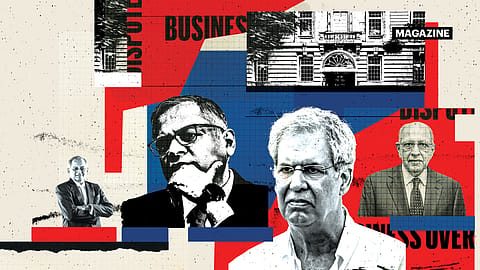
(From left) Venu Srinivasan, N. Chandrasekaran, Noel Tata and Vijay Singh. | Credits: Anirban Ghosh
This story belongs to the Fortune India Magazine june-2026-indias-most-valuable-celebrities issue.
ON A FRIDAY AFTERNOON, four days before the extraordinary board meeting of Tata Sons on May 26, Noel Tata walked into Bombay House for an unusual conversation that could redefine the narrative around the leadership clash in the Tata Group. He took the elevator to the fourth floor and went to the corner office of Tata Sons chairman N. Chandrasekaran — the holding company of around 100 Tata Group firms.
Noel Tata’s discussion with Chandrasekaran was anchored around two critical issues — the performance of Tata Sons’ unlisted subsidiaries, and the possibility of getting permission for deregistering Tata Sons from the Reserve Bank of India’s upper-layer NBFC framework to retain its private status, says sources in the know. Instead of allowing the recurring dissent to dominate the discourse in the group, the meeting signalled the beginning of a shift towards “business first”.
The two critical concerns of Noel Tata were deeply linked. The group’s new businesses — Air India, Tata Digital, Tata Electronics, Tejas Networks, and Agratas Energy Storage Solutions — were consuming enormous amounts of capital. Noel Tata’s concern was that continued borrowing to fund these businesses could once again push Tata Sons into the upper-layer NBFC category, despite the company repaying nearly ₹20,000 crore of debt in 2024 to exit the list.
These concerns became intertwined with another sensitive issue — the extension of Chandrasekaran’s tenure as chairman until 2032. At the Tata Sons board meeting in February, Noel Tata had opposed the move, while directors, including Venu Srinivasan, Harish Manwani, Anita M. George and group CFO Saurabh Agrawal, backed Chandrasekaran’s third extension till 2032, five years beyond his retirement age of 65. Their view was that the group’s new businesses required time, patience, and stability to turn around.
When Noel Tata sat down with Chandrasekaran, public debate around a possible listing of Tata Sons was also gathering momentum. Investors worried that governance tensions could escalate into another prolonged conflict similar to the fallout after the ouster of Cyrus Mistry. But this time, Noel Tata adopted a more conciliatory tone.
Chandrasekaran used the meeting to outline what he intended to present before the board on May 26 and again on June 12. The focus was clear — give directors a detailed picture of the operational and financial realities of Tata Sons’ step-down subsidiaries. The meeting lasted an hour, but marked an important shift. Noel Tata appeared keen to move the conversation away from “dissent everywhere” towards profitability and long-term strategy.
Lending an ear
More Stories from this Issue
Inside the Tata Sons boardroom on May 26, beneath the marble bust of Jamsetji Tata, directors gathered shortly after 10 am along with CEOs of several new businesses. Chandrasekaran’s objective was straightforward — every director, including Noel Tata, should leave the meeting with complete clarity about the future of the group’s emerging ventures.
Following an initial briefing, Chandrasekaran invited the CEOs one after another to make detailed presentations. Air India CEO Campbell Wilson, Tata Electronics CEO and MD Randhir Thakur, and Tata Digital CEO and MD Sajith Sivanandan outlined their growth plans, capital expenditure requirements and funding needs, including loss coverage.
“The board meeting was calm, more focussed on business losses and turnaround plans,” says an insider.
Noel Tata, however, remained deeply inquisitive throughout the discussions. “His focus was on the financial burden. It is clear he wants every business to turn self-sustainable at the earliest with enough cash flow to reinvest for expansion,” the insider adds.
{{#most-powerful-women-snapshot-individual.slug}} {{/most-powerful-women-snapshot-individual.slug}} {{^most-powerful-women-snapshot-individual.slug}} {{/most-powerful-women-snapshot-individual.slug}} {{#showRanking}} {{current-rank}} {{/showRanking}} {{#photo.0.url}}
{{name}}
Chandrasekaran chose to frame the discussion around a broader transformation underway across industries. He spoke about the impact of AI, cloud technologies and changing industrial structures, and how the Tata Group needed to position itself for emerging opportunities, according to sources.
The May 26 meeting took place against the backdrop of growing debate over the future structure of Tata Sons. At the February board meeting, Noel Tata had warned that continued losses and rising borrowings could eventually force Tata Sons into a mandatory listing under RBI rules applicable to upper-layer NBFCs.
“The board has not taken any decision on allocating funds,” says a source. The immediate funding requirements of Air India and other ventures are expected to be discussed further at the June 12 board meeting.
“The May 26 presentations have provided greater clarity on the funding requirements of Tata Sons’ step-down subsidiaries. Board members also received better visibility into business performance,” adds another source. According to him, such reviews could become regular exercises now.
Importantly, the board deliberately avoided placing sensitive issues such as the listing of Tata Sons and Chandrasekaran’s tenure extension on the formal agenda. Instead, directors focussed almost entirely on business performance, strategy, and future opportunities.
The listing conundrum
With Tata Sons preparing for its June 12 board meeting, the conglomerate finds itself at a defining strategic moment. What should ideally be a discussion on capital allocation, execution priorities and future growth risks are being overshadowed by a complicated triangle of issues — retaining Tata Sons’ private status, Chandrasekaran’s possible third term, and the long-pending exit aspirations of the Shapoorji Pallonji Group, which holds an 18.37% stake in Tata Sons. The two previous meetings set the tone for the third.
The danger is that these issues are increasingly becoming entangled with business performance, pushing critical operational priorities into the background.
The broader strategic reality is more straightforward. Tata Sons may remain unlisted, but several subsidiaries will eventually need to tap the public market for capital. Chandrasekaran’s continuity is seen by many within the group as essential until the newer businesses stabilise and legacy companies adapt to technological disruption. Equally important is leadership grooming, succession planning, and bringing greater professional diversity into discussions at both Tata Sons and Tata Trusts.
The June 12 meeting is, therefore, expected to focus on far more than governance questions. It will likely examine execution across aviation, semiconductors, batteries, electric vehicles, renewable energy, retail, quick commerce and manufacturing transformation.
Meanwhile, the debate around Tata Sons’ listing continues to attract sharply differing views, even as Noel Tata is reportedly said to have written to the RBI opposing any such move, arguing that it could alter the long-term character of the group’s holding company and disrupt the philanthropic objectives of the Trusts.
“The listing of Tata Sons would be beneficial for stock market investors,” says Deven Choksey, MD, DRChoksey FinServ. “At present, Tata Sons is funding loss-making businesses using capital resources generated by listed group companies. A listing would bring greater transparency and accountability to capital allocation decisions, while helping protect the interests of shareholders across Tata Group companies.”
The counter-view is equally strong. For Tata Trusts, retaining private status is central to preserving long-term strategic control and ensuring uninterrupted dividend flows for philanthropic activities. A listed Tata Sons would inevitably face greater shareholder scrutiny, market pressures and regulatory oversight that could dilute the trusts’ influence over group companies.
Historically, the Tata structure has allowed the group to take long-term decisions without short-term market pressure. The acquisition of Air India, financial support for Tata Motors’ passenger vehicle turnaround and EV transition, and the decision to settle the dispute with Japan’s NTT Docomo over its exit were all possible in the past because Tata Sons remained insulated from quarterly market compulsions.
But the debate has now evolved beyond markets, into a serious regulatory issue.
Says Sonam Chandwani, managing partner at KS Legal & Associates, “Under the RBI’s scale-based regulation framework, upper-layer NBFCs are expected to comply with mandatory listing norms within a specified period. However, Tata Sons occupies a unique position because it functions as the principal holding company of the Tata Group and is substantially controlled through charitable trusts.”
“A forced listing may satisfy transparency and governance objectives, but it could also change the existing control and decision-making structure within the group,” she adds.
The likely outcome may, therefore, be a middle path involving restructuring, reclassification or reduction of NBFC exposure rather than a direct IPO. Noel Tata has already initiated consultations with legal experts to explore options for avoiding a mandatory listing.
At the same time, the continuation of Chandrasekaran as chairman is increasingly tied to the need for stability during one of the most complex transition phases in the group’s history. Tata Sons is simultaneously integrating Air India, investing aggressively in semiconductors and electronics, scaling digital commerce, strengthening EV and renewable businesses, and navigating technological disruption across core sectors. More importantly, the largest dividend payer in the group, TCS, is reinventing itself to become the world’s largest AI-led technology services firm and Chandrasekaran has a bigger role as its former CEO.
Tata Sons’ unlisted ventures together posted net losses of more than ₹10,900 crore in FY25, sharply higher than ₹1,557 crore in FY20. Estimates suggest combined losses may have risen to ₹29,000 crore in FY26, largely because of Air India and Tata Digital, which include businesses such as the super app Tata Neu and BigBasket.
Air India remains the group’s biggest challenge, with estimated losses of nearly ₹27,000 crore in FY26. The airline is pursuing a massive $70-billion fleet expansion involving 570 Airbus and Boeing aircraft as it attempts to build a global aviation network.
Tata Electronics, however, is expected to emerge as one of the strongest long-term bets. The company is building semiconductor and packaging facilities in Gujarat and Assam with investments of around $15 billion and partnerships with PSMC of Taiwan and Intel. Other businesses, including Tejas Networks and battery venture Agratas, are also expected to come under review at the June 12 meeting.
Tension at the Trusts
The governance tensions escalated in Tata Trusts — which holds 66% stake in Tata Sons — on May 15 when Maharashtra’s Charity Commissioner blocked a scheduled board meeting of Tata Trusts. The development brought internal disagreements into a formal regulatory arena, since Tata Trusts vice chairman Venu Srinivasan was one of the petitioners.
Srinivasan and another petitioner argued that the Sir Ratan Tata Trust may be in violation of Section 30A(2) of the Maharashtra Public Trusts Act, which limits the number of perpetual trustees to 25% unless explicitly permitted in the trust deed. The trust currently has six trustees. Noel Tata, Jimmy Tata and Jehangir H.C. Jehangir are understood to be perpetual trustees, while Srinivasan, Vijay Singh and Darius Khambata serve fixed terms.
The May 16 meeting was expected to discuss several sensitive matters, including Tata Sons’ listing, Chandrasekaran’s continuation and Srinivasan’s extension on the Tata Sons board after crossing the age threshold. In another twist, Srinivasan and Vijay Singh were voted out of the Tata Education and Development Trust after trustee Mehli Mistry opposed their reappointment. Noel Tata also voted against extending their tenure.
Earlier, Srinivasan, Vijay Singh and Noel Tata had opposed Mehli Mistry’s reappointment to the boards of Sir Dorabji Tata Trust and Sir Ratan Tata Trust. Another trustee, Pramit Jhaveri (former Citibank India CEO), had decided not to seek reappointment on the board of the Sir Dorabji Tata Trust following disagreements with Noel Tata.
The larger concern is that leadership disputes and listing-related tensions are increasingly feeding into one another and creating uncertainty around critical businesses undergoing transformation.
Business first
The Tata Group is currently undertaking one of the most ambitious investment cycles in its history. Billions are being deployed across aviation, semiconductors, electric mobility, batteries, digital infrastructure, consumer brands, and manufacturing ecosystems aligned with India’s industrial ambitions. These businesses require execution discipline far more than prolonged boardroom manoeuvring.
At Air India, the turnaround remains a long-pending dream, though the group has completed merging all aviation businesses under one entity. Fleet modernisation, business integration, service transformation and profitability restoration require sustained attention. Tata Consumer Products needs faster scale expansion, wider distribution and margin improvement to become a truly global-scale consumer company.
Tata Motors has built strong momentum in passenger vehicles and electric vehicles (EVs), but sustaining leadership against rising competition will require constant investment and technological upgrades. Though the group has merged all its financial services businesses under Tata Capital, the opportunities are abundant outside, and many of them are yet unexplored. Meanwhile, Tata Digital and the group’s broader e-commerce ecosystem are still searching for a sustainable profitability model. Several digital bets remain works in progress and require sharper strategic discipline.
This is why the June 12 board meeting matters beyond personalities or internal alignments.
The Tata Group’s immediate challenge is no longer simply governance management. It is the far larger task of ensuring that business execution, capital allocation, and technological transformation do not get overshadowed by dissent at the top.
Follow Fortune India
Sign in to read full story
To access our exclusive magazine content, sign in to your Fortune India account.
Sign In NowNEXT STORY