MNC 500: How the sum of multiples is propelling the BBK group’s India story
/ 5 min read
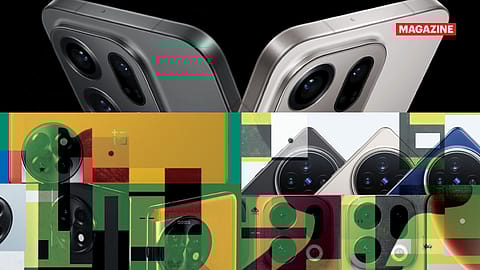
BBK Electronics is ranked 6th on the Fortune India MNC 500 list | Credits: Anirban Ghosh
MNC 500: How the sum of multiples is propelling the BBK group’s India story
The BBK Electronics group, a major player in India's smartphone market, employs a house of brands strategy, offering diverse brands like vivo, OPPO, realme, and OnePlus. This approach allows them to cater to various consumer needs and price points, maintaining a strong market presence. Their success is attributed to quick adaptation to technological shifts and strategic brand positioning.
This summary is AI-generated, and Fortune India is not responsible for its content or any associated copyright issues.
A house of brands strategy gives this otherwise elusive BBK Electronics group—ranked 6th on the list—an edge in India’s highly competitive smartphone market.
BBK Electronics is ranked 6th on the Fortune India MNC 500 list | Credits: Anirban Ghosh
This story belongs to the Fortune India Magazine february-2026-mnc-500-indias-largest-multinationals issue.
TEENAGERS ARJUN BANNERJEE and his younger sister Aditi (both names changed) are as different as chalk and cheese. With differing tastes and needs, their choices of smartphones also vary distinctly. Arjun, a first-year student of hotel management in Bhubaneswar, says his two-year-old OnePlus 11R 5G helps him stay connected with family and friends in Kolkata, shoots decent photos, and is unobtrusive enough to carry while interning at five-star properties. Aditi, a high-school student and gamer who consumes a lot of content on her phone, is a fan of the bright screen, superior performance, and long battery life of her iQOO Z9s Pro 5G. Both agree that their dream phone is the vivo X200 Pro, which their cousin Subhas (name changed), an IT professional and travel junkie, uses. Ask them if the siblings would like to swap phones, and pat comes their reply: “No chance!”
What the bickering siblings don’t realise is that all the brands in their realm are connected to the same group. And it’s no ordinary group. Not only is market leader vivo (in terms of market share in India) a part of the stable, but the entity has had a combined market share of more than 40% over the past five years, according to data from Counterpoint Research, and has products across price points. Industry watchers say the entity is the China-based BBK Electronics, and besides vivo (and its sub-brand iQOO), the other brands include OPPO, realme, and OnePlus.
So what is the group’s strategy and why has it been so successful in India?
According to Ambi Parameswaran, veteran brand strategist and founder of brand advisory Brand-Building.com, the group is following the house of brands strategy — offering multiple brands under the same roof, with only the back end (manufacturing, technology and supply chain) being common.
“It’s good to have a multi-brand strategy... they have the size and the scale, and they can compete. Because, once you have achieved a particular scale, your economies of scale kick in,” says Parameswaran.
Agrees Tarun Pathak, research director at Counterpoint Research. “When you have scale, you can have very strong bargaining power in terms of the supply chain… someone who is sourcing 10 million units [vis-à-vis] someone who is sourcing 120 million.”
Harish Bijoor, brand expert and founder of boutique consulting firm Harish Bijoor Consults Inc., calls it the Chinese model of competition. “Typically, at the top end, one big company competes against another big company,” he says, adding that the second level of competition is when a company’s individual brands compete with other outside brands. “That is the standard model of competition.” According to the Chinese model, he says, “products compete with products, models compete with models, and prices compete with prices. It means companies don’t compete against one another, but [the competition is] between individual models sold.” When you adopt such a model, Bijoor explains, the customer is common, and what he/she is looking for is a different set of offerings.
More Stories from this Issue
Besides the wide portfolio, what has also contributed to the group’s success is the fact that when India moved from 3G to 4G, these brands were very quick to pivot, offering a range of products at different price points. “They could tweak it as per consumers’ demands, because they understand that consumer cohort really well. And then they pivoted towards a different price tier with OnePlus, which they successfully positioned as a premium smartphone brand,” says Pathak, adding, the grouping has kept its leadership position, decision-making, the go-to-market strategy, and even the manufacturing, procurement, components and supply chain intact even after all these years.
Plus, because of the house of brands strategy, the entity has been able to make a mark at various price points, as it comes without the “brand baggage” says Ashita Aggarwal, professor of marketing at SP Jain Institute of Management and Research. “Organisations follow a house of brands strategy when they want to have a more diversified portfolio. [While it is] expensive because you are not leveraging on the established brand, it gives you the flexibility to work beyond the boundaries of your sibling or parent brand.”
Parameswaran says another advantage of having multiple brands is that it allows firms to do exclusive deals with multiple partners.
While the house of brands strategy is pretty common in fields such as FMCG, such a model in the smartphone space is usually restricted to the developing markets since they are price-sensitive, say experts. “[The house of brands strategy is] largely limited to Asia and South Asia… in western countries and Europe, the people are very comfortable with a trusted set of brands (read Apple and Samsung),” says Pathak.
{{#most-powerful-women-snapshot-individual.slug}} {{/most-powerful-women-snapshot-individual.slug}} {{^most-powerful-women-snapshot-individual.slug}} {{/most-powerful-women-snapshot-individual.slug}} {{#showRanking}} {{current-rank}} {{/showRanking}} {{#photo.0.url}}
{{name}}
Aggarwal points out that in the West, companies grow in depth, so they offer products and services within a sector, keeping the boundary condition in mind. The entrepreneurial culture, more prevalent in the East, “is one of the reasons… you will find more such examples coming in”.
But with so many products in similar price segments, wouldn’t that lead to cannibalisation? “Cannibalisation and overlap happen everywhere… even if you are a distinct brand,” says Pathak.
Bijoor goes a step further. Highlighting that China is the capital of mass customisation, he says cannibalisation is actually healthy. “The belief of this system is that only the best shall survive, and the best in terms of price, product promotion and where it’s being sold, and to that extent, what really happens is that competitiveness increases. It becomes sharper.”
The Indian smartphone market has remained flat for the past few years at 152-154 million, says Pathak, adding, the pressure is on brands to differentiate since even hardware enhancements seem to have reached a plateau. There might be some consolidation, in the sense that “now it’s difficult for one smaller brand to scale up, so eventually it will become a zero-sum game, where the loss of one brand is the gain of others”. He adds that the future looks like a game of sub-brands. While Aggarwal feels that consolidation may happen in the bottom part of the segment, Bijoor believes, “there will be a top player who will have a 35% market share, there’ll be a 33% player, and then there will be players with 6%, 5%, 2%, 1% share.”
Even as Arjun and Aditi keep bickering over whose phone is better, these brands are like “little drops of water making that big ocean,” as Bijoor puts it. And therein lies the BBK group’s strength.
Follow Fortune India
NEXT STORY