MNC 500: Mercedes-Benz and the art of rewriting luxury
/ 7 min read
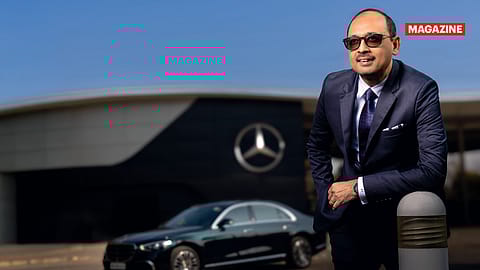
Santosh Iyer, MD & CEO, Mercedes-Benz India | Credits: Narendra Bisht
MNC 500: Mercedes-Benz and the art of rewriting luxury
Mercedes-Benz India, under CEO Santosh Iyer, is redefining luxury by focusing on high-end models rather than volume sales. Despite a 3% decline in 2025, the company remains India's top luxury car brand, prioritizing core luxury segments over entry-level models. This strategy enhances brand exclusivity and profitability, ensuring long-term success in a competitive market.
This summary is AI-generated, and Fortune India is not responsible for its content or any associated copyright issues.
Mercedes-Benz, ranked 27, is busy redrawing the rules of luxury in India’s constantly evolving market by focussing on premiumisation and steering clear of the numbers-chasing game.
Santosh Iyer, MD & CEO, Mercedes-Benz India | Credits: Narendra Bisht
This story belongs to the Fortune India Magazine february-2026-mnc-500-indias-largest-multinationals issue.
IN A NUMBERS-OBSESSED world, Santosh Iyer, the MD and CEO of Mercedes-Benz India, doesn’t believe in selling a lot of cars. And certainly not at any cost. In fact, Iyer draws his wisdom from another industry that famously turns billionaires into millionaires, or even worse, bankrupt. “You had two big airline brands in India. One acquired company, A, and the other acquired company, B, for leadership. They both don’t exist today,” he tells Fortune India. Iyer’s veiled reference is to Jet Airways and Kingfisher Airlines, which acquired Sahara and Air Deccan, respectively, and have since folded. “No doubt, growth is important, and volumes are important, but not at any cost,” he clarifies.
The Indian subsidiary of the German automaker had a decent run in 2025. It retained the No. 1 position in India’s luxury vehicles market, selling a little over 19,000 vehicles. Rival BMW sold nearly 18,000 cars; the first time the automaker has closed the gap with Mercedes at this scale in nearly a decade. Audi sold a paltry 4,510 units in 2025.
Iyer is unfazed, despite the strong show by BMW, whose annual growth was more than 10% compared to his company’s 3% decline. He, instead, wants to focus entirely on its core segment of buyers and products. That means products priced above ₹60 lakh, including the likes of the C-Class, E-Class, S-Class, and their SUV versions, among others. The E-Class is Mercedes-Benz’s largest-selling vehicle and has been for many years. Much of Mercedes-Benz’s success in India hinges on three factors. First, there is strategic patience, which includes waiting out and continuing to invest, while many other automakers around them shut down. Among others, Ford and General Motors, which arrived on Indian shores around the time Mercedes did, have shut down.
“In the luxury market, the entry segment is close to 30%,” Iyer explains. “At the centre, it would be around 50%, and the top end is about 18-20%.” In contrast, for Mercedes, 25% of sales come from the top end, while the core luxury segment forms a little more than 60%. “At the entry level, our mix is about 13%,” he adds. This is also why the company isn’t wholeheartedly trying to redraw its entry-level game.
“It’s a trade-off,” says Harshvardhan Sharma, group head, automotive tech & innovation group at Nomura. “Focussing on core and top-end luxury improves margins, brand exclusivity, and dealer economics.” That said, entry models play a critical role as brand feeders, he adds. “Any leader might want to retain a well-differentiated entry presence while laddering customers into higher segments over time.”
Currently pegged at $1.5 billion, India’s luxury car market is expected to grow to $1.92 billion by 2031, notes market research firm Mordor Intelligence. Rising household wealth is a key factor driving demand for luxury goods. As of 2025, India had nearly 870,000 millionaire (net worth around ₹8.7 crore) households — almost double that of 2021.
“What we have seen in the last six months is an intensive price competition in the entry segment,” Iyer says. “We would rather not participate because there are two ways to do so: either sell cheaper cars or do significant discounts on your core and entry cars, which will take away the residual value and the customer experience.” Critically, the past few years have seen Mercedes invest considerable effort to ensure its vehicles retain residual value and remain attractive in the second-hand market. Higher new-car prices have a consequential impact on the residual value of older cars.
More Stories from this Issue
A 33-year-long journey to the top
For more than three decades, Mercedes was busy redrawing the rules of luxury car ownership in India. The Stuttgart-headquartered automaker came to India in 1994 by importing the legendary W124 through a partnership with the Tata group and retailing it for around ₹20 lakh.
By 2009, it set up a plant in Maharashtra’s Chakan to manufacture more than 20,000 vehicles. But the early 2010s saw Mercedes go through its worst phase as it slipped behind BMW and Audi in India’s luxury vehicles segment. Globally, too, it was lagging. Coincidentally, the launch of the A-Class, an entry-level car, played a key role in the company’s India turnaround a few years later.
In 2022, Iyer came in as the first Indian CEO and the youngest after the company began domestic operations. Reiterating the point of value over volume, Iyer says, “This is not the first time we’ve seen these pressures. I was part of this company in 2012-13. I think we need to focus on ensuring the customer sees the right products. Last year was our best year in terms of revenue. We were in the Top 5 markets for Maybach globally.”
Vinay Piparsania, founder and principal of MillenStrat Advisory & Research, takes note of this deliberate shift from volume-led growth to value-led growth in India. “The company has consciously stepped back from aggressively chasing entry-level luxury because that segment has increasingly become discount-driven, margin-dilutive, and risks brand-building boundaries. Instead, Mercedes is reinforcing its core positioning around aspiration, craftsmanship, and exclusivity by focussing on top-end luxury, AMG models, and premium EVs (electric vehicles),” Piparsania, a former executive director at Ford India, says.
{{#most-powerful-women-snapshot-individual.slug}} {{/most-powerful-women-snapshot-individual.slug}} {{^most-powerful-women-snapshot-individual.slug}} {{/most-powerful-women-snapshot-individual.slug}} {{#showRanking}} {{current-rank}} {{/showRanking}} {{#photo.0.url}}
{{name}}
This has also meant that in half a decade, the average price of a Mercedes car has crossed ₹1 crore; it was ₹57 lakh in 2020 and ₹89 lakh in 2024. The company’s current portfolio includes sedans across the C, E, and S-Class, while its SUV range spans the entry-level GLA to the GLS. There are the Maybachs, Cabriolets, and Coupes, too. In January, the carmaker launched the celebration edition of the Maybach GLS priced at ₹4.10 crore. It also annually sells about 1,000 EVs, which sit at the top of the luxury market, priced at an average of ₹1.5 crore.
Getting it right
Much of Mercedes-Benz’s success in India hinges on three factors. First, there is strategic patience, which includes waiting out and continuing to invest, while many other automakers around them shut down. Among others, Ford and General Motors, which arrived on Indian shores around the time Mercedes did, have shut down.
But more important is its innovative sales strategy for financial services and a direct-to-consumer (D2C) model. In October 2021, amid the Covid-19 pandemic, Mercedes introduced the D2C sales channel, thus eliminating dealer discounts of the traditional dealership route. “This was a major change, and there was no playbook. But the results on the balance sheet side are positive,” Iyer says. What’s more impressive is that the company’s dealer balance sheet has also turned positive. “They were never as profitable as such. And only if they are profitable can they take care of customers. Otherwise, the business model is you sell more cars with no margin, and then you make money out of service,” he explains.
Then comes the growing role of the financial services arm. Mercedes-Benz India’s non-banking financial services business now accounts for nearly half of its sales. The financial services arm, which offers an array of curated products under the Star Agility financing programme, today has a portfolio of more than ₹15,000 crore. The scheme allows customers to pay an upfront deposit followed by EMIs. At the end of the contract period, the customer can choose to buy the vehicle at the residual value or return it.
“In luxury markets, customers increasingly buy on monthly outflow and ownership experience, not only on sticker price,” says Sharma of Nomura. “Strong residual values lower lease and finance costs, protect brand equity, and reinforce confidence in the product. A strong captive finance arm enables control on the full ownership lifecycle, new car sales, renewals, upgrades, and certified use, making it a major competitive lever rather than just a support function.”
This has kept the value of a Mercedes strong in the country’s used-car market. Today, even as a new Mercedes-Benz GLC costs ₹91 lakh, a 2020 model hasn’t seen a significant drop in the second-hand market. Similarly, the price of a 2021 Mercedes-Benz E-Class still commands around ₹50 lakh in the second-hand market, even though in 2021, the E-Class retailed between ₹57 lakh and ₹75 lakh (top-of-the-line AMG variant).
“Today, my bigger challenge is to buy back a Mercedes-Benz because I don’t have enough used cars,” Iyer says. That means, even now, by not chasing volumes, especially in the entry-level segment, Mercedes might lose the battle in the short term but could be looking at winning the war underway in the luxury market. “By staying away from price-led entry plays, Mercedes protects brand equity, residual values, and long-term relevance. As Indian luxury buyers mature, they’re choosing aspiration and experience over entry-level access,” adds Piparsania.
The road ahead
With Mercedes now rewriting the rules of the luxury car market, it’s almost certain to have ripple effects in the country’s automotive sector. Last year, much of BMW’s success came from its wildly popular entry-level electric SUV, the iX1, which retails at less than ₹50 lakh, making it among the most affordable luxury SUVs in the country. India’s luxury car market grew by between 1% and 2% in 2025, but the auto sector is expected to see windfall gains after the Centre announced income tax cuts and new GST rates.
Meanwhile, Mercedes expects the upcoming launch of the CLA electric — the sedan that will become the carmaker’s entry-level model — to give it a firm footing in the EV segment. The company also plans to launch a new product almost every month while expanding its dealer network. “We will surprise the market with a different kind of product,” Iyer says. “So, we are fully geared up.”
So, what lies ahead for Iyer and Mercedes? “I think we don’t just rest on the innovations that we do. The relentless pursuit of being relevant to the market, keeping the customer at the centre of what we do, bringing those innovations to the market, and making them relevant — I think that’s the secret sauce,” Iyer says.
Follow Fortune India
Sign in to read full story
To access our exclusive magazine content, sign in to your Fortune India account.
Sign In NowNEXT STORY