One step at a time: Khadim reinvents itself for tomorrow
/ 9 min read
Footwear firm Khadim is reinventing itself with a mix of legacy and modernisation.
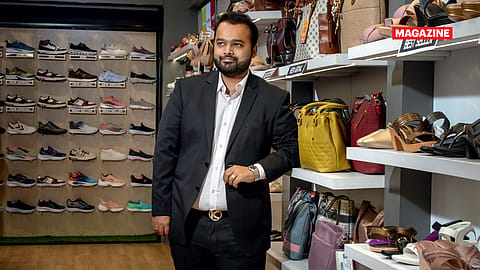
Rittick Roy Burman, MD, Khadim India | Credits: Ranendra Nath Chakraborty
This story belongs to the Fortune India Magazine May 2026 issue.
AT ONE POINT in his childhood, Rittick Roy Burman had turned his bedroom into a mini shoe-house! Pairs picked up randomly, with designs and textures that he fell for, would make their way home and quietly disappear under his bed. The goal: to study each one of them — the curve of the sole, the feel of the material, the stitching on the sides, things that would later become prerequisites of his job.
Eventually, his mother intervened. The inventory would be cleared out once a year, but Burman’s instinct remained. Years later, that same instinct would shape how Khadim sees product, pricing, and survival in an increasingly competitive domestic footwear market.
Today, at 33, as MD of Khadim India, Burman finds himself steering a company with a legacy spanning over six decades that has spent the last few years grappling with losses, cost pressures, and the consequences of an ambitious expansion strategy. His task now is not reinvention, but reset — Khadim 2.0.
Back to the roots
If there is one idea Burman swears by, it is this: Khadim, at its core, is a retailer. “That is in our blood,” he says proudly.
It is a philosophy that was drilled into him early. As a teenager returning from boarding school, weekends meant store duty. His father, Siddhartha Roy Burman (currently the executive chairman at Khadim), insisted he learn dukandaari, or shopkeeping. “Do billing at the cash counter. See how shoes are packed,” he recalls being told. “There is a certain way you have to pack the shoe. Since you are a retailer, you have to learn dukandaari.” That training continues to shape his management style at Khadim, which has 264 company-owned stores. Even now, Burman spends weekends visiting stores, talking to customers, and often selling to them. “Directly selling to customers gives lots of insights,” he says.
This retailer-first mindset is critical to understanding Khadim’s strengths and challenges. The company operates across retail, wholesale, and manufacturing — a rare combination in the footwear industry. “We are one of the few brands that are successful in retail and wholesale,” Burman says. “In retail, we procure from vendors and sell in our stores. In wholesale, we manufacture our own products and sell through distributors to smaller multi-brand outlets.” Khadim’s quintessential hawai chappals, PVC chappals (flip-flops, sliders, and sandals), and PU chappals (known for being lightweight) comprise the wholesale business. These are usually priced below ₹500.
More Stories from this Issue
“Wholesale is a bulk business,” says Burman. “So, if you manufacture, there is price competitiveness. The products that we sell in wholesale, like hawai chappals, require a lot of machinery investment. These cannot always be undertaken by small manufacturers.”
“Our plus point is that since we manufacture as well, we can give some technical know-how to vendors,” he adds.
In April 2025, the company demerged its wholesale business into KSR Footwear Ltd. The retail brand comes under Khadim Ltd. Together, the businesses sell around 30-40 million shoes every year, claims Burman. This hybrid model has historically given Khadim an edge, especially in price-sensitive markets. But it has also created operational complexity.
During one of his earliest stints at Khadim’s hawai chappal factory in Panpur, near Kanchrapara in West Bengal, Burman learnt the nitty-gritty of manufacturing — how important raw material sourcing was and how pricing worked. He recalls calling up suppliers in South Korea to bypass intermediaries. “If I could import raw material directly, I wouldn’t have to pay trader margins. If you want to be competitive, sourcing is important.” As the company scaled up capacity, invested in machinery, and built infrastructure, fixed costs rose sharply. “Initially, we used to have three to four hawai press machines, then we increased them to eight or nine. So, we built that infrastructure,” says Burman, adding, building a manufacturing set-up is capital-intensive, but the sales may not follow soon.
{{#most-powerful-women-snapshot-individual.slug}} {{/most-powerful-women-snapshot-individual.slug}} {{^most-powerful-women-snapshot-individual.slug}} {{/most-powerful-women-snapshot-individual.slug}} {{#showRanking}} {{current-rank}} {{/showRanking}} {{#photo.0.url}}
{{name}}
Simultaneously, the company was pursuing aggressive geographic expansion beyond its core markets. “We thought of expanding all over India,” he admits. “But in markets like Mumbai or the North, we don’t have the kind of brand recall we have in the East or South.”
The result was a period marked by cost pressures and balance sheet blues. Burman is candid about the gaps. “As an organisation, we needed to be more agile,” he admits. “And we needed to apply [more] financial wisdom. That’s where we went wrong for a few years.”
“Khadim went for national expansion too early, even before the brand was ready,” says Ankur Bisen, senior partner, The Knowledge Company. “The expansion created a lot of pressure on the brand. Along with the Covid pandemic, it dealt a double blow.”
Rewire, reinvent
The correction underway is deeply rooted in discipline. One of the most visible changes is the company’s willingness to shut loss-making stores — something it had historically avoided. “Earlier, we never used to close stores,” Burman says. “Now we are shutting loss-making stores. We have decided to get out of Rajasthan and Mumbai. We will not open stores just for the sake of opening them.”
The shift reflects a deeper change in mindset. Expansion for the sake of scale is no longer the goal. “For a retail store to be successful, location is the most important thing. I no longer feel the need to open a huge store,” he says. “My market needs to be good, and the store has to be financially viable. We need quality sales. We need profitable sales and growth.”
A key part of the strategy has also been to refocus on core markets — East and South India — where Khadim enjoys stronger brand recall. “If I open a shop here, I can get a payback within a year,” Burman says. Around 84% of Khadim’s retail stores are in East and South India compared to 16% in North and West.
Then comes franchising, which has long been central to Khadim’s growth, with over 500 outlets across the country, and 50-70 being added every year. “My father started this when franchising was not even a term,” Burman says. “He would go to markets, select a shop, and tell them to sell only Khadim products.” Currently, around 65% of the company’s stores are owned by franchisees.
“One needs lots of convincing and relationship-building to create these franchisees. In smaller markets like Malda and Murshidabad, convincing small shopkeepers to keep only Khadim products was a tough task… But our franchisees are also many years old; now, the second and third generations have come into the business in various markets.”
That model helped the company penetrate deeper into Tier II and III markets, something that the late Satya Prasad (S.P.) Roy Burman, Rittick’s grandfather, had envisioned long ago. “My grandfather used to draw a train line, and say, there should be a Khadim shop at every station. This has been our strategy for a long time. Tier II, III, IV… these are just fancy terms used now,” says Burman.
Around 68% of the company’s retail stores are in Tier II and III markets, compared to 32% in metros and Tier I towns and cities.
But changing dynamics have also made some of the old terms and conditions outdated. “Rentals have changed, competition has increased, customer preferences have changed,” he says. “So I am tweaking the store model to make it [more] financially viable.” The company is balancing inventory and allocating seasonally, based on regional demand to increase sales. From 131, the number of inventory days has come down to 117, according to the minutes of an investor meet in February. It is looking to bring it down further to 107 days.
The focus is on ensuring franchisees remain profitable. “Only then can we grow,” says Burman.
While the company has been cautious about opening new stores, it is also seeing significant opportunity in reviving existing outlets. “There are some legacy stores in our core markets where we are underperforming, but the market itself is strong, due to our brand recall,” Burman says. He points to a store in Tezpur, Assam. “We changed the products, improved the store, and worked on presentation. Now it is generating double the sales… We have also tweaked our franchisee model in many places.”
This strategy — fixing what exists rather than adding new stores — is emerging as a key growth-driver.
Resetting the playbook
On the product front, the immediate priority has been to reverse declining volumes. “We had degrowth,” Burman says. “Now we have arrested that.” Khadim has introduced more value-priced products to ensure accessibility. “We have launched starting price products so that customers don’t feel that the brand has become too expensive.”
At the same time, it is upgrading design and comfort through “better soles, materials, and colour combinations”. “Technically, our products are comparable to any big brand,” he says. The brand has evolved from yellow-red to white-red, and now to grey-white-orange for a more contemporary and international identity.
The store interiors are also undergoing a reset. The look and feel are more modern, and products are scientifically displayed. Some products are hung, while others get more focus on the shelves. In short, the company is doing a lot of visual merchandising.
The portfolio is also being segmented more clearly. The core Khadim brand will remain value-focussed, while sub-brands like Sharon and British Walker will go premium. “Premiumisation will happen in sub-brands,” Burman says. “Khadim wants to focus on value.” The wedding market will be a key area. “We are looking to premiumise wedding wear a bit more. We have a lot of scope to increase our design offering in that segment, and we are working on it.”
Women’s footwear brand Sharon and its leather counterpart for men, British Walker, have seen 10% YoY growth since last year. Khadim expects these two to contribute 20-25%, against the current 10-15%, to its total sales in the next three to four years.
Then comes athleisure, the latest entrant in Khadim’s revamp playbook. Launched last year in around 70 stores, Burman says he plans to ramp up the segment going forward. But the focus on footwear continues as it generates 70% of the firm’s revenues; the rest comes from accessories such as belts, wallets, and handbags.
The company has also tied up with U.S.-based Skechers. Currently, the Skechers collection is available at around 20 Khadim stores, and contributes ₹1-2 crore in annual revenue. The market watchers are keen. The stock has risen 27% over the past month until April 30.
Digital: The next frontier
Online currently contributes only 4-5% of revenue, but Khadim wants to double that. “We want to take it to 10%,” Burman says. The push will involve strengthening its own website, investing in digital marketing, and launching more youth-oriented products like sneakers and clogs. “We have to make designs more Gen Z-focussed,” he says, acknowledging that the competitive landscape has changed. “Earlier, there were only one or two brands. Now everyone is selling footwear.”
Consumer behaviour, too, has become more fluid. “The buyer is ever-changing,” says Burman. “Sometimes regional brands do well, sometimes national brands. Then again, you have to reinvent.” But the opportunity is huge. Footwear consumption in India is around 1.5 pairs per person, compared with 7-8 pairs overseas, he says.
Khadim’s advantage lies in flexibility, believes Burman. “Regional brands can change designs and prices quickly. They have a lot of vibrancy in their range. But the agility has to be matched with financial discipline.”
But can the turnaround sustain? Industry observers believe the company’s course correction is on track, but execution remains key. “Closing loss-making stores and focussing on core markets are sensible moves. But revival in retail is never linear — consistency over the next few years will determine whether Khadim can fully recover,” says a retail analyst who did not want to be named.
“Brands do go through cycles of realisation — wrong acquisitions, wrong market entry strategies. How you can improvise, what learnings you can harness from your missteps, how you reinvent yourself are important,” adds Bisen. “Khadim should go back to its roots and see what had given them the added advantage, and how the company can build on that advantage to ensure revival and growth.”
For Burman, the past decade has indeed been a steep learning curve. “I have learnt how to combat cost pressure and lay out strategies so that these problems don’t happen again.”
From a child collecting shoes under his bed to the MD balancing legacy and change, his journey mirrors that of the company itself. For Khadim, meanwhile, the road ahead is not about chasing rapid growth, but getting the basics right again — store by store, market by market. Or, as Burman might put it, returning to dukandaari — this time with a sharper financial discipline.
Follow Fortune India
Sign in to read full story
To access our exclusive magazine content, sign in to your Fortune India account.
Sign In NowNEXT STORY