Sports fans fuel billion-dollar business beyond superstars
/ 7 min read
The sports fan does not just support the star. Their obsession and love is also big business for sportswear majors and healthy for the economy.
Credits: Getty Images
This story belongs to the Fortune India Magazine july-2026-mpw-100-most-powerful-women issue.
Scene I: It is late afternoon on a balmy Tuesday in early June at a popular shopping mall in tony South Delhi. Not the busiest of times. People are sauntering in — most are office-goers who have slipped out a tad early. A young couple enters the Adidas store gingerly to click photos with the giant cut-outs of football stars. Soon, they make their way to the corner where FIFA World Cup jerseys are stacked. A few minutes later, two new fans emerge — of the Spanish and German football teams, respectively.
Scene II: More than a thousand kilometres away from Delhi, at a mall in a Mumbai suburb, a pack of college-goers is desperately looking for jerseys of their favourite teams at the Nike store, before stocks run out. Elsewhere in the mall, a high-school lad sporting an RCB jersey marches into the Puma store demanding the authentic CR7 jersey.
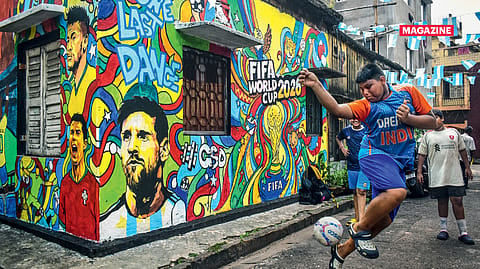
Scene III: At Kolkata’s Maidan market, the City of Joy’s hub for sporting goods, two groups are having a heated argument about which team will lift the cup — Brazil or Argentina? The harried shopkeeper is trying his best to get them to haggle about the sale. These jerseys, knock-offs of the originals, sell at 1/10th or 1/12th the price of the authentic ones, and make their appearance in bulk every four years.
Three different cities united by one passion — football.
Soccer-crazy parts of India are once again bathed in yellow and blue — the dominant colours of the two South American teams, Brazil and Argentina, that the majority support.
Gigantic cut-outs of this edition’s biggest stars — Argentina’s Lionel Messi, Portugal’s Cristiano Ronaldo, and Brazil’s Neymar Jr. make their presence felt. Indian men’s and women’s teams may be at No. 138 and No. 69, respectively, in the FIFA rankings as of June 2026, but there’s no dearth of fans.
For sportswear companies, the FIFA World Cup is big business worldwide, including cricket-crazy India (see: The World Cup Story). In fact, the fan merchandise economy forms a chunk of the global sportswear market, which was worth $399.4 billion in 2025, according to Grand View Research. The report estimates that it will expand at a CAGR of 10.7% between 2026 and 2033, from an estimated $437.4 billion to $890.4 billion.
More Stories from this Issue
This is a part of the broader sports economy, which the World Economic Forum, in a January 2026 report, pegged at $2.3 trillion in 2025. The report, titled ‘Sports for People and Planet’ and brought out in association with global consulting firm Oliver Wyman, says that the sports economy contributed 0.9% to India’s GDP in 2024. It divides the sports economy into four core and five connected verticals. Among the core verticals is sports goods — including fan merchandise — valued at $614 billion in 2025.
The India story
The merchandise economy, while still nascent in India, is growing along with the rest of Asia. A 2024 Deloitte report said the sporting goods and apparel sector in India, pegged at $24.9 billion in 2023, was projected to grow to $58 billion in 2030 at a 13% CAGR.
“Fan merchandise is becoming a meaningful business in India, although it is still at a relatively early stage compared to mature sports markets such as the U.S. and Europe. Cricket remains the biggest driver, led by Indian Premier League (IPL) franchises and Team India, while football, kabaddi, and emerging leagues are also creating merchandise demand,” says Rajesh Sethi, partner and leader-media, entertainment and sports, PwC India. “For brands, merchandise is no longer just a revenue stream; it strengthens fan engagement, builds identity, and creates year-round touchpoints with consumers.”
{{#most-powerful-women-snapshot-individual.slug}} {{/most-powerful-women-snapshot-individual.slug}} {{^most-powerful-women-snapshot-individual.slug}} {{/most-powerful-women-snapshot-individual.slug}} {{#showRanking}} {{current-rank}} {{/showRanking}} {{#photo.0.url}}
{{name}}
Credits: Prabal Biswas
He adds that licensed sports merchandise is a multi-billion-dollar industry globally, with football commanding the largest share due to its scale and international fan base. “Markets such as the U.S., the U.K., Europe, and increasingly Asia are leading consumption. India is still a high-growth market, with significant potential as digital fandom and sports consumption continue to expand,” Sethi says.
Globally, football is in pole position, besides Formula One and basketball (limited to a few geographies), being the number spinners, says Lloyd Mathias, angel investor and business strategist. “[Globally,] North America, Australia, New Zealand, and Western Europe would dominate, but increasingly I see Asia pushing in big numbers,” he says.
That is a long way from where the fan merchandise industry was only a few decades ago.
“Indian fan merchandise has evolved from unorganised jerseys and caps sold outside stadiums to officially licensed apparel, collectibles, and digital products powered by e-commerce, quick commerce, and social media,” says Sethi.
“Sales typically peak around marquee events such as the IPL, FIFA World Cup, and UEFA Euro, but successful franchises increase year-round demand through limited-edition drops, athlete storytelling, and digital fan communities.”
Mathias says that the fan economy was a little sporadic before the IPL, which experts say has acted as a catalyst for growth.
“I think the IPL did two things. One, it brought in people going to games wearing merchandise. Two, it had people getting together and watching screenings… so I think that created the first real fandom in sports in India,” he says, adding that the space has seen a little bit of an upswing over the last decade, because of a lot of apparel manufacturers have taken a position with big tournaments such as the IPL.
Shreya Sachdev, head of marketing at Puma India, which supplies kits to IPL teams Royal Challengers Bengaluru and Delhi Capitals, says that when the IPL began in 2008, it was still a premature market. “We started slow, but we had the vision with RCB from the beginning, that we’re going to build a whole culture around fanwear and not just limited to the jersey.”
She adds that globally, football has a culture that extends beyond the season. “People wear the jerseys through the year; it’s a style statement. You don’t need to be going to a stadium for a match to wear a jersey, and that’s the culture we wanted to build here as well,” Sachdev says.
Growth drivers
What is driving the recent growth in India? The Deloitte report says that a growing fitness culture and rising discretionary spends are fuelling the sector’s growth.
According to Sachdev, one of the reasons the fan merchandise market is growing is because team jerseys are becoming something of an annual purchase and a collectible for fans. “We are seeing a big shift in the intent to purchase… we are seeing a lot of that also come from very young people, because if you see the IPL, a huge share of viewership spike comes from people who are 25 and below,” she says, adding that younger people who have just started their personal journey are willing to commit a share of their wallet to their favourite team or player.
But it is not without challenges. For one, the fake economy and bridging the gap between knock-offs and originals, says Mathias. “For every one genuine shirt, maybe 20 rip-offs are being sold, but that’s part of the deal.”
Credits: Prabal Biswas
However, there is definitive growth, he adds. “I think largely it springs on two counts: one is on sporting gear, and then, of course, apparel… the footwear majors — whether it’s the Nikes, the Adidas, the Reeboks, the ASICS... [and] all the apparel manufacturers, especially those who have taken active positions with teams.”
Despite the knock-offs, Mathias emphasises that the growing merchandise economy has a bright future in the country “because as India gets more affluent [and] as team fandom spreads, people are bound to aspire for better quality merchandise”.
Emotional connect
According to brand expert Harish Bijoor, a team’s popularity underpins fan merchandise sales, while marquee events act as powerful demand accelerators. “Fan merchandise is typically event-led. Closer to the day of the event, the merchandise [sales] tend to spike. In the case of IPL, it is the match-day sale that is important… Therefore, it is really about moment marketing. It’s about the chemistry that the teams create at the grassroots level,” says the founder of boutique strategy consulting firm Harish Bijoor Consults Inc.
A lot also depends on the fans and how they connect with the stars. Ashita Aggarwal, professor of marketing at SP Jain Institute of Management and Research (SPJIMR), says there are people who believe in “the ideology of a person they are a fan of, and they relate to them not because of just a demography or just where they belong, but as a personality they can connect with, which could be aspirational, or something which connects them”. That’s why, she says, a Messi or a Ronaldo fan will buy a jersey irrespective of the team they are playing for.
It also explains the next critical aspect of the merchandise economy: a sense of community. “Community building is critical because fans buy merchandise not only to support a team or player, but also to express belonging and identity. IPL franchises like Chennai Super Kings and Mumbai Indians have built loyal fan bases that drive repeat purchases of jerseys and limited-edition. Sports stars are powerful catalysts. [Virat] Kohli, [M.S.] Dhoni, and Rohit Sharma drive significant merchandise demand in India,” says Sethi.
Some IPL franchisees have also done a stellar job of building brands and fanning the merchandise economy, observes Bijoor. “For a long time, MI and CSK were very significant, but right now I think RCB is leading a big pack. One is because you know Bengaluru has a huge, huge identification with RCB. Two is they’ve stayed kind of consistent over the years,” he says, adding that “even for a sport that’s much smaller, the kind of fandom that the Bengaluru Football Club has, is itself quite startling”.
Puma India’s Sachdev echoes similar views as she recalls the Women’s Premier League jerseys selling like hot cakes even during the inaugural season, courtesy of RCB’s brand value. The apparel brand also provides kits for Bengaluru FC in the Indian Super League.
The massive shift in consumer behaviour, Sachdev says, has encouraged Puma to expand its RCB portfolio to sneakers and fan scarves. Reiterating how jerseys have become year-round style statements, she adds, “We are kind of pushing the boundaries as well, because we realise the consumer is enjoying flaunting this fanwear beyond just match days or the IPL season... we are seeing them actually value it as a style statement. So, compared to last year, for example, our RCB sales are up 80%.” Among jerseys, the highest-selling SKU is the one at the highest price point, she says.
These aren’t just retail figures. They point towards what will be a thriving economy fuelled by a growing sports market. In a cricket-obsessed nation where football commands passionate followings in select pockets, the sports merchandise market is no longer a niche — it is poised for sustained growth.
Follow Fortune India
Sign in to read full story
To access our exclusive magazine content, sign in to your Fortune India account.
Sign In NowNEXT STORY