T-Hub: Telangana’s startup crucible
/ 8 min read
Technology Hub, or T-Hub, is accelerating the future of deeptech and defence innovations.
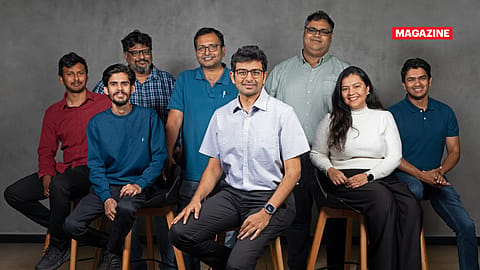
Kavikrut, CEO, T-Hub with startup founders. | Credits: Sanjay Rawat
This story belongs to the Fortune India Magazine june-2026-indias-most-valuable-celebrities issue.
EARLIER THIS YEAR, a New Delhi resident suffered a health emergency during a trip to Beijing. Miles away, a 41-day-old premature infant weighing under 1.5 kg had to be safely transferred from Surat to Hyderabad in a highly critical condition.
In both cases, Hyderabad-based startup RED.Health ensured seamless transfers. In the first case, it brought the patient on ventilator back to New Delhi by a charter booked in an air ambulance configuration. It deployed a fully equipped neonatal ambulance for a 24-hour non-stop 1,200-km journey in the second. RED.Health was founded by Prabhdeep Singh in 2016 as India’s largest 24/7 emergency response system startup, with a captive advanced 5G ambulance fleet and presence across 250-plus hospitals.
From emergency healthcare and fintech to spacetech and robotics, Hyderabad’s startup ecosystem is emerging as a hub for innovation. Companies such as RED.Health, Sanyark Space, Zynk, Water Robotics, and Deep Grid Semi, among others, are building cutting-edge solutions across sectors.
Sanyark Space, founded by former ISRO scientist and Deloitte spacetech consultant Raghava Kundrapu, is working on Low-earth Orbit (LEO) satellites for high-precision navigation and communication for defence as well as autonomous systems. In simpler terms, the startup is trying to address the problems of users getting lost while using navigation apps, by improving the accuracy to centimetres through the use of LEO constellation, which is only 500-900 km away from the earth, compared with a Medium-earth Orbit (20,000 km) or Geostationary Earth Orbit (over 36,000 km) satellite, thereby accounting for higher precision.
Another startup, Zynk, is helping cross-border payment platforms (such as remittance firms) with instant settlements without the need for pre-funding. Pre-funding ensures the financial institution holds liquidity in destination markets to settle payments. Then there are deeptech startups such as Water Robotics, which is building a robotic bed with more than 10,000 pressure sensors and 45-plus adaptive zones to power active ergonomics, or Deep Grid Semi, developing indigenous Advanced Driver Assistance Systems to facilitate assisted driving, or HirePlusPlus, an AI hiring and assessment platform.
The common thread among all these startups and thousands of others in the city is that they are associated with the incubator ecosystem — T-Hub, or Technology Hub — the nerve centre of innovations made across segments but with a keen focus on spacetech and deeptech. Located in Hitech city and spanning over 572,000 sq. ft, T-Hub is the world’s largest startup hub and provides world-class infra for collaboration, and experimentation.
With a network of 90-plus partner VCs and about 1,700 deal introductions, the incubator supports founders from ideas to scale via programmes, partnerships, and global access, by bringing startups, corporates, academic institutions, government bodies and investors under one roof.
More Stories from this Issue
T-Hub CEO Kavikrut emphasises that more than the formal association, it is about the unlock that can be achieved with the entire ecosystem coming together. “Association of startups with T-Hub is understood to be in terms of cash, i.e., funding, cohorts, and co-working. These are the three Cs for any traditional incubator. But I am of the view that we cannot be finite [in terms of] the formal association, as we have to do whatever it takes to support startups. We are here for the city, for the community, for the state, and hence for the country, and the world,” he tells Fortune India.
SparrowG, a STEM learning startup, conducting a workshop at T-Works.
T-Hub also houses the Atal Incubation Centre, along with Machine Learning and Artificial Intelligence Technology Hub (MATH), and is the largest incubator running 70-plus defence tech challenges under the Innovations for Defence Excellence scheme (iDEX) launched by PM Narendra Modi in 2018. Through iDEX, startups associated with T-Hub have unlocked orders worth ₹255 crore. The hub also has a 78,000-sq. ft prototyping centre offering startups the advanced fabrication facility to design, build, and test their physical campus. In all, T-Hub has supported 1,750 startups in the last two years and more than 2,500 since its inception in 2016. Its growing emphasis on deeptech is also reflected in the kind of startups T-Hub actively champions and showcases.
The glass wall of Kavikrut’s office is lined with post-its with the names of 30-plus startups spanning diverse sectors, but mostly deeptech where, according to him, Hyderabad is steadily emerging as a major hub. In fact, Skyroot, which recently became India’s first spacetech unicorn at a pre-money valuation of $1.1 billion following a $60-million fundraise, has been associated with T-Hub in its early journey.
On the mix of startups in the high-potential Top 30 list, Kavikrut says, “The list is biased towards Hyderabad, and has startups working predominantly in deeptech, including aerospace, healthcare, life sciences, and robotics. There are a few wild cards based on founder potential with domains such as fintech, logistics startups.” AI has accelerated the pace of building startups. “We broadly see five emerging areas within deeptech — aerospace, defence, biotech/healthcare/lifesciences, industry (manufacturing, automation, robotics). The fifth is animation, visual effects, gaming, and comics (AVGC), which has a lot of potential. In fact, VFX evolving with AI is a huge opportunity, and companies sitting here have been doing VFX work for studios across the world for many years,” he adds.
{{#most-powerful-women-snapshot-individual.slug}} {{/most-powerful-women-snapshot-individual.slug}} {{^most-powerful-women-snapshot-individual.slug}} {{/most-powerful-women-snapshot-individual.slug}} {{#showRanking}} {{current-rank}} {{/showRanking}} {{#photo.0.url}}
{{name}}
From its beginning as a co-working space, T-Hub has come a long way, facilitating startups to explore the next big frontiers. “Three key objectives were envisaged for T-Hub,” says B.V.R. Mohan Reddy, founder of Cyient and former Nasscom chairman. He is also on the T-Hub board. “First, creating a world-class co-working and innovation space. Second, enabling corporate innovation. And third, driving the internationalisation of startups.” Reflecting on T-Hub’s journey, Reddy notes that the ecosystem has made significant progress by creating over 2,000 seats and supporting over 3,000 startups beyond co-working. However, he emphasises that the scale required for India’s future ambitions is far greater.
“If India has to create a million jobs every month — nearly 10 million jobs a year... scaling towards 100 million jobs — we will need an ecosystem that can support nearly 20,000 startups. This growth doesn’t have to come from Hyderabad alone, but from a much larger national innovation ecosystem.”
Prabhdeep Singh, founder and CEO, RED.Health.
Reddy also highlights T-Hub’s focus on strengthening the startup experience beyond incubation. “We are working to ensure startups receive far more comprehensive support services, including access to finance, audit and business planning, market access, HR support, intellectual property guidance, and legal services.”
Prabhdeep Singh recalls how RED.Health’s first two funding rounds were linked to the incubator. “Kalaari Capital was at T-Hub. The second fund-raise came from Hyderabad Angels, again pitches organised by T-Hub at the Indian School of Business (ISB),” says Singh, adding, the startup has raised around $32 million, including debt worth $8 million.
Leveraging on the support systems, startups have kept the campus buzzing, whether it’s occupying space or testing their prototypes in T-Works. T-Hub mentor-turned-founder and Zynk CEO Prashanth Swaminathan knew exactly where to go when he decided to launch his own startup. Drawing on his experience across fintech, banking, and blockchain, Swaminathan and his co-founders spotted niche inefficiencies, built a business model around them, and founded Zynk in 2024. “I’ve been associated with T-Hub for years as a mentor and have seen how it supports startups. Becoming a founder myself, it was natural to tap into that ecosystem.”
Swaminathan explains the opportunity ahead. “Out of the $200 trillion annual volumes that happen [in remittances] today, up to $10 trillion is stuck in pre-funding to enable these transactions. So this is a huge unlock even if we tap 10% of it,” he points out.
The startup offers services to new-age remittance players up against the likes of U.K.-based Wise and U.S.-based Remitly who have established a competitive moat in the industry on the back of liquidity parked at multiple global locations for faster and cheaper disbursement of remittances. To date, Zynk has raised $5 million from Hivemind Capital and others.
Kavikrut feels startups like Zynk reflect the kind of high-potential ventures that T-Hub wants to back. “Some high-potential companies are solving global problems with very high-potential teams, those that you see in Bengaluru or the Bay Area. When you see such teams and such ideas, you need to throw the kitchen sink behind them,” he adds. But with the kind of co-founders Zynk had, it did not need help on the product and tech side. While one co-founder Manish Bhatia was a former CTO of Amazon Pay India, his partner Abhishek Pitti has deep experience in the digital asset ecosystem. “We needed help on amplifying what we are doing here in terms of getting new introductions, media relations, access to newer investors, and liquidity,” Swaminathan says.
Meanwhile, Sanyark Space has received fund support from T-Hub itself and has lined up future launch plans. “We are building software-defined navigation and communication satellites. As we advance into next-generation technologies, our satellites also have to be designed so that navigation and communication can be integrated with the terrestrial networks. That’s how we are designing our satellites, which will deliver centimeter-level navigation and seamless connectivity from space,” says Kundarapu. T-Hub is joining hands with SIDBI to invest ₹1 crore in Sanyark Space.
For Teja Vinukollu, the idea of an AI robotic bed came when he suffered a slipped disc working long shifts while on a regular job. The entire fabrication of the robotic bed was done at T-Works under one roof. “I built the physical intelligence model and the necessary custom pressure sensors. Our entire sensor array is compatible with the machine learning array we have built,” Vinukollu says.
Venture capitalists are bullish on the investing prospects of startup ecosystems that the likes of T-Hub bring to the table. “T-Hub, T-Works, and Genome Valley are taking amazing deeptech initiatives. There is advanced manufacturing, which most people do not associate with Hyderabad. Thanks to GCCs, IT, aerospace and defence, and pharma and healthcare legacies, today we have a bunch of startups across these spaces,” says Srikanth Tanikella, managing partner, Pavestone VC.
The VC firm is launching its second fund soon. “Our first fund, Parampara, an early-stage deeptech opportunities fund (₹75 crore) was launched 10 years back. Pavestone Technology Fund 1 of $100 million was launched four years ago. We are launching a ₹2,000-crore fund with a focus on enterprise tech and deeptech,” Tanikella adds.
Another VC firm, Dallas Venture Capital, meanwhile, has backed Bluecopa, an AI-native finance automation startup. The startup raised $7.5-million Series A funding led by Analog Partners in January this year. T-Hub was an early backer of Bluecopa.
“T-Hub gives us regular access to emerging startups and has become a nerve centre for founders and investors alike,” says Kiran Kalluri, partner, India Fund at Dallas Venture Capital. “Our investment thesis has been narrow so far, but as we expand into sectors like defence and deeptech, these startups become our first source.”
Given the traditional prowess in sectors such as space and biotech, Hyderabad is set to become a capital for deeptech and defence innovations. Ecosystems like T-Hub will only help catalyse that.
Follow Fortune India
Sign in to read full story
To access our exclusive magazine content, sign in to your Fortune India account.
Sign In NowNEXT STORY