Noel Tata vs Chandrasekaran: The war unfolding at Tata
/ 11 min read
For the first time, Tata Sons and Tata Trusts are headed for a legal showdown over N. Chandrasekaran. Can Noel Tata regain control?
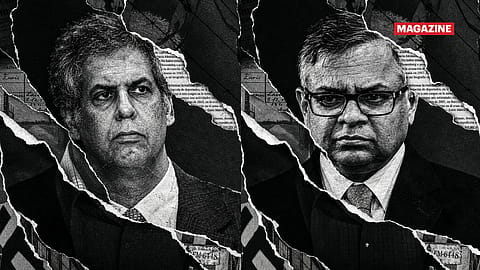
L-R: Noel Tata and N. Chandrasekaran | Credits: Fortune India
This story belongs to the Fortune India Magazine october-2026-the-indian-luxury-boom issue.
Noel Tata was clearly restless on the night of Tata Sons’ board meeting on Thursday, September 17. The board had cornered him, deciding to offer Natarajan Chandrasekaran a third five-year term as chairman of Tata Sons despite Noel’s lone dissenting vote. In fact, the board counted the veto vote of another Tata Trusts nominee, Venu Srinivasan, to blunt Noel’s authority. Harish Manwani, chairman of the Nomination and Remuneration Committee (NRC), which took up the matter, used his casting vote to render a Tata family head insignificant for the first time in the group’s history.
As the battle at Bombay House heated up, the next morning, on Friday, Noel, chairman of Tata Trusts, fired off two emails to Tata Sons’ board members. The first questioned the process of Chandrasekaran’s reappointment. The second followed, insisting that the board take into account Article 118 of the Articles of Association (AoA)—the framework governing the architecture of the group’s holding company—while deciding on the reappointment.
Tata Sons rebutted Noel’s objections days later, arguing that Article 118 applies only to the appointment of a first-time chairman, not the reappointment of an incumbent. The company maintained that Article 121 governed the reappointment and that it talks about the board’s voting procedure. Both camps said the 2022 reappointment of Chandrasekaran was via a resolution.
Noel’s latest objection followed Chandrasekaran’s August 12 letter to the board, in which he stated that he had decided not to seek reappointment. The following day, Tata Trusts approved his decision and wrote to Tata Sons to initiate the process of forming a selection committee to find a successor. Chandrasekaran had, in fact, asked the board to fast-track the succession process to ensure a smooth transition.
Tata Trusts argued that no decision on reappointment could be taken without the affirmative support of a majority of its nominee directors, given its 66% stake in Tata Sons. “This is a separate condition under the AoA.” The AoA does not leave any board decision to a mere headcount of directors, it added.
The sequence of events before the board meeting is equally revealing as the ones after. In May, the Maharashtra Charity Commissioner barred board meetings of Sir Ratan Tata Trust (SRTT), preventing Noel from removing Srinivasan as a Tata Trusts nominee. The commissioner acted on a petition filed by Srinivasan himself, alleging a breach of rules in limiting perpetual or lifetime trustees to a maximum of 25% of the total board strength. Interestingly, the board had retained the same composition during Ratan Tata’s tenure. The suspension of SRTT board meetings also stalled the Tata Sons AGM, which was to consider the extension of Chandrasekaran’s directorship.
Against this backdrop, the dispute has now widened to include the governance of the Sir Dorabji Tata Trust (SDTT) as well. According to sources, SDTT has filed a caveat with the Maharashtra Charity Commissioner, seeking a hearing before any order is passed on the complaint against the trust’s administration and governance. SDTT is also expected to convene its board soon to finalise its nominee for the Tata Sons AGM amid the blockade at SRTT. Sources say SDTT may move a motion against Srinivasan over complaints he filed without raising the issues in board meetings, including questions over Noel Tata’s appointment as Tata Trusts chairman, Neville Tata’s inclusion on the SDTT board, and the role of trust directors in Tata Sons’ decision-making.
More Stories from this Issue
The developments at SDTT could prove critical, given that both trusts must jointly nominate a representative for the Tata Sons AGM, without which the quorum would be incomplete. Article 86 of the AoA requires an authorised representative jointly nominated by the two trusts for the AGM quorum.
This effectively puts the decision on extending Chandrasekaran’s directorship under Noel’s control. Chandrasekaran needs his directorship to be renewed at the shareholders’ meeting, if convened, to continue as chairman. But the Charity Commissioner must first give the green light for the SRTT board meeting.
The other outsider at the centre of the drama is the Reserve Bank of India (RBI). The banking regulator wrote to Tata Sons on September 11, rejecting the request to deregister Tata Sons as a core investment company (CIC) and maintained it under the upper-layer NBFC (NBFC-UL) category. The RBI also filed a pre-emptive caveat in the Bombay High Court to prevent any ex parte stay on its order if Tata Sons challenges it. Under the RBI’s governance directions, NBFC-ULs must list their equity shares. Ratan Tata had fought against classifying Tata Sons as an NBFC and resisted listing the holding company, which was designed to serve the philanthropic interests of Tata Trusts. But the five Tata Sons board members, including Chandrasekaran, and minority shareholder Shapoorji Pallonji (SP) Group view the listing as a process to bring in transparency.
Meanwhile, on September 28, Tata Trusts proposed merging Tata Electronics Systems Solutions (TESS) and Tata Consulting Engineers (TCE) into the holding company to shed the NBFC and CIC tags. It marks a return to Tata Sons’ earlier operating model, in which it combined its own businesses and revenues with its role as a holding company.
{{#most-powerful-women-snapshot-individual.slug}} {{/most-powerful-women-snapshot-individual.slug}} {{^most-powerful-women-snapshot-individual.slug}} {{/most-powerful-women-snapshot-individual.slug}} {{#showRanking}} {{current-rank}} {{/showRanking}} {{#photo.0.url}}
{{name}}
The move would alter Tata Sons’ financial structure. An operating revenue of 1,05,043 crore in FY26 would exceed 40,072 crore in income from financial assets, potentially helping the holding company to cease to be an NBFC. In addition, the share of investments in group companies would fall below 90% of the aggregate net assets of `2,00,158 crore, taking Tata Sons out of the ambit of a CIC.
The proposal has been sent to the Tata Sons board and the RBI. To take it forward, Tata Sons will have to approve the proposal and seek a no-objection certificate from the RBI for the merger.
Conflicting legal views
As both sides harden their stance, the Noel vs Chandrasekaran battle now pits two of India’s most prominent lawyers against each other. Abhishek Manu Singhvi is representing Noel Tata and Tata Trusts, while Harish Salve is defending Tata Sons and Chandrasekaran. Their arguments will determine whether the board could override the dissent of one of the two Trusts’ nominee directors and whether the chairman’s casting vote could validate the resolution.
Singhvi argues that the fundamental rights of shareholder-owners cannot be nullified in the manner in which they have been. He represented Ratan Tata and the Tata Group in the 2016 suit filed by the late Cyrus Mistry against his removal as chairman. In March 2021, the Supreme Court ruled in favour of Tata Sons, upholding Mistry’s removal and setting aside allegations of oppression of the SP Group.
Having worked closely with Ratan Tata and being familiar with his legacy, Singhvi says he knows the principal actors on both sides of the current dispute personally. The board of privately held Tata Sons cannot deny Tata Trusts the rights that come with its 66% ownership, he argues.
Senior lawyer Harish Salve, who represented Mukesh Ambani in his legal battle with brother Anil, argues that the casting-vote provision under Article 121 is essentially meant to break a deadlock arising from an internal split among nominees. According to him, nominee directors are not proxy delegates and owe fiduciary obligations directly to Tata Sons. Salve adds that the best talent should run Tata and that is a national priority.
The legal controversy centres on the interpretation of Article 118 of the AoA, which says, “… the Board may appoint the person so recommended as the Chairman of the Board of Directors, subject to Article 121, which requires the affirmative vote of [the directors of Tata Sons that have been appointed by the Tata Trusts (Tata Trusts nominee directors)].”
Article 121 says, “Matters… shall require the affirmative vote of a majority of [Tata Trusts’ nominee directors]… and in the case of an equality of votes, the Chairman shall have a casting vote.”
Karishma Vora, cross-border disputes barrister at 39 Essex Chambers (London), says the decision on reappointment hangs in the balance on whether the last line means the casting vote can break a deadlock caused by (a) an equality of votes at the Tata Sons board level or (b) when there is a tie among Tata Trusts’ nominee directors.
“With the two Tata Trusts nominee directors, Noel Tata and Venu Srinivasan, respectively, opposing and supporting the resolution concerning N. Chandrasekaran’s reappointment, the question is whether Chandrasekaran’s appointment actually received the ‘affirmative vote’,” she says.
The Trusts’ legal challenge rests on the relationship between Articles 118 and 121. Noel’s position is that the chairman’s selection must follow the process prescribed under Article 118 and that the affirmative support required from Trusts-nominated directors cannot be substituted by a casting vote. Tata Sons argues that Article 121 governs the board’s decision and permits a casting vote in the event of a tie. The holding company has cited opinions from former Chief Justice of India U.U. Lalit, former Supreme Court judge B.N. Srikrishna and senior advocate Sudipto Sarkar to support its interpretation.
Former Chief Justice of India D.Y. Chandrachud offers a different interpretation. “The affirmative vote of the nominee directors of the Querists is an independent and standalone requirement,” he says. The affirmative-vote requirement operates on a wholly different plane from the chair’s casting vote, which is designed to resolve a tied vote among all directors of the board taken cumulatively, he adds. “The casting vote of the chairperson is only applicable where there is an equality of votes amongst two functions of the board as a whole, and not amongst two specific directors, whether they be nominee directors or not,” he adds.
An earlier opinion by former Supreme Court judge Justice Rohinton F. Nariman has also resurfaced amid the public spat. The April 2025 opinion, on a draft protocol of Tata Trusts, has been used to justify nominee director Venu Srinivasan’s independence in siding with Chandrasekaran despite objections from other Tata Trusts board members. The draft protocol was based on an October 17, 2024, resolution by SDTT and SRTT directing their Tata Sons board nominees to act under the guidance of the trustees and the executive committee.
How it will play out
Tata Trusts is likely to take the matter either to the National Company Law Tribunal (NCLT) or the Bombay High Court, say sources. “Singhvi and team are working to file the petition and it will land in the court soon,” a source close to the developments says.
The procedure is straightforward. The plaintiff—in this case, Tata Trusts—will file a petition outlining its claims and demands, while the defendant, Tata Sons, will respond with its defence in a written statement. Hearings will begin thereafter.
Before this procedure, Tata Trusts is likely to move for an interim order, says Ramesh Vaidyanathan, managing partner of law firm BTG Advaya. “Tata Trusts is more likely to file the petition in the NCLT and seek for an interim order to halt the reappointment.” He, however, adds that Tata Trusts will have to convince the NCLT that there is sufficient urgency to justify stalling the reappointment. In the final hearing, both sides will argue their interpretations of the AoA and explain how its provisions have historically been used to govern Tata Sons. “Tata Trusts is expected to argue that majority shareholder rights have not been protected; the AoA has not been respected, and there has been a breach of contractual rights,” says Vaidyanathan.
On the interim relief petition, Tata Sons is expected to argue that the group, with over 100 companies, cannot afford leadership uncertainty, adds Vaidyanathan. “They may also cite impact on shareholder value due to the leadership crisis.” The court will also examine how the board applied the rules while appointing Cyrus Mistry, Chandrasekaran and previous chairmen, as well as how the AoA protected Tata Trusts’ interests in the past.
In the Cyrus Mistry-Ratan Tata battle, the Tata Sons board stood with Ratan Tata, and the company fought the legal battle. In Noel Tata’s attempt to remove Chandrasekaran, Tata Sons finds itself on the opposite side of the Tata family, and Noel’s control is limited to Tata Trusts.
Tata insiders point to two factors that could shape the proceedings. First, delay in holding the Tata Sons AGM, caused by the Charity Commissioner’s blockade of the SRTT nominee appointment, will help Chandrasekaran to continue. If his directorship is not renewed at the AGM, he would cease to be a board member and would no longer qualify to continue as chairman. The legal battle will end there.
The second factor is the time the legal proceedings could consume. The Cyrus Mistry-Ratan Tata battle began in the NCLT in December 2016, with the Supreme Court delivering its final verdict in March 2021. The dispute lasted more than four years. Chandrasekaran is expected to continue as chairman during a similar legal battle if the Tata Sons AGM is not held.
Srinivasan’s stand is another contentious issue. There are no hard-and-fast rules governing how Tata Trusts’ nominees should exercise their veto in Tata Sons’ board meetings. If a majority of the trustees of key bodies, including SDTT and SRTT, object to how a nominee exercises his veto, the question is how that disagreement should be resolved legally.
Justice Nariman’s opinion cited Section 149(7) of the Companies Act, which defines a nominee director as one appointed to represent the interests of the person/entity that nominated them. However, Section 166, which sets out directors’ duties, requires allegiance to the company itself and the exercise of independent judgment.
The jurists will have to delve deeper into the issue that Justice Nariman touched upon in his opinion—Can Srinivasan decide his position independently while representing the majority promoter in a privately held firm?
Meanwhile, Noel Tata will have to fight another battle as well. As the majority shareholder of Tata Sons, Tata Trusts will have to approach the court to challenge the RBI’s decision requiring Tata Sons to comply with the NBFC norms. The Tata Sons board, barring Noel, is in favour of listing the holding company.
Noel’s rivals
Srinivasan’s complaint against the composition of the SRTT board may have wider implications. But it was not the first attempt to challenge Noel Tata’s authority. Another complaint, filed by Vijay Singh, another trustee and former nominee on the Tata Sons board, over the 1989 share transfer by Navajbai Ratan Tata Trust (NRTT) in June 2026, failed to achieve that objective. The Charity Commissioner found that the transaction was lawful, properly documented, backed by an appropriate valuation from the Wealth Tax Commissioner and compliant with the laws in force at the time.
NRTT transferred 833 Tata Sons equity shares to the late Naval H. Tata on January 18, 1989. After Naval Tata died in May 1989, the shares devolved to his family members in 1993, including sons Ratan Tata, Noel Tata and Jimmy Tata, and wife Simone Tata. Noel thus inherited a portion of these privately held shares.
Following Ratan Tata’s demise, Noel’s elevation as chairman of Tata Trusts triggered a high-stakes internal power struggle, splitting the board into distinct camps. In the beginning, the centre of the friction was Mehli Mistry, a close confidant of the late chairman and executor of his will, who emerged as a principal challenger to Noel’s authority.
The corporate drama escalated during a dispute over nominee appointments to the Tata Sons board. A bloc of trustees—Mehli Mistry, former Citibank India CEO Pramit Jhaveri, legal expert Darius Khambata and Jehangir H.C. Jehangir—opposed the reappointment of Vijay Singh, a former bureaucrat and trusted lieutenant of Ratan Tata. Singh eventually stepped down from the Tata Sons board to prevent friction. The resulting vacancy prompted Mistry to seek a seat on the board himself.
His ambition met resistance from Noel Tata and his key supporter, Srinivasan, chairman emeritus of TVS Motor Company. Viewing Mistry’s nomination as a challenge to institutional governance, Noel, backed by Singh and Srinivasan, blocked his entry. Finally, Mistry was voted out from SDTT and SRTT. In turn, the proposed reappointment of Srinivasan and Singh as trustees of the Tata Education and Development Trust (TEDT) ran into opposition, with Mehli Mistry and J.N. Mistry voting against the move.
Subsequent disputes over governance decisions—including the listing of Tata Sons, Chandrasekaran’s extension and facilitating the sale of the SP Group’s 18.37% stake in Tata Sons—showed that alignments remained fluid. Figures such as Srinivasan and Singh advocated changes that put them at odds with Noel’s core strategy.
Now, the dispute is headed for the legal corridors.
If Noel loses, the Tata family’s role could be confined to managing the philanthropic activities of the trusts, funded by dividends from Tata Sons. The architecture of control over a conglomerate spanning software, steel, automobiles, aviation, retail, hospitality and semiconductors could change forever. Chandrasekaran could continue pursuing unfinished capital investments and strategic forays into new sectors without interference from the Trusts. A listing of Tata Sons would further reshape the holding firm’s relationship with its shareholders. The board’s case for Chandrasekaran’s continuation is linked to the group’s investments in aviation, semiconductors, batteries and digital commerce—businesses that require substantial capital and sustained execution.
In short, the Tata Group could eventually either evolve into a fully professionally managed conglomerate, or the Trusts will continue to hold sway over the group’s operational issues.
The jury, to extend the legal metaphor, is still out.
Follow Fortune India
Sign in to read full story
To access our exclusive magazine content, sign in to your Fortune India account.
Sign In NowNEXT STORY