They came, they saw, they compounded: The Motilal Oswal story
/ 15 min read
In a highly cyclical business, Motilal Oswal Financial Services has done something rare: built an integrated financial powerhouse. With the founders and the next-gen both in the game — backed by a professional management structure — the firm is now betting big on the India Growth Story.
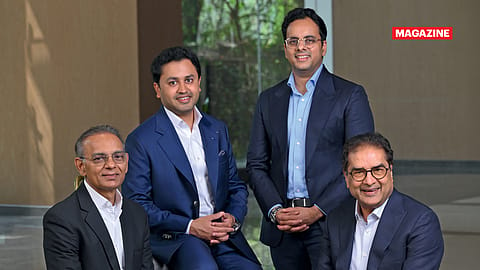
Motilal Oswal (left) and Raamdeo Agrawal (right) with sons Vaibhav Agrawal (second from left) and Pratik Oswal. | Credits: Padmini B
This story belongs to the Fortune India Magazine june-2026-indias-most-valuable-celebrities issue.
IN THE LATE ’80s, a young chartered accountant (CA) from Rajasthan would stand at the Four Bungalows bus stop in Andheri, a Mumbai suburb, every morning, waiting for a connecting bus to take him the last leg home to Lokhandwala. On most days, a Hero Honda motorcycle would pull up alongside, ridden by another young man who happened to be heading in the same direction. “I used to get down at Four Bungalows, and just by coincidence Raamdeo would be coming from there on his bike. He used to park it at Andheri station,” recalls Motilal Oswal, sitting at the company’s headquarters. “I started waiting for the bus, but really, I started waiting for the lift! Then one day we got talking, only to discover that not only we had a common profession, we also came from the same hostel... Something just clicked,” Oswal tells Fortune India.
That two-wheeler, that bus stop, and the coincidence of two CA students from the same Rajasthan hostel (run by RVG Educational Foundation) in Andheri, ending up in the same neighbourhood, is what is today Motilal Oswal Financial Services Ltd (MOFSL): an integrated financial powerhouse, valued at over ₹51,000 crore.
Four decades on, the 64-year-old Oswal from Rajasthan and 69-year-old Agrawal from Chhattisgarh are still together. Last year, they donated ₹100 crore to RVG to build a residential CA hostel within the Andheri campus that was once their home.
Motilal, the first graduate among four brothers, hailed from a family that was into grain-trading. Raamdeo’s father was a farmer. Neither family had any connection to the stock market, to Bombay, or to finance. The duo were, in the most literal sense, chasing a qualification because, as Agrawal says, “Marwari log ya toh CA karte hain, ya khud ka business. Baaki koi option nahi tha.” (Marwari people either pursue CA or their own business. There are no other options).
The first thing they did together was to become a sub-broker in 1987 for Sundar Iyer, on a 50:50 revenue share. Then their lucky break came, courtesy Harshad Mehta. The Big Bull’s run, before the scam unravelled in 1992, sent trading volumes surging, helping them make enough money over three years to buy their own BSE membership card for around ₹25 lakh. The card had to be in one name, and since Motilal was the one walking the trading floor and executing trades, the three years of experience on stock exchange records was in his name. Agrawal was the researcher, the one on the phone with clients. So, the card, and, eventually, the brand became Motilal Oswal.
To answer the question, “What’s in a name?” Quite a lot, it turns out.
The franchise, last fiscal, clocked over ₹9,400 crore in revenues, ₹1,869 crore in profits, and is sitting pretty with a net worth of ₹12,888 crore. Simply put, the firm today earns more in a single day than what the BSE card cost the founders in the ’90s.
More Stories from this Issue
One name, two partners — a common goal
In their own words, the nature of their roles was never engineered. It happened because that’s how their strengths landed. Agrawal could read a balance sheet, value a business. Oswal could run operations, manage clients, and control risks. Today, almost 40 years later, the split is essentially the same. Agrawal runs research and asset management, and Oswal runs operations, technology, human resources (HR), marketing, and the broking businesses.
When asked what kept them going all these years even as there was a buzz of a split, Agrawal says, “The good thing about our partnership is that unlike family businesses, at the end of the day, we go back to our respective homes and families.”
Oswal concurs. “We have had our share of disagreements, but that’s natural. Even today Raamdeo handles my personal portfolio.” And then Oswal, with a chuckle, drops a hot potato: “In fact, my personal portfolio has done badly versus his. Now, I’m using you to accuse him!”
{{#most-powerful-women-snapshot-individual.slug}} {{/most-powerful-women-snapshot-individual.slug}} {{^most-powerful-women-snapshot-individual.slug}} {{/most-powerful-women-snapshot-individual.slug}} {{#showRanking}} {{current-rank}} {{/showRanking}} {{#photo.0.url}}
{{name}}
Agrawal responds with a wry smile: “This is how he rubs it in. Now, I can either take his comment to heart, or take it as a joke.” After a pause, he continues: “It’s not to say we haven’t had our share of differences. But there have been no issues which have been irreconcilable.”
This candour, perhaps, is also what makes their partnership unusual. “The second source of conflict is usually when business unravels badly. But the franchise is generating enough money, and there is no need of any stress,” says Agrawal. The comment holds given that their combined 67.5% holding is worth ₹35,783 crore, placing them among India’s top 200 dollar billionaires.
And then there’s trust. “I can spend a hundred crore, he will not ask me. He will lose a hundred crore, I will not ask him,” says Oswal.
That latitude, however, was always anchored in a discipline that the firm’s longest-serving professionals say defined MOFSL from day one. Navin Agarwal, the group’s MD and one of the earliest professional hires, frames the original blueprint in one line: “To finish first, you have to first finish.” Even when the firm was a tiny brokerage, Navin says, “The vision to be India’s biggest and best was seeded. While we were small, there was no doubt that we would become big. And we were willing to make whatever investments in people, in processes, in research, and in the brand, just as a company far bigger than us would have done at that point in time.”
Interestingly, in 1994 MOFSL hired Madhusudan Kela — who later went on to become a well-known fund manager and today runs MK Ventures, a boutique investment management firm — to set up their institutional broking business, and Nirmal Kumar Jain, who headed research, and went on to found IIFL. “There must be something for a firm to identify these kinds of people, hire them, and let them lead the firm to grow it,” says Navin.
Rajat Rajgarhia, who today heads the institutional equities business after more than two decades inside the firm, says the combination of promoter ownership and professional management is one of the franchise’s most underappreciated edges. “A lot of players are either MNCs, bank-sponsored, or private equity-owned. We are unique with promoter ownership staying steady for the past two decades. All businesses are run by professional CEOs. There is consistency, stability within the organisation.”
A Watson moment, a PE dagger
The Motilal Oswal of today would not exist had it not been for two external interventions.
The first, by the name of Mathias, the former country head of Watson Wyatt Worldwide, walked into Motilal Oswal’s office in 1997. He wanted business; much to the surprise of Agrawal, given that the fledgeling firm was just a ₹3-crore outfit. But not one to let go of the opportunity, Agrawal gave him a mandate: “We want to become a corporation.”
The inspiration largely came from his experience of dealing with foreign institutional clients, especially Morgan Stanley. “I loved their systems and the way the organisation was run,” recalls Agrawal.
Mathias’ first contribution was almost mundane: creating an HR rule book. Raamdeo, his wife (then HR chief), and Mathias sat for five hours a day for 10 days, drafting it. The moment it rolled out, employee requests for a loan, a personal advance or anything financial became more structured. That was when the contours of a corporation started taking shape.
The next leap came in 2003, when they did something almost no Indian broking firm of their size had done: they offered stock options to everyone, right from front office employees to back-office staff. “But only two employees took it up,” says Agrawal. Most didn’t understand what they were being offered.
The second intervention came in 2006 when two private equity funds, Bessemer Venture Partners and New Vernon, the latter run by Arshad Zakaria, brother of journalist Fareed Zakaria, invested in the firm at a valuation of ₹1,200 crore for a 9.29% stake.
But the pre-IPO deal came with a clause: an 18% IRR (internal rate of return) commitment. “There was nothing wrong with the PE funds, they had a good pedigree. But 18% in a business as cyclical as ours was an open-ended liability. It was a dagger over our heads. We wanted them out fast,” recalls Agrawal.
MOFSL went public in 2007, an opportune window before the market lost half its value as the Lehman Brothers went bust. The objective was singular: to get the investors out. “They (the funds) were happy staying unlisted, but we just didn’t want to be in that space,” Agrawal says, almost matter-of-factly.
In hindsight, it was the most important strategic move the firm had made. It established a currency for talent. Stock options became real wealth the moment the company got listed. “We could now hire anyone by offering shares,” says Agrawal. It distributed wealth among employees in a way that compounded loyalty. “All of our guys who got their ESOPs five, six years back, everybody is in the money, and good money. Someone made ₹50 crore, someone made ₹100 crore. If you’ve been working at Citi or any other foreign bank for 20 years, you wouldn’t make that kind of wealth,” says Agrawal. For instance, among the prominent professionals, Navin and Rajat today own 5.1% and 1.1%, respectively.
“Your ethics, your risk management practices, and your aspiration, when these align with the right kind of people, it can create magic,” says Agrawal. It also allowed the promoters themselves to monetise their stakes in ways no privately held founder can: to give, to invest, to scale.
The Berkshire influence
If there is one mental model that explains how the firm has been built, it is one Agrawal borrows freely from a guru he has been reading and visiting for 30 years — the Sage of Omaha.
The company’s balance sheet today is a two-engine machine. About ₹3,000 crore sits in the operating businesses: broking, asset management, private equity, wealth management, investment banking, and now private credit. Another ₹9,000 crore sits in the treasury, invested largely in equities, including the firm’s own products. The operating businesses generate roughly 25-27% return on equity (RoE). The treasury compounds at 18-19%. The combination is, by design, a smaller, Indian, capital-markets version of Berkshire Hathaway.
The aspiration is open: 25% RoE, 25% growth, every year. Not 50% one year and zero the next, but blended, durable compounding. Look at the firm’s five-year, three-year, and one-year RoE numbers and they cluster around the 25-31% band.
But within that ceiling, the verticals have been added with deliberate logic. Broking was the base. Portfolio management service came in 2002. Private equity and investment banking layered on through the 2003–2008 boom. Mutual funds came after 2010. Custodian services, wealth management, and private credit play are the more recent additions. Each business shares a common thread: it sits squarely inside the capital markets ecosystem, where the founders understand risk intimately.
As a rule, MOFSL won’t take balance sheet risk. “Even in our housing finance company, we have not given any guarantees. This company doesn’t know what’s debt… we always had more money in our hands than what was needed in the businesses,” says Agrawal.
It is a philosophy. Limit the downside structurally, let the upside compound.
Navin frames that philosophy to three non-negotiables, separating financial firms that survive cycles from those that don’t. The first is a fortress balance sheet. “All the players who went down had high leverage and a weak balance sheet. Berkshire has $350 billion worth of cash on its balance sheet. We have ₹10,000 crore of liquid assets and investments at our current size,” says Navin. The second is governance, where he insists regulation isn’t a barrier but an edge: “If you’re more compliant than your competitor, regulation will hit them harder than you,” a claim he backs with MOFSL’s four-decade regulatory track record. The third, and most counter-intuitive, is risk management. “Why do financial services firms fail? Because they take their eyes off risk in a big upcycle. The best time for Motilal Oswal to gain market share is in a downturn. Upturns are when you give away some market share and that’s when practices get out of control. That mindset—to finish first, you have to first finish — requires you to dial down on risk in an upcycle, so that you are stronger to grab market share in a down cycle,” explains Navin.
If skin in the game and a fortress balance sheet are the invisible pillars, the most visible one is research. The fundamental research team today is 70-plus analysts, and the firm is now in what Rajgarhia calls “a massive investment phase,” aimed at raising team strength, doubling coverage, and rewiring research processes around new technology. “Research will remain an even stronger differentiator in times to come because the noise is increasing a lot with each passing day,” says Rajgarhia.
With the likes of Zerodha and Groww emerging as the first port of call for new entrants, MOFSL does not see them as threats. “They haven’t taken share from MOFSL. They’ve created a blue ocean of millions of first-time investors who weren’t in the market at all,” says Agrawal. When those clients scale from ₹1 crore to ₹50 or 60 crore, he expects them to migrate towards the likes of MOFSL. “They’re a breeding ground for my next clients. I have to remain differentiated.”
That differentiation, the belief across the board within MOFSL, is research. From 1997 onwards, the firm branded itself as a world-class research broker, before sharpening the pitch to: “Think Equity, Think Motilal Oswal.”
“The market is about what? Price and value. Price everybody knows; value nobody knows. Very few are focussed on research. Every day, practically three new companies are getting listed. Who will talk about them?” adds Agrawal.
The next-gen layer
If the founders were the men who built the franchise, Vaibhav Agrawal, 37, and Pratik Oswal, 38, are the next-gen being groomed to inherit it.
The two have known each other longer than they have known almost anyone else. “He was actually my first friend ever, because we are exactly one year apart,” Vaibhav says of Pratik. “When he was born, I was there,” Pratik says cheekily. They grew up in and out of the same office their fathers were building, exploiting the fact that the firm had the fastest Wi-Fi because of its online trading terminal. “The only place I’d get fast Wi-Fi was office. I’d come and download music,” says Pratik, though he later went on to intern on the trading floor at the age of 12.
But neither of them was pushed into the business.
Their fathers, in fact, were explicit about the opposite. “My father was very clear: you should explore, and you should do what you think you’ll be good at. Because if you join the business and don’t enjoy it, you won’t do well,” says Pratik, who spent over three years helping build a fintech startup in the U.S.
The senior Agrawal has been a Buffett devotee for 30 years. He has attended every Berkshire Hathaway annual meeting he could since 1994, and built much of his investing framework (quality, growth, longevity, and price) around Buffett’s philosophy. But Vaibhav, as a 20-year-old undergraduate at a U.S. university in 2007-08, was part of one of the few student-run mutual funds in America. The programme included a session inside Buffett’s office. He still remembers Buffett, then 78, walking up and down the room for two hours without stopping, recalling trades from 40 years ago like he had done them yesterday. “Obviously, his investing acumen is good, but what struck me was his powerful memory. To be so deeply embedded in what you do. That’s what stays with me,” recalls Vaibhav.
Both, however, chose to come back to their fathers’ venture — having seen the outside, they decided the inside was where the trade was.
“India is on a growth curve which is once in a century. We’re where the U.S. was in the late ’70s, late ’80s. Imagine if you had Goldman Sachs, Morgan Stanley, JP Morgan, Bear Stearns all in the late ’80s. That’s the trade India represents right now. And we’re in a leadership position in many of those businesses,” says Vaibhav.
The sons have since been inducted on to the MOFSL board last year as non-executive directors.
But the fathers are unsparing about the current stage. “Right now, we are not seeing their vision. We have just inducted them. They are still being groomed,” says Oswal. Neither of the sons has ever directly reported to their fathers either. Both have always reported to professional managers: partly to learn the business, partly to internalise. “There are no special privileges for being a promoter’s child,” says Oswal.
The sons, though, are smart enough to know what they have walked into.
“The coolest thing about this company is the opportunity we have to build a Blackstone, a BlackRock, a UBS, a Goldman Sachs, and a Berkshire Hathaway; all in one. We’ve done each of these businesses for over 20 years. The scale we can see in each business in the coming decades is insanely high,” says Pratik, who now heads the passive and quant funds business at Motilal Oswal Asset Management.
They are also more aggressive than their fathers about how the existing pieces fit together. “The five businesses together have a lot of symbiotic value. Broking and wealth management distribute asset management’s products. Asset management provides clients to the others. The power is in all of them being together with cash flows accumulating at the level of treasury, capital allocation moving between treasury and operating businesses,” mentions Vaibhav, who oversees assets of over ₹36,000 crore across the alternate investment and PMS platform of the AMC.
The most striking thing about the next generation, however, is not their ambition, but their conviction.
The treasury that Agrawal describes as 70% of the balance sheet is, in his son’s opinion, almost a statement of identity. “You won’t find a personal or corporate treasury in India like ours. Our money is in listed or unlisted equities. By standard metrics of risk, we’d be way off on the risky side. But we understand it because we’ve seen it now over so many years,” says Vaibhav. Pratik concurs: “Our personal wealth is 100% equities. Our company balance sheet is 90% equities. Our businesses themselves are centred around equities. That level of conviction, I feel nobody has. If we had a 10% allocation to fixed income, we’d probably have a sleepless night.”
Vaibhav puts it more clinically. “99.99% of people miss this about MOFSL. The treasury adds 6-7% more to compounding. Over long periods, even 1% extra creates very different outcomes.” Their internal compounding target: the one they’ve been handed and the one they’ve internalised is 25-30% a year for the next 30 years. “If you just do the math, where we are sitting today will be nothing compared to where we’ll be 30 years from now — almost 100 to 500x more,” mentions Vaibhav.
There is a generational shift visible even in the way they talk about decision-making. The founders, both sons acknowledge, are evolving in their willingness to allocate big capital upfront, to hire senior industry talent at premium prices, to wait three or four years for a bet to play out. “When you come from the backdrop they came from, that ability to take big decisions — it’s a mindset they’re evolving into now, which wasn’t the case even five years ago,” says Vaibhav. It is, in some ways, the next generation pushing the founders gently toward bets the founders themselves taught them to evaluate.
For instance, the private credit venture is built on a philosophy MOFSL has refined over years of starting businesses from zero: no acquisition cost, no platform bought, no book inherited. To kick it off, MOFSL has committed the first ₹1,000 crore upfront.
“That is the power. Once your own capital is anchored in the fund, the rest of the money follows,” says Agrawal. By his own admission, this is not because investors have done independent due-diligence, but because they are taking comfort from his own exposure. He describes what investors follow as a Marwari philosophy: “Tu pandrah taka dene wala hai na. Tera paisa dub raha hai na. Chal hamara bhi thoda dubega” (You’re giving ₹15, right? Your money is at risk, right? Fine, ours will also be at risk a bit).
The worst realistic outcome, in other words, is a lower yield, not a loss of principal. Given the scale of his risk capital, it is a downside Agrawal is willing to absorb.
He is candid about the limits of his own expertise. “I don’t know private credit. I can only judge the person [driving the business] and give the money to him.” In other words, he knows his role is to underwrite the operator (the person leading the business), not the loan book.
The strategic logic for MOFSL is bigger than the fund itself: the addressable private credit market is over ₹30 lakh crore, a business that could compound for years alongside the group’s existing businesses.
The bull case
There is no version of a conversation with Raamdeo Agrawal that does not, eventually, become a conversation about India. The Sensex was at 500 levels when they started out in 1987, it is now over 74,000. The market capitalisation of Indian equities has gone from a rounding error to ₹427 lakh crore. With a mcap-to-GDP ratio of 1.2x, for the first time, the financial markets have become large enough to pull the real economy, rather than the other way around. The wealth effect from listed equities concentrated heavily among urban Indians, but spreading through systematic investment plans and domestic institutional flows, is the single-biggest underappreciated force in the Indian economy, according to Agrawal.
The ambition at MOFSL is simple: 10x the balance sheet, 10x the profit, and markets willing, 10x the market cap. “Everybody knows. This number is non-negotiable,” says Agrawal.
If Raamdeo’s pitch is 10x, Navin’s is louder.
“Blackstone is $1.3 trillion of AUM. Why should we not become that? It’s all in the mind,” he says. He pegs the addressable tailwind even higher: “The total wealth of Indians is about less than $15 trillion, which will be $120 trillion by 2047. Financialisation of savings and creation of wealth are two mega trends that Motilal Oswal will play on,” says Navin.
Rajgarhia, too, concurs. “If the past 25 years was about growth, the next 25 years is size onto growth. From 2000 till here, growth has brought us to this level. But today, from where we stand, our growth will compound on a size. This is what we call as the golden era of India.”
The promoters extend no leeway, not even to their own. “I’ve told my son: nobody matters here, this number matters. I’ll do anything to achieve it. If you don’t like the job, do whatever you want — but this is non-negotiable. I have no obligation to come in for eight or nine hours every day. But I feel relieved the moment my car reaches office at 11 am. It’s important to be here. To watch, to give direction, to stay focussed,” says Agrawal.
Compounding, it turns out, doesn’t just work on capital, but on ambitions too.
Follow Fortune India
Sign in to read full story
To access our exclusive magazine content, sign in to your Fortune India account.
Sign In NowNEXT STORY