What India can learn from the Hormuz crisis
/ 4 min read
India may have weathered the Middle East war without major disruptions, but it has served as a powerful reminder that energy security cannot be taken for granted.
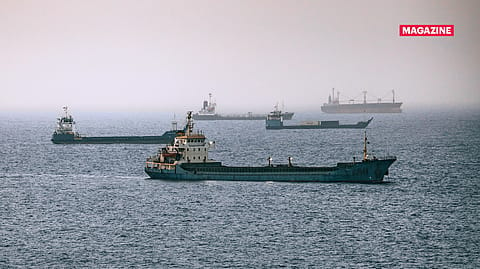
Crude oil tankers, bulk carriers, and vessels sit anchored around Qaboos Port on June 22 in Muscat, Oman. | Credits: Getty Images
This story belongs to the Fortune India Magazine july-2026-mpw-100-most-powerful-women issue.
AFTER NEARLY four months of uncertainty and disruption, the war clouds over the Middle East are finally beginning to lift. Peace discussions between the U.S. and Iran are progressing, and the Strait of Hormuz — through which nearly 20% of the world’s oil and liquefied natural gas trade passes — is gradually reopening.
The easing of tensions already has a visible impact on global energy markets. Brent crude prices have dropped to near $70 a barrel from around $97 over the past two weeks, while natural gas markets are expected to return to balance in the third quarter as shipping resumes through the strategic waterway. However, industry experts caution that a return to pre-war normalcy could still take several months.
The immediate challenge involves clearing naval mines, restoring insurer confidence, and repositioning tankers. Traffic is expected to recover initially to only 50-60% of pre-crisis levels as shipping companies and insurers seek evidence of sustained stability.
“Most operable Gulf production, including Saudi Arabia, Kuwait, and U.A.E. volumes routed through the Fujairah bypass, should resume export flows. Crude tightness is expected to ease, although product tightness may persist longer due to refinery damage,” says Maulik Patel, head of research at Equirus Securities.
Shipping companies are likely to take at least two months to restore full operations in the Persian Gulf, while damaged refining infrastructure will require additional time. “Normalisation is, therefore, a third-quarter FY27 story at the earliest, and a higher structural oil price floor is a challenge India will have to live with for the remainder of 2026,” Patel adds.
Navigating the crisis
For India, the crisis posed a significant challenge. The country imports nearly 85% of its crude oil and about 50% of its natural gas requirements. A prolonged closure of the Strait of Hormuz could have triggered fuel shortages, higher inflation, rising fertiliser costs, and a widening current account deficit.
More Stories from this Issue
Before the crisis erupted on February 28, India’s dependence on the Middle East remained substantial. The region supplied nearly half of the country’s crude oil imports and up to 90% of its LPG requirements, primarily from the U.A.E., Saudi Arabia, and Oman.
Yet, India’s energy sector demonstrated remarkable resilience. Although public sector oil marketing companies (OMCs) initially suffered losses estimated at nearly ₹1,000 crore a day due to higher crude prices, freight surcharges, transit delays, and elevated war-risk insurance premiums, the country avoided major disruptions in fuel availability.
A key factor was the rapid diversification of supply sources. Over the past three months, India expanded crude sourcing to nearly 40 countries, including the U.S., Venezuela, Angola, Nigeria, Egypt, and Libya. More than 70% of India’s crude imports were rerouted outside the Strait of Hormuz.
Russian oil emerged as a critical buffer. Imports touched an all-time high of 2.66 million barrels per day (bpd) in the first half of June, accounting for more than half of India’s total crude imports. Volumes had already averaged 1.91 million bpd in May.
{{#most-powerful-women-snapshot-individual.slug}} {{/most-powerful-women-snapshot-individual.slug}} {{^most-powerful-women-snapshot-individual.slug}} {{/most-powerful-women-snapshot-individual.slug}} {{#showRanking}} {{current-rank}} {{/showRanking}} {{#photo.0.url}}
{{name}}
India also moved swiftly to rebalance its LNG sourcing. U.S. LNG exports to India surged more than sixfold, from 137,000 tonnes in January this year to 907,000 tonnes in May. Nigeria doubled its shipments, while Oman maintained supplies of around 500,000 tonnes per month.
The government complemented these efforts with a multi-pronged strategy focussed on supply-chain diversification, strategic reserves, excise duty cut, and domestic preparedness. Strategic petroleum reserves were expanded, refineries were directed to maintain high operating rates and adequate crude inventories, and sufficient petrol and diesel stocks were maintained. Domestic LPG production from refineries was also stepped up to support consumer demand.
The initial strain on OMCs, fertiliser manufacturers, chemical producers, and city gas distribution networks gradually eased as alternative supplies began flowing in greater volumes. The fuel price hike slightly reduced the strain on OMCs.
Neutral diplomacy played an equally important role. New Delhi engaged intensively with key West Asian partners and the U.S. and Russia to secure shipping access and facilitate trade flows. According to Ministry of External Affairs spokesperson Randhir Jaiswal, 11 India-bound vessels had safely crossed the Strait of Hormuz after the U.S. and Iran signed a memorandum of understanding on June 17, while another 10 vessels were awaiting transit.
Takeaways for India
The Hormuz crisis has reinforced a fundamental reality: energy security ultimately depends on reliable access to resources.
Experts argue that India’s long-term strategy must place greater emphasis on upstream investments and diversification. National oil companies will need to expand their international portfolios and secure equity oil and gas assets across multiple geographies to reduce concentration risks and ensure access to supplies during future disruptions.
“In parallel, the continued push to maximise domestic upstream potential through improved recovery from mature fields and selective development of deep-water and frontier resources requires equal attention,” says Nick Sharma, executive director, upstream energy at S&P Global.
Recent policy reforms aimed at improving licensing flexibility and fiscal incentives are steps in the right direction. However, translating policy intent into meaningful production gains will take time. In an increasingly volatile geopolitical environment, access to stable resources, faster project execution, and diversified supply chains are becoming as important as cost efficiency, he says.
For India, the Hormuz crisis may have passed without major disruptions, but it has served as a powerful reminder that energy security cannot be taken for granted. Strengthening domestic production, expanding overseas resource ownership, and maintaining a diversified import basket will remain essential as the country navigates an increasingly uncertain global energy landscape.
Follow Fortune India
NEXT STORY