AI summit optimism fails to shield NIFTY IT; ₹11,000 crore FII pullout drags index down 15% in Feb
/ 4 min read
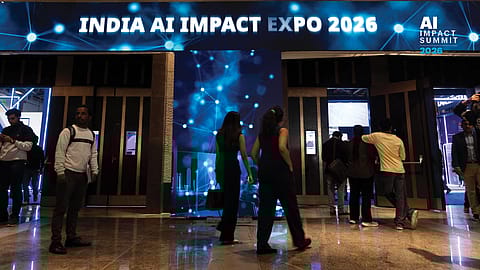
FPIs were net sellers of Indian IT stocks worth ₹10,956 crore between February 1 and 15 | Credits: Sanjay Rawat
AI summit optimism fails to shield NIFTY IT; ₹11,000 crore FII pullout drags index down 15% in Feb
Despite the AI Impact Summit 2026 showcasing significant investment commitments, the Nifty IT index fell over 15% in February due to a ₹11,000 crore pullout by foreign institutional investors. Concerns over AI's potential to disrupt traditional IT services have led to a broad-based sell-off, affecting major companies like Infosys and TCS.
This summary is AI-generated, and Fortune India is not responsible for its content or any associated copyright issues.
Shares of Infosys, TCS, HCLTech, Wipro, and Tech Mahindra have declined between 13% and 17% this month, wiping out a combined market capitalisation of around ₹4.85 lakh crore.
THIS STORY FEATURES
FPIs were net sellers of Indian IT stocks worth ₹10,956 crore between February 1 and 15 | Credits: Sanjay Rawat
Foreign institutional investors (FIIs) have pulled out nearly ₹11,000 crore from Indian information technology (IT) stocks in the first half of February, pushing their holdings in the sector to a four-year low. The Nifty IT index has fallen over 15% during the same period, led by index heavyweights Infosys, Tata Consultancy Services (TCS), HCL Technologies, Wipro, and Tech Mahindra.
According to data from National Securities Depository Limited, foreign portfolio investors (FPIs) were net sellers of Indian IT stocks worth ₹10,956 crore between February 1 and 15, after pulling out ₹1,835 crore in January 2026. As a result, the total value of FII holdings in IT shares declined sharply by nearly 16% to ₹4.49 lakh crore as of February 15, down from ₹5.34 lakh crore at the end of January.
The sharp correction comes despite the strong investment commitments showcased at the recently concluded AI Impact Summit 2026, highlighting the growing divergence between long-term AI optimism and near-term market caution.
The sell-off has been broad-based, with the top five IT heavyweights declining between 13% and 17% this month, wiping out a combined market capitalisation of around ₹4.85 lakh crore. On the year-to-date basis, the Nifty IT index is down more than 21%, reflecting sustained pressure on the sector.
Market participants attribute the latest wave of selling to concerns over the rapid rollout of advanced generative AI tools, including those developed by Anthropic, which are increasingly capable of automating traditional IT services such as application development, testing and maintenance. Investors fear that this technological shift could compress billable hours, accelerate pricing pressure and structurally disrupt the manpower-driven outsourcing model that has underpinned Indian IT growth for decades.


AI investment wave fails to cheer market
The market correction in IT stocks came even as India hosted the AI Impact Summit 2026 from February 16–20, an event that showcased massive long-term commitments toward artificial intelligence. More than $200 billion (around ₹17 lakh crore) in AI-related investments are expected to flow into India over the next two years. Union Minister Ashwini Vaishnaw said that between $70 billion and $90 billion has already been pledged or announced specifically for AI infrastructure as of February 2026.
The scale of corporate commitments announced at the summit was significant. Reliance Industries and Jio said they would invest ₹10 lakh crore (about $120 billion) over the next seven years to strengthen India’s AI and deep-tech capabilities. The Adani Group unveiled plans for a $100 billion sovereign AI infrastructure platform powered by green energy.
Global technology giants also outlined major investments. Google committed $15 billion to build foundational AI infrastructure in India. Amazon reaffirmed its ₹2.9 lakh crore investment plan to expand cloud and AI-led digitisation by 2030. Microsoft pledged ₹1.5 lakh crore for data centres and AI training initiatives, while Qualcomm launched a $150 million venture fund to back Indian AI startups.
On the government front, the IndiaAI Mission reiterated its ₹10,372 crore outlay, currently onboarding more than 58,000 GPUs to expand affordable compute access. The 2026–27 Union Budget also outlined a ₹1 lakh crore deep-tech RDI fund, with ₹20,000 crore allocated this fiscal year for AI applications across healthcare, agriculture and education.
Long-term fundamentals intact?
Drumil Vithlani, Technical Analyst at Bonanza, said the NIFTY IT continues to remain under pressure after correcting more than 20% year-to-date, with February alone witnessing sharp double-digit losses amid heavy FII outflows exceeding ₹11,000 crore.
“Technically, the index has decisively broken its rising trendline and is trading below key moving averages, indicating a clear shift to a bearish structure. The RSI is hovering near oversold territory, suggesting the possibility of a short-term pullback, but the broader momentum remains weak. Until the index reclaims its 50-DMA zone, rallies are likely to face selling pressure,” he said.
{{#most-powerful-women-snapshot-individual.slug}} {{/most-powerful-women-snapshot-individual.slug}} {{^most-powerful-women-snapshot-individual.slug}} {{/most-powerful-women-snapshot-individual.slug}} {{#showRanking}} {{current-rank}} {{/showRanking}} {{#photo.0.url}}
{{name}}
Vithlani added that the near-term bias remains negative, while any meaningful medium-term recovery will depend on stability in global cues and a reversal in FII flows.
VK Vijayakumar, Chief Investment Strategist at Geojit Investments Limited, struck a relatively constructive note. He said that once the uncertainty surrounding the IT sector settles, FIIs are likely to return as buyers. According to him, if the ongoing unwinding of the AI trade in the US extends further, it could prompt global investors to reallocate funds toward India, which he described as a relatively non-AI-driven market at this stage.
Meanwhile, Tata Mutual Fund has advised investors to adopt a balanced and patient approach amid the ongoing volatility, as artificial intelligence reshapes the industry’s business models.
The fund house noted that the recent sell-off in IT services appears to reflect markets pricing in the decline of legacy revenue streams even before the benefits of AI-led transformation begin to materialise. While disruption risks are real, it believes the impact on large IT companies is likely to unfold gradually, giving them time to build new revenue streams from AI adoption — similar to the digital transformation cycle.
“Transitions are rarely smooth,” the fund house observed, adding that while the AI shift may be painful in the near term, strong free cash flows and healthy dividend yields among frontline IT firms should provide downside support to stock prices.
Over the past six months, earnings revisions for the Nifty IT index have remained flat to slightly positive, even as the broader market faced downward estimate revisions. This suggests that IT earnings may have already bottomed out, potentially positioning the sector more resiliently relative to other segments.
On valuations, the index is trading slightly above its long-term averages but remains within a reasonable band. With earnings expectations stabilising and valuations no longer stretched, the scope for sharp valuation-led downside appears limited, Tata Mutual Fund said. It added that moderate growth visibility and stabilising fundamentals offer some cushion for investors navigating current uncertainty.
(DISCLAIMER: The views and opinions expressed by investment experts on fortuneindia.com are either their own or of their organisations, but not necessarily that of fortuneindia.com and its editorial team. Readers are advised to consult certified experts before taking investment decisions.)
Follow Fortune India
NEXT STORY