Rly stocks on a roll with gains up to 12% powered by fare hikes, mega budget expectations
/ 2 min read
The sector's biggest gainers included Rail Vikas Nigam Ltd (RVNL), Indian Railway Finance Corporation (IRFC), Indian Railway Catering and Tourism Corporation (IRCTC), and RailTel.
THIS STORY FEATURES
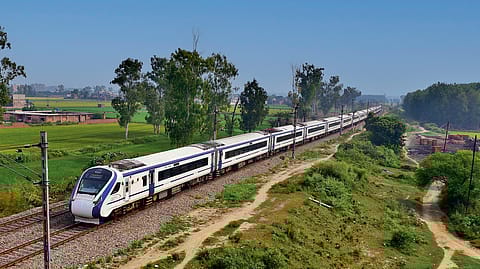
Credits: Getty Images
Railway-related stocks rallied today, gaining up to 12% as reduced passenger rail tariffs went into effect today.
The sector's biggest gainers included Rail Vikas Nigam Ltd (RVNL), Indian Railway Finance Corporation (IRFC), Indian Railway Catering and Tourism Corporation (IRCTC), and RailTel.
RVNL led the surge, rising as far as 12.58% to Rs 389.20, IRFC increased 9.27% to Rs 132.75, while IRCTC rose 4.59% to Rs 710.85. Jupiter Waggons went up 2.85% to Rs 350.30. The stocks have maintained their uptick trend after the Railway Ministry announced price hikes in tickets.
The rally comes on the back of the recent rationalisation of the fare structure, where the expected revenue gain from this change is ₹600 crore, while the union budget is also around the corner, igniting buying interest amongst investors.

Fare hike details:
For journeys beyond 215 km, there will be a fare hike of 1 paise per km in Ordinary Class, and 2 paise per km for Mail/Express Non-AC and AC classes. The expected revenue gain from this change is ₹600 crore, and passengers on a 500 km Non-AC journey will pay an additional ₹10. There is no fare increase for journeys under 215 km in Ordinary Class.
There is no increase in fare for the Suburban and Monthly season ticket.
For a 500 km journey in non-AC coaches, passengers will have to pay only 10 rupees extra.
Railways have expanded their network and operations significantly over the last decade. To cater to a higher level of operations and to improve safety, it is increasing its manpower.
Consequently, manpower cost has increased to ₹1,15,000 crore. Pension cost has increased to Rs 60,000 crore. Total cost of operations has increased to ₹2,63,000 crore in 2024-25.
To meet this higher cost of manpower, railways are focusing on higher cargo loading and a small amount of passenger fare rationalisation.
Due to these efforts on safety and improved operations, railways have been able to substantially improve safety. India has become the second-largest cargo-carrying railway in the world. The recent successful mobilisation of more than 12,000 trains during the festival season is also an example of improved operational efficiency.
Follow Fortune India
NEXT STORY