TCG Asset Management wants to play the patient game in investing
/ 4 min read
The Purnendu Chatterjee-owned entity’s investment approach entails the rigor of private equity with the liquidity of listed equity
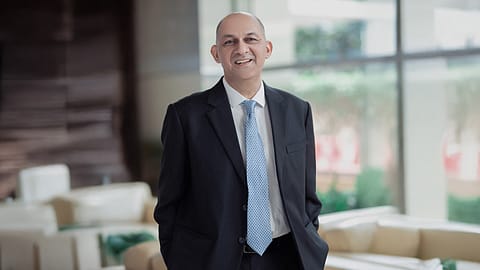
Most investors who have followed the Kolkata-born, Berkeley-trained Dr. Purnendu Chatterjee know him through Haldia Petrochemicals, the company that first put his name on India's industrial map more than three decades ago. Few, however, are aware that Haldia is just one piece of a sprawling, roughly $10-billion private conglomerate that spans petrochemicals (Haldia, MCPI), specialty manufacturing (Garden Silk), process technology (Lummus Technology), life sciences and IT services, real estate, and a not-for-profit deep-science research institute, TCG CREST (The Chatterjee Group Centres for Research and Education in Science and Technology), wherein the 76-year-old billionaire is putting much of focus and money.
Asset management is the newest, and most public-facing addition to that stable. TCG Asset Management has existed in some form for years, largely managing offshore capital. But in October 2024, under CEO Shahzad Madon, the firm relaunched itself as a full-fledged domestic asset manager, offering alternative investment fund and portfolio management service products, with plans to expand into additional asset classes over time.
With ₹400 crore of AUM split 60:40 between AIF and PMS, it remains small by industry standards. It's the philosophy the team has chosen to build around, and the deliberate way they've gone about scaling it.
The investment philosophy
Madon and his team includes Vivek Ganguly, formerly of Nine Rivers Capital, with a strong small-cap stock-picking track record, and Gopal Khaitan, a 24-year veteran at Reliance Nippon AMC. “We have a private equity-like investment approach. The rigour of private equity with the liquidity of listed equity," Madon tells Fortune India.
In practice, that means, the emphasis is on concentration over diversification. The flagship, Transformative Growth strategy, typically holds just 15–20 stocks, weighted toward small and mid-caps (weighted average market cap of roughly ₹11,289 crore), and deliberately avoids over-diversifying.
Beyond standard fundamental research, the team commissions forensic due diligence from external specialists who mine companies' digital footprints, brings in outside experts for niche sectors it doesn't have in-house expertise in, and runs environmental risk assessments.
The fund tries to identify “ahead-of-the-curve” theses and enter before the market re-rates a stock, then hold through the wait. "We are ready to invest early and wait patiently," says Madon. Since inception, the flagship strategy has sold only one stock.
The portfolio's targeted debt-to-equity ratio is roughly 0.2x, reflecting a preference for companies funding growth through their own accruals rather than leverage.
Stocks are chosen not just for organic earnings growth but for a "kicker", that is a corporate action, regulatory shift, or business turnaround that can produce growth above and beyond the base case. “We are focused on nonlinear growth. Companies which we believe will be able to get growth, which is... not just linear, but which could be non-linear, a kicker along the way, when things turn."
For instance, the fund bought ZF Commercial Vehicle (formerly WABCO) as a bet on regulatory tailwinds with ADAS-style safety mandates extending from passenger to commercial vehicles, the fund expects per-vehicle content to nearly double from roughly ₹40,000–45,000 to ₹80,000 over three to four years, layered on top of ordinary volume growth. DB Corp (Dainik Bhaskar) is a contrarian call on legacy print media, premised on the idea that the market is pricing in zero growth while ignoring three under-appreciated tailwinds: monetization of its digital app, global legislative moves forcing search engines and AI platforms to compensate content creators, and the cash-generative, winner-take-all economics of dominant regional print businesses. Orkla India (MTR, Eastern spices) reflects the team's taste for high-quality, cash-generative consumer franchises that have derated post-listing.
Slow and steady
Since its October 2024 launch, a difficult phase for Indian equities, the flagship strategy is up a mere 0.7%, against a -2.5% in the 250 Small Cap TRI and zero return on the BSE 500 TRI. Madon mentions that starting a track record in a falling market, while uncomfortable in the short run, is preferable to launching into a bull market and setting expectations that can't be sustained. “Investing should always be started in a bear market, never in a bull market. Had we started in September 2023 instead of '24, we couldn't have had too many happy investors,” says Madon.
{{#most-powerful-women-snapshot-individual.slug}} {{/most-powerful-women-snapshot-individual.slug}} {{^most-powerful-women-snapshot-individual.slug}} {{/most-powerful-women-snapshot-individual.slug}} {{#showRanking}} {{current-rank}} {{/showRanking}} {{#photo.0.url}}
{{name}}
Beyond the flagship strategy, TCG AMC sees the next leg of opportunity as a second PMS offering, the India Investment Opportunities Portfolio launched in November 2024 with the firm's own capital before external money. "We believe there is a very strong, very strong and high growth structural capex opportunity and the themes which we are betting on are: energy transition, digital infra, manufacturing, defence, and mobility,” says Madon.
The portfolio is built around five structural themes that together account for roughly 40% of the broader market: The largest holdings: Reliance, Welspun Corp, L&T, GE Vernova, and Hitachi Energy, reflect that conviction.
And on how he wants the fund distinguished from peers who he suggests are marketing convenience rather than substance: "This is not one of those portfolios wherein you, for example, position it as infra fund and hold bank stocks too. Whatever we are doing is true to label,” explains Madon.
Since its inception in November 2024, the portfolio has delivered a CAGR of 14.1% against a negative 0.4% on the BSE India Infrastructure TRI and 4.3% on the BSE 500 TRI.
The future roadmap
Beyond the two flagship portfolios, the firm intends to add further asset classes over time. The client-facing team of roughly 16 people currently operates out of Mumbai, Kolkata, NCR, Bangalore and Chennai, with Ahmedabad next on the list.
On profitability, Madon says Chatterjee has been unambiguous: “He never talks about profit because whatever profit we make now will be small compared to the larger scheme of things. It's primarily: do a good job, keep your customers happy, business will happen."
In a crowded PMS and AIF market, TCG AMC is positioning itself as a long-duration business built for a long-duration investment style. “It's a long journey, not something you can do quickly. This is a game of test cricket, you have to stay on the wicket, the results will come,” says Madon.
NEXT STORY