As lab-grown diamonds redraw category boundaries, India’s jewellery market reaches a turning point
/ 3 min read
The next phase of India’s jewellery industry will be defined by clarity of roles, not competition for dominance
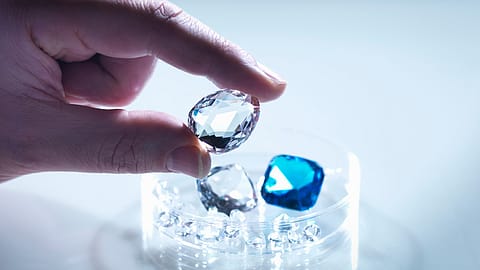
LGDs are expanding the jewellery market by activating segments that gold and natural diamonds have never fully reached | Credits: Getty Images
India’s jewellery industry, long shaped by cultural convention and family-led purchasing, is entering a period of structural change. Gold has historically served as the country’s store of value and emotional bedrock, while natural diamonds have symbolised aspiration, romance, and ceremonial prestige. Now, lab-grown diamonds (LGDs)—priced at less than half the cost of natural diamonds—are emerging as a third force redefining how value, desirability, and accessibility play out in the country’s most traditional retail category.
Unlike many disruptions, this shift is not about replacement. LGDs are expanding the jewellery market by activating segments that gold and natural diamonds have never fully reached. The real story is not rivalry between categories but portfolio expansion, sharper price ladders, and distinct consumer motivations.
Gold: The immovable anchor
Gold’s dominance is unlikely to shift. It functions simultaneously as an adornment, an investment, a wedding gift, and a ritual object. Purchases remain tied to predictable life moments—weddings, festivals, and births—and these behavioural anchors ensure its resilience.
LGDs do not compete with this logic. They carry no investment value or ceremonial role. For leading chains such as Kalyan Jewellers, Malabar Gold & Diamonds, and Joyalukkas, LGDs sit adjacent to their core consumer proposition, not in opposition to it.
Territorial natural diamonds
Natural diamonds continue to occupy a space defined by emotional permanence, controlled supply, and global branding. Their perceived rarity—reinforced through decades of marketing and certification—makes them the default choice for engagement rings, milestone gifts, and heirloom pieces.
Brands such as Tanishq, CaratLane, and several boutique jewellers operate inside this trust-led frame. Their consumers value consistency, craftsmanship, and legacy. These are not the buyers migrating to LGDs. A natural-diamond purchase is high-involvement and family-driven; an LGD purchase is more self-led and spontaneous. The categories do not cannibalise each other because they serve fundamentally different occasions.
LGDs unlock new demand
The rise of LGDs marks the most significant opportunity for market expansion in a decade. Technologically produced through CVD and HPHT processes, LGDs match natural diamonds in chemistry and optical performance, but at accessible price points. Being less than half the cost of natural diamonds is not a marginal difference; it is an entry unlocker.
India’s diamond penetration has historically remained low at 4-7% of households. LGDs could push this into the 10-15% range, driven by younger professionals, self-purchasing women, fashion-led buyers, and aspirational consumers in Tier II and III cities. These consumers are best described not as “value seekers”, but as access-seekers looking for visible carat, contemporary design, and dignity of affordability.
{{#most-powerful-women-snapshot-individual.slug}} {{/most-powerful-women-snapshot-individual.slug}} {{^most-powerful-women-snapshot-individual.slug}} {{/most-powerful-women-snapshot-individual.slug}} {{#showRanking}} {{current-rank}} {{/showRanking}} {{#photo.0.url}}
{{name}}
Retailers are already responding. Trent launched POME, an LGD-led line distributed through Westside stores. Senco Gold & Diamonds is experimenting with LGD-driven offerings. Digital-first labels such as Limelight and Jewelbox have accelerated awareness through aggressive online outreach.
LGDs are not diverting spend from natural diamonds; they are creating an entirely new diamond customer.
Retailers are choosing strategy, not sides
The industry’s divergence between early adopters and conservative incumbents is strategic rather than ideological. For some jewellers, LGDs present a high-velocity, design-first category that complements gold and natural diamond offerings. For others, especially brands built on ceremonial value, LGDs could blur positioning or dilute symbolic equity.
Both choices are rational. What would be risky is confusing consumers by mixing milestone jewellery with everyday luxury—two categories with distinct emotional and financial roles. Clear segmentation is key.
India’s unique position
While global markets like the U.S. have seen LGD prices correct sharply as supply scales, India’s ecosystem offers stability: gold’s cultural dominance, natural diamonds’ premium anchoring, and LGDs’ distinct lifestyle role.
More importantly, India holds structural advantages. The country already polishes most of the world’s diamonds, LGD manufacturing capabilities are scaling rapidly, and government endorsement—from diplomatic gifting to policy encouragement—has accelerated legitimacy.
India is one of the few markets capable of participating across the entire diamond continuum: mined, grown, and branded.
A market expanding, not fragmenting
The next phase of India’s jewellery industry will be defined by clarity of roles, not competition for dominance. Gold will continue to anchor wealth and ritual value. Natural diamonds will retain premium ceremonial relevance. Lab-grown diamonds will drive incremental growth through accessible, design-led consumption.
For retailers, the opportunity is not choosing one category over another—it is building coherent portfolios that match the evolving economic confidence and aesthetic preferences of India’s consumers.
LGDs are not rewriting India’s jewellery narrative. They are widening its reach.
(Hundekari and Singh are Partners at Kearney. Views are personal.)
Follow Fortune India
NEXT STORY