Beyond generation: Why the transmission grid is the real backbone of Viksit Bharat
/ 4 min read
India’s rising power demand, rapid renewable energy expansion and emerging sectors such as data centres are making a future-ready transmission grid critical to integrating clean energy, strengthening reliability and achieving the Viksit Bharat@2047 vision.
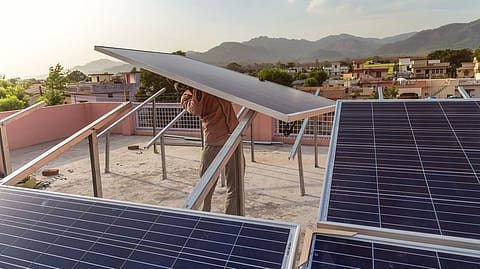
Representational Image
As India undergoes rapid urbanisation and industrialisation, alongside accelerating digital growth, electricity demand is soaring. Whether it is manufacturing, infrastructure development, electric vehicles, data centres, or sunrise industries, the demand for power across all these segments is leading to greater focus on the reliability of the power ecosystem.
Powering Economic Growth
However, the simplistic solution of generating more electricity is only one part of the issue. Equally critical is moving that power efficiently to consumption centres across the country. Against this backdrop, the significance of transmission infrastructure becomes clear, as it will be a pivotal pillar in driving the nation’s next phase of economic growth. A future-ready transmission grid can serve as an invisible growth engine, propelling the Viksit Bharat@2047 vision.
The Bharat Electricity Summit 2026, held in March, highlighted the government’s commitment to developing a roadmap for a strong, future-ready power industry to realise its Viksit Bharat vision. The summit noted that India’s installed capacity had surpassed 520 GW, one of the fastest global expansions, while its transmission network had expanded to more than 500,000 circuit kilometres. Renewable energy (RE) capacity had also grown substantially, with solar capacity rising from 2.8 GW in 2014 to more than 143 GW. By 2030, electricity demand is poised to increase by more than 30%, fuelled by electric mobility, AI-driven data centres, and other emerging sectors.
The Key Role of Renewable Energy
Given these developments, the nation must add more than 137,000 circuit kilometres of transmission lines by 2030, requiring investments of approximately ₹900,000 crore. Consequently, energy storage needs are projected to rise significantly, with pumped storage potential exceeding 200 GW. Herein, BESS (Battery Energy Storage Systems) is gaining favour as a core solution for managing peak demand.
Meanwhile, the ongoing energy transition is redefining the power grid as RE capacity transforms how electricity is generated and distributed. As RE resources are usually built far from major consumption zones, it is driving the need for robust transmission networks. This calls for a strong grid capable of integrating renewable generation while remaining stable and reliable. Accordingly, future transmission plans must anticipate both growing demand and shifting generation patterns.
To integrate around 500 GW of non-fossil capacity, the country has already spent roughly ₹200,000 crore on transmission infrastructure. This includes green energy corridors linking solar- and wind-rich states such as Gujarat and Rajasthan to pan-India demand centres.
Pressure to increase power capacity is mounting from data centres and electrification projects. With around 1.25 GW of data centre capacity, the country is developing an additional 800 MW. As a result, demand is expected to grow at a CAGR of 21% up to 2030. Since the nation needs to add approximately 450 GW of RE capacity within a decade, timely project implementation will be imperative. In future, new capacity additions will be dominated by solar and wind energy, with batteries and pumped hydro as storage options.
Improving Transmission and Distribution Networks
As these changes take place, the legacy power grid is being transformed into an intelligent, digitally enabled network. Automation, digital substations, advanced protection systems, real-time monitoring and data analytics can improve visibility, transparency and operational efficiency. Similarly, predictive maintenance can identify potential faults before disruptions occur. Therefore, the future grid must be connected, data-driven and responsive, rather than merely capacity-driven.
The energy industry propels pan-India economic growth and is critical to achieving energy security and sustainability objectives. As RE capacity rises, the transmission network is undergoing a major technological transformation, with the use of GIS (Gas-Insulated Switchgear), HVDC (High-Voltage Direct Current), and STATCOMs (Static Synchronous Compensators), synchronous condensers, and advanced substation systems, which are used to control, transmit, and stabilise high-voltage power networks.
As the transmission ecosystem evolves, EPC companies are also expanding their capabilities to build and strengthen high-voltage infrastructure. This is particularly important as India moves towards larger renewable energy projects and increasingly interconnected power networks. The ability to execute such high-voltage infrastructure at scale will be critical to ensuring that renewable power can be evacuated efficiently, transmitted reliably and integrated seamlessly into the national grid.
While generation and transmission are pivotal pillars of the power ecosystem, distribution companies (DISCOMs) serve as the interface between power utilities and consumers. Home connections, billing, service complaints and power supply disruptions are all linked to the distribution system. If DISCOMs operate efficiently, service quality improves. Conversely, if DISCOMs are under financial stress, the impact is felt across the ecosystem.
{{#most-powerful-women-snapshot-individual.slug}} {{/most-powerful-women-snapshot-individual.slug}} {{^most-powerful-women-snapshot-individual.slug}} {{/most-powerful-women-snapshot-individual.slug}} {{#showRanking}} {{current-rank}} {{/showRanking}} {{#photo.0.url}}
{{name}}
Smart Meters Can Realise the Viksit Bharat@2047 Vision
Keeping this in mind, the Centre launched the Revamped Distribution Sector Scheme (RDSS) in 2021, with a total allocation of around ₹303,000 crore. The scheme aims to support States and Union Territories in improving the financial sustainability and operational efficiency of DISCOMs, thereby ensuring a reliable, high-quality power supply. A core component of RDSS is the rollout of smart meters for consumers, feeders and distribution entities. Through mobile applications, smart meters provide consumers with near-real-time visibility of electricity usage, enabling them to monitor consumption patterns, recharge easily, access usage data to optimise consumption and receive low-balance alerts. Across India, 56.2 million smart meters have been installed under RDSS and other schemes.
Modernising the transmission network will bridge the gap between rising power generation and India’s expanding energy needs. Investments to expand power capacity and enhance smart infrastructure will soon help India realise its energy potential and boost economic growth. Ultimately, a future-ready transmission grid will help build a stronger, more competitive and developed India, realising the vision of Viksit Bharat@2047.
(The author is Executive Director and CEO, Hartek Power. Views are personal.)
NEXT STORY