Budget 2026: Holding the growth line in uncertain times
/ 4 min read
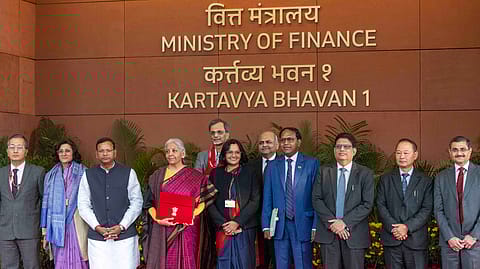
Finance Minister Nirmala Sitharaman has proposed a nearly 9% increase in capex for the next fiscal year, raising the allocation to ₹12.22 lakh crore to keep infrastructure projects on track and support overall economic growth. | Credits: Narendra Bisht
Budget 2026: Holding the growth line in uncertain times
The 2026 Union Budget, presented by Finance Minister Nirmala Sitharaman, aims to bolster India's growth amid global uncertainties. It emphasises increased capital expenditure, infrastructure development, and support for MSMEs. The budget also focuses on fiscal discipline, aiming to reduce the fiscal deficit and debt, while fostering economic resilience and inclusivity.
This summary is AI-generated, and Fortune India is not responsible for its content or any associated copyright issues.
The Union Budget presented at a time when the global economy is facing considerable uncertainty due to geopolitical tensions, slow global growth, volatile financial market, and persistent inflation pressure.
Finance Minister Nirmala Sitharaman has proposed a nearly 9% increase in capex for the next fiscal year, raising the allocation to ₹12.22 lakh crore to keep infrastructure projects on track and support overall economic growth. | Credits: Narendra Bisht
Union Finance Minister Nirmala Sitharaman presented her ninth consecutive Union Budget 2026 in Parliament on February 1. The Budget presented at a time when the global economy is facing considerable uncertainty due to geopolitical tensions, slow global growth, volatile financial market, and persistent inflation pressure.
The main focus of the Budget is to accelerate growth by sustainably increasing capital expenditure, preserving fiscal discipline, generating employment, and strengthening India’s position in an increasingly fragmented global economy – a task that has become increasingly complex in a fragile global economy.
3 key duties for the government
This Budget provides a framework for development through three key duties (Kartavyas) for the government. The first duty is to accelerate and sustain economic growth by increasing productivity and competitiveness and building resilience to volatile global conditions. The second duty is to fulfil the aspirations of the people and build their capacity so that they can become strong partners in the country's path to prosperity. And the third duty, which is linked to the government's vision of 'Sabka Saath, Sabka Vikas', is to ensure that every family, community, region and class has access to resources, facilities and opportunities for meaningful participation.
At the heart of Budget 2026 lies the government’s continued belief in public investment-led growth. In the last few years, capital expenditure has emerged as an important element of economic activity, helping to offset weak global demand and stimulate private investment. By maintaining the strong momentum, the government demonstrates strong confidence in countries long-term growth prospects despite global headwinds.
Capex as a key driver of economic activity
The Budget reaffirms the government’s commitment to capital expenditure as a key driver of economic activity, job creation and crowding in private investment. If we look at the pace of capital expenditure, it has increased significantly, from around ₹2 lakh crore in 2014-15 to ₹11.21 lakh crore in 2025-26, and now, it will further increase to ₹12.22 lakh crore in 2026-27 to push infrastructure growth.
The Finance Minister has proposed a nearly 9% increase in capital expenditure for the next fiscal year, raising the allocation to ₹12.22 lakh crore to keep infrastructure projects on track and support overall economic growth. It is noteworthy that the Budget estimate of capital expenditure for the current financial year is ₹11.21 lakh crore, which has been revised to ₹10.96 lakh crore.
However, if we talk about numbers, capital expenditure has increased continuously, but in relative terms, it has decreased compared to the Budget Estimate of the current financial year, whereas it has increased compared to the revised estimate. The capital expenditure to GDP ratio is estimated to be 3.12% of GDP i.e. ₹393 lakh crore in FY26-27. On the other hand, in the current financial year it is expected to be 3.14% as per the Budget Estimate and 3.07% as per the revised estimate of GDP (₹357.14 trillion).
Infrastructure spending has once again taken centre stage. The Budget places special emphasis on sustaining investment-led growth through continued support for infrastructure development. The Budget's focus on expanding infrastructure in transport, logistics, and urban development is an important step to maintain the momentum of growth.
The government is focusing on building roads, transport, and other projects in smaller (tier II and III) cities. Apart from this, seven high-speed rail corridors have been proposed in the budget for faster development between cities. The government has proposed to set up an infrastructure Risk Guarantee Fund to provide prudently determined partial credit guarantees to lenders and strengthen the confidence of private developers.
Central role in job creation
Budget 2026 has a renewed focus on micro, small, and medium enterprises (MSMEs), reflecting their central role in job creation, exports and regional development. In a volatile global environment, smaller firms are often the most vulnerable to credit constraints and fluctuations in demand. Considering them a key engine of growth, a dedicated ₹10,000 crore SME Growth Fund is proposed to nurture future champions and provide incentives to enterprises based on select criteria.
While the growth story is prominent, fiscal mathematics remains a cornerstone of Budget 2026. The government has reiterated its commitment to a gradual path of fiscal consolidation, indicating that macroeconomic stability will not be compromised to support growth. In this backdrop, the government plans to modestly improve its fiscal position, including reducing the fiscal deficit and debt, while also boosting growth and supporting manufacturing in sectors ranging from textiles to chips.
{{#most-powerful-women-snapshot-individual.slug}} {{/most-powerful-women-snapshot-individual.slug}} {{^most-powerful-women-snapshot-individual.slug}} {{/most-powerful-women-snapshot-individual.slug}} {{#showRanking}} {{current-rank}} {{/showRanking}} {{#photo.0.url}}
{{name}}
The fiscal deficit is expected to decline to 4.3% of GDP in 2026-27, from 4.4% in 2025-26. With the new fiscal health benchmarks introduced in the last Budget, the debt-to-GDP ratio is expected to decline to 55.6% in the coming fiscal year, from 56.1% in 2025-26. The Budget reflects the potential for significant fiscal consolidation. A gradual reduction in fiscal deficit is an important assurance for investors and rating agencies, especially at a time of rising global interest rates and tightening financial conditions.
Ultimately, the effectiveness of Budget 2026 will depend less on key announcements and more on implementation. The timely completion of infrastructure projects, efficient support to small and medium enterprises, and the pace of continued reforms will determine whether the promised growth benefits are achieved. Because in a world full of uncertainties, policy stability itself becomes a valuable asset.
In conclusion, this Budget is a balanced, growth-oriented and fiscally disciplined budget designed to address geopolitical tensions, including the Russia-Ukraine war, rising US tariffs, growing US-China technological competition, and shifts in regional power. Whether this balancing act succeeds or not will determine India's economic direction in the years to come.
(Srivastava is a Professor of Finance and Area Head at Institute of Technology and Science, Ghaziabad. Views are personal)
Follow Fortune India
NEXT STORY