Incentivising the next wave of mobile manufacturing in India
/ 4 min read
By creating distinct incentives for manufacturing, localisation, and innovation, the mobile phone manufacturing scheme encourages businesses to invest across the entire mobile phone value chain
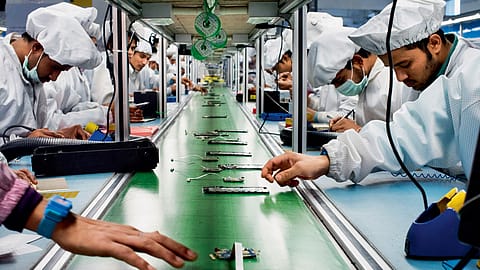
The Government of India has introduced the Mobile Phone Manufacturing Scheme (MPMS) as a significant policy initiative aimed at strengthening the country’s mobile phone manufacturing ecosystem. With a budgetary outlay of ₹62,500 crore and a five-year implementation period from FY27 to FY31, the scheme seeks to build on the success of the earlier Production Linked Incentive (PLI) programme while placing greater emphasis on domestic value addition, component manufacturing, innovation, and technology development.
Unlike conventional manufacturing incentive programmes that primarily reward production volumes, MPMS adopts a more comprehensive approach by encouraging production, localisation, and research & development. At the heart of the scheme is a multi-layered incentive framework designed to promote large-scale manufacturing while simultaneously driving the development of a robust domestic supply chain and fostering innovation within India.
1. Production-linked incentive
Under MPMS, manufacturers of mobile phones in India will be eligible for incentive support on eligible sales at rates ranging from 2.25% to 5%. The incentive structure has been designed to encourage manufacturers to expand production capacities, improve operational scale, and enhance India’s competitiveness in the global mobile phone market. By linking incentives directly to sales, the scheme is expected to support higher levels of production and exports while attracting further investment into the sector.
2. Incentive for domestic sourcing
Recognising the need to reduce dependence on imported components, the scheme provides an additional incentive of up to 1.5% for domestic sourcing of key components and sub-assemblies. This incentive is expected to encourage investments in the manufacture of components such as printed circuit boards (PCBs), camera modules, battery packs, display assemblies, connectors, and other critical inputs required for mobile phone production.
By rewarding localisation efforts, MPMS aims to deepen domestic value addition, strengthen supply-chain resilience, and create a more integrated electronics manufacturing ecosystem within the country. The incentive also has the potential to encourage global manufacturers to develop local vendor networks and increase procurement from domestic suppliers
3. Design and R&D incentive for Indian brands
A distinguishing feature of MPMS is the introduction of an additional 3% incentive for Indian brands engaged in product design and research & development activities. This incentive reflects the Government’s intention to promote innovation-led manufacturing and support the creation of indigenous technologies and intellectual property.
The incentive is expected to encourage Indian companies to invest in areas such as:
· Product design and engineering
· Software development
· Research and innovation
· Patent creation
{{#most-powerful-women-snapshot-individual.slug}} {{/most-powerful-women-snapshot-individual.slug}} {{^most-powerful-women-snapshot-individual.slug}} {{/most-powerful-women-snapshot-individual.slug}} {{#showRanking}} {{current-rank}} {{/showRanking}} {{#photo.0.url}}
{{name}}
· Technology development
· Product customisation for domestic and global markets
By incentivising these activities, the scheme seeks to support the emergence of globally competitive Indian brands and strengthen India’s position as an innovation hub within the electronics sector.
Strategic significance of the incentives
The incentive architecture under MPMS reflects a clear shift from assembly-led growth to value-addition-led growth. While India has achieved considerable success in attracting mobile phone manufacturing investments, a significant share of high-value components continues to be sourced from overseas markets. MPMS seeks to bridge this gap by directly linking additional incentives to localisation and innovation efforts.
The scheme simultaneously supports three key objectives:
1. Expanding manufacturing capacity through production-linked incentives.
2. Developing domestic supply chains through localisation incentives.
3. Encouraging innovation and intellectual property creation through design and R&D incentives.
This integrated approach is expected to contribute towards the development of a more resilient, self-reliant, and globally competitive electronics manufacturing ecosystem.
Expected impact on industry
The Government expects the scheme to facilitate mobile phone production worth approximately ₹39 lakh crore during its tenure, accompanied by a substantial increase in exports. The programme is also projected to generate around 60,000 direct jobs, further strengthening India's position within global electronics value chains.
For mobile phone manufacturers and Electronics Manufacturing Services (EMS) players, MPMS offers an opportunity to enhance project viability through incentive support while accelerating localisation initiatives. Component manufacturers are also expected to benefit from increased demand as manufacturers seek to maximise benefits available under the domestic sourcing incentive
Further, the dedicated R&D incentive could encourage Indian companies to move beyond contract manufacturing and focus on developing proprietary products, technologies, and intellectual property. This could result in higher domestic value capture and support India's long-term aspirations of technological self-reliance.
The Mobile Phone Manufacturing Scheme represents a forward-looking incentive framework that goes beyond traditional production-linked support. By creating distinct incentives for manufacturing, localisation, and innovation, the scheme encourages businesses to invest across the entire mobile phone value chain rather than limiting their focus to assembly operations alone.
The layered incentive structure enhances the commercial attractiveness of investments in India while simultaneously promoting domestic sourcing, technology development, and value addition. In doing so, MPMS creates a strong foundation for the development of a more integrated and competitive mobile manufacturing ecosystem.
As companies increasingly seek resilient and diversified manufacturing bases, MPMS has the potential to emerge as a key catalyst for fresh investments in mobile phones, components, and technology
development. By aligning financial incentives with the objectives of localisation, innovation, and scale, the scheme can play a pivotal role in shaping the next phase of growth for India’s mobile manufacturing sector and strengthening its position as a global electronics manufacturing destination.
(The author is Partner, CAPEX Growth & Incentives SL, Grant Thornton Bharat LLP. Views are personal.)
Follow Fortune India
NEXT STORY