India’s MSMEs don’t lack demand, they lack dependable logistics
/ 4 min read
The country's next export chapter will be decided not just by what gets manufactured, but by whether it gets delivered.
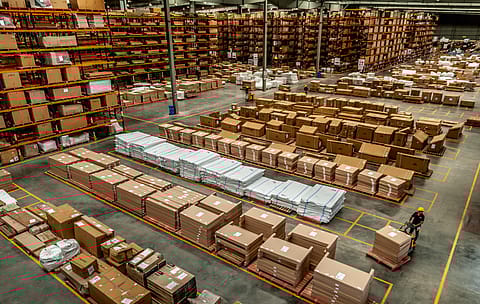
Representative image
India’s exports story is increasingly becoming an MSME story. Small manufacturers are finding new opportunities across global markets as exports continue to grow. The next phase of this journey will depend not only on producing competitively, but on delivering consistently.
MSME exports have more than tripled in four years, from ₹3.95 lakh crore in FY21 to ₹12.39 lakh crore in FY25. The sector accounts for nearly half of India’s merchandise exports and contributes close to a third of the GDP. The country’s manufacturing and export ambitions are gaining speed, with MSMEs at the centre of it.
But behind these numbers lies a challenge that aggregate export data tends to obscure.
The new reality for India’s MSMEs
The business environment MSMEs operate in today looks very different from five years ago. Digital marketplaces, cross-border e-commerce, and global supply chain shifts have opened new corridors for small manufacturers to reach customers they couldn’t before.
But buyer expectations have risen alongside that opportunity. A small supplier is now held to the same delivery standards as a large enterprise. MSMEs are expected to show up globally while working with lean teams, limited capital, and often no dedicated logistics function.
The cost gap large companies don’t feel
India’s logistics cost stands at 7.97% of GDP for 2023-24, revised down from 8.84%. The government’s push on multimodal infrastructure, digitalisation, and the National Logistics Policy are aimed at pulling that figure down further. What the national average doesn’t show is how differently those costs land depending on business size. The NCAER-DPIIT study found firms with turnover up to ₹5 crore spend 16.9% of output on logistics. Firms with turnover above ₹250 crore spend 7.6%. That is not statistical noise. It is the reason a small manufacturer and a large exporter in the same sector are not truly competing on the same terms.
Approximately 65% of India’s freight moves by road. Large businesses have the scale to buffer fuel volatility, corridor congestion, and carrier inconsistency. Small manufacturers take the hit directly. The gap is not only in the roads businesses use, but also in the systems available to manage disruption, volatility and uncertainty.
How buyer behaviour has changed
Procurement decisions today go beyond product quality and price. International buyers can track exactly how a supplier performs over time, and delivery reliability has become part of the commercial evaluation itself.
A precision engineering firm in Rajkot supplying components to a European manufacturer is a useful illustration. The product quality may win the first order. A single delayed shipment can stall a production line abroad, trigger financial penalties, and quietly end the relationship. In integrated global supply chains, delivery reliability matters as much as manufacturing quality.
What dependable logistics actually unlocks
Industry research indicates that 73% of MSMEs using technology-enabled logistics platforms reported lower transportation costs, while nearly 95% saw measurable improvements in on-time deliveries.
For smaller businesses, those numbers represent something concrete. When fulfilment becomes predictable, businesses can make commitments they can keep. This is often what turns a trial order into a repeat buyer. With the MSME sector growing at an estimated 12-15% annually, consistent delivery becomes the harder capability to replicate.
{{#most-powerful-women-snapshot-individual.slug}} {{/most-powerful-women-snapshot-individual.slug}} {{^most-powerful-women-snapshot-individual.slug}} {{/most-powerful-women-snapshot-individual.slug}} {{#showRanking}} {{current-rank}} {{/showRanking}} {{#photo.0.url}}
{{name}}
Express logistics helps close that gap. It gives smaller businesses access to capabilities that previously required the kind of supply chain infrastructure only large enterprises could build.
A trillion-dollar export target requires stronger logistics foundations
India has set a $1 trillion merchandise export target for 2030. MSMEs, which already account for nearly half of the country’s merchandise exports, will be central to whether that number is reached.
Expanding manufacturing capacity and improving product quality are necessary. But they do not, on their own, get goods to customers reliably. What opens an export door is product quality. What keeps it open is whether the business on the other side can count on you.
Strengthening India’s export ecosystem
India’s logistics transformation has gathered real momentum in recent years. The National Logistics Policy, PM GatiShakti and the ULIP platform are making connectivity, digital integration and supply chain efficiency more accessible, bringing down the friction businesses face when moving goods across the country.
The next phase of this journey is about making sure MSMEs can actually use these reforms to hold their own in international markets. Express logistics sits at the heart of that, giving exporters faster market access, more dependable delivery and greater confidence in their supply chains.
For MSMEs serving time-sensitive and high-value sectors, the difference express logistics makes is straightforward. Orders reach global customers faster, with better visibility and fewer surprises, and that is precisely what keeps international buyers coming back.
India’s ongoing investments in multimodal connectivity, digital integration and simplified freight processes are steadily strengthening the logistics ecosystem. As these initiatives continue to evolve, they will further enhance ease of doing business for MSMEs, improve export competitiveness and help Indian businesses access global markets with greater confidence.
At its core, this is not just about faster shipments. It is about giving Indian businesses a real shot at new markets, stronger buyer relationships and a bigger role in India’s export growth.
Building the next phase of MSME growth
India’s MSMEs have proven they can compete and find new markets. The demand is real. The manufacturing base is in place. What logistics determines now is how many of them can sustain that growth at scale.
India’s next export chapter will be decided not just by what gets manufactured, but by whether it gets delivered.
(The author is managing director, Blue Dart. Views are personal.)
Follow Fortune India
NEXT STORY