India’s next economic frontier: The rise of designers and creators beyond metros
/ 3 min read
India’s creative shift is no longer metro-centric.
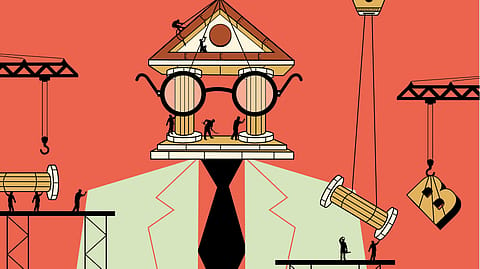
As India’s innovation economy expands beyond its traditional metro centres, architects, engineers, designers, animators, and creators are emerging as an increasingly important force in shaping the country’s economic future. | Credits: Illustration by Anirban Ghosh
India has spent the last decade building one of the world’s most powerful digital foundations. But the next phase of India’s growth will not be defined only by how many consumers it can connect; it will be defined by how effectively it can empower the people creating the products, infrastructure, experiences, and industries of tomorrow. As India’s innovation economy expands beyond its traditional metro centres, architects, engineers, designers, animators, and creators are emerging as an increasingly important force in shaping the country’s economic future.
India has already shown what happens when access is built at scale. Digital payments transformed how millions transact, internet access expanded at unprecedented speed, and digital platforms reshaped how people consume and participate in the economy. That phase is largely complete. The next question for India is harder—now that India has connected its people, can it empower them to build?
The answer will depend less on consumers and more on creators—architects, engineers, designers, animators, and manufacturing entrepreneurs who are increasingly shaping India’s economic future from places that barely registered on the innovation map a decade ago.
The Rise of India’s Distributed Creator Segment
If India’s next phase of growth will be shaped by creators and builders, then we also need to broaden how we define the creator economy itself. Much of the conversation today centres around content—influencers, YouTubers, podcasters, and short-form media. While that ecosystem is significant and growing, it represents only one part of a much larger story.
India’s deeper creator class includes the architect designing future cities, the engineer building next-generation products, the animator creating for global audiences, the designer shaping user experiences. These are people whose work determines not just what we watch, but how we build, move, live, and work. And increasingly, they are not in Mumbai or Bengaluru. They are in Coimbatore, Rajkot, Bhubaneswar, and Jaipur and they are choosing to grow where they live.
More than half of India's DPIIT-recognised startups now come from Tier II and Tier III cities. That single statistic signals something larger: the geography of Indian ambition is shifting, and the ecosystem around it needs to shift just as fast.
Access Is India’s Next Infrastructure Layer
For decades, professional ecosystems naturally concentrated around a few large cities. Talent moved to where the tools, networks, customers, and opportunities existed. But technology is changing that equation. Today, an architect in Coimbatore can work on projects across markets, an animator in Nagpur can create for global platforms, and a product designer in Jaipur can collaborate with teams across continents.
Geography no longer limits capability. But it can still limit access.
The professionals driving India’s next growth phase need more than connectivity. They need professional platforms, learning ecosystems, industry networks, and market opportunities that are genuinely available outside the metros equivalently.
Because access does more than improve productivity; it shapes possibility.
Building for a New Generation of Creators
Today’s creators and builders are working differently from the generations before them. Talent is increasingly distributed; collaboration is no longer confined by geography, and professional journeys are becoming more fluid. An architect may run projects across multiple cities; an animator may work with global clients, and a designer may move across industries and teams over the course of a career. Increasingly, work is being defined by capability, not location.
{{#most-powerful-women-snapshot-individual.slug}} {{/most-powerful-women-snapshot-individual.slug}} {{^most-powerful-women-snapshot-individual.slug}} {{/most-powerful-women-snapshot-individual.slug}} {{#showRanking}} {{current-rank}} {{/showRanking}} {{#photo.0.url}}
{{name}}
This shift matters because ecosystems influence behaviour. The easier it becomes for professionals to access what they need on terms that reflect how they work, the easier it becomes for participation and innovation to scale.
Their expectations have shifted accordingly. They want tools and ecosystems that are digital-first, intuitive, and flexible enough to meet them at different stages of growth, not systems designed around a single, assumed career path. The professionals who will shape India’s next decade are not waiting for permission or proximity. They are already working. The question is whether the platforms and ecosystems around them are keeping pace.
India has always celebrated the scale of its connections. A billion people online. A billion transactions processed. But connectivity was never the destination—it was the precondition. The real measure of what comes next is simpler and harder: how many of those connected people get to build something that matters?
That question has a specific answer. It depends on whether the tools, platforms, and ecosystems available to a designer in Coimbatore or an animator in Nagpur are genuinely equivalent to those available to someone sitting in a Bengaluru or Mumbai office. Access at scale is not enough if the quality of that access is uneven.
India’s next revolution will not be measured by reach. It will be measured by leverage.
Empowerment is not a soft idea. It is an infrastructure problem. And India has solved infrastructure problems before.
(The author is vice president, Autodesk India and SAARC. Views are personal.)
Follow Fortune India
NEXT STORY