The FAQs are AI-generated, and Fortune India is not responsible for its content or any associated copyright issues.
Let the fossil fuel rest in peace
/ 3 min read
The energy transition is no longer a choice. It is the only logical conclusion to a century of dependence on a dying resource.
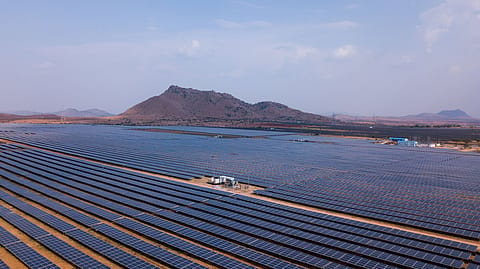
Solar module manufacturing capacity has grown more than 90 times since 2014, from 2.3 GW to approximately 210 GW by December 2025. | Credits: Fortune India
Every great power transition begins with an energy shock. The warnings have become headlines. The global energy crisis that erupted in the wake of Russia's invasion of Ukraine and continued to deepen with geopolitical developments across the U.S. and the Middle East has sent shockwaves through every economy. Fuel prices spiked. Supply chains buckled. And India, for all its ambition and scale, has not been immune.
The numbers tell a stark story. India imports approximately 85% of its crude oil, over 45% of its natural gas, and over 60% of its LPG, the vast majority from one volatile region. Early this year, as Middle East tensions deepened, LNG and LPG shortages rippled across the Indian industry in real time. Energy shortages alone already cost India approximately 1.9% of GDP annually. India recorded its largest energy deficit in 14 years in June 2024, and power demand is growing at 6% annually, projected to double by 2045. The dream of an Atmanirbhar Bharat remains distant as long as we are structurally dependent on fuels we neither control nor price.
At an industrial level, coal still dominates, accounting for roughly 75% of India's electricity generation. At the consumer level, the hesitation to shift to clean alternatives remains real. Yet Energy sovereignty is now increasingly becoming economic sovereignty. The nations that control clean energy generation will dictate the terms of the 21st-century economy. India has a narrow window to choose which side of that equation it stands on.
The future demands scale, and fossil fuels cannot deliver it
The next technological epoch runs on electricity. AI is a civilisational shift with an extraordinary energy appetite. It is projected that global electricity demand from data centres will reach 1,200 TWh by 2035, rising to 3,700 TWh by 2050. Fossil fuels cannot service this demand at the required scale, speed, or cost. It requires abundant, uninterrupted, clean electricity, and solar is the most scalable answer on the planet.
India is building fast on it. The total installed renewable capacity crossed 266 GW by February 2026. Solar module manufacturing capacity has grown more than 90 times since 2014, from 2.3 GW to approximately 210 GW by December 2025. The infrastructure of the new energy economy is rising.
Building the new energy economy
Prime Minister Modi's vision is unambiguous, and India has already surpassed the 50% non-fossil installed capacity milestone, five years ahead of schedule. We now rank third globally in solar power production, ahead of Japan. The International Solar Alliance, co-founded by India, is mobilising $1 trillion in investments across 100+ nations. We are currently leading the world's energy transition.
At Vikram Solar, we founded this company in 2005 with the conviction that solar would one day power the world. Twenty years on, that conviction is backed by concrete action. In November 2025, we commissioned our 5 GW Vallam facility in Tamil Nadu, one of India's most advanced automated solar manufacturing plants, built on next-generation robotics and TOPCon technology. Our total manufacturing capacity now stands at 9.5 GW, scaling to 15.5 GW soon, with products shipped across 39 countries so far.
Every gigawatt of domestic solar manufacturing we add is a gigawatt of energy security earned. India's total solar potential is estimated at 748 GW. We are using a fraction of it. With green hydrogen targeting 5 million tonnes annually by 2030, the horizon of what India can achieve is genuinely limitless.
Clean energy wins. The question is who leads.
The fossil fuel era did what it was designed to do. It powered the industrial revolution, built cities, and connected continents. But the externalities: climate volatility, geopolitical fragility, price shocks, and resource wars, have become intolerable. The ledger no longer balances.
Climate events are demanding resilience at the national scale. Geopolitical tensions are demanding sovereignty at a strategic scale. None of these forces can be answered by burning more coal or importing more oil.
India's energy story in this decade will define the kind of nation we become in the next century. The companies investing in solar, storage, green hydrogen, and smart grids today are laying the foundation of India’s future economy.
{{#most-powerful-women-snapshot-individual.slug}} {{/most-powerful-women-snapshot-individual.slug}} {{^most-powerful-women-snapshot-individual.slug}} {{/most-powerful-women-snapshot-individual.slug}} {{#showRanking}} {{current-rank}} {{/showRanking}} {{#photo.0.url}}
{{name}}
Let the fossil fuel rest in peace. Its time is done. Ours is just beginning.
(The author is Chairman and Managing Director, Vikram Solar. Views are personal.)
Follow Fortune India
Frequently Asked Questions
NEXT STORY