The risk India faces in the nuclear power sector
/ 5 min read
The goal should be to enable Indian companies to compete with global players, ensuring cost competitiveness while reducing the risk of external dependence being used to influence our energy security.
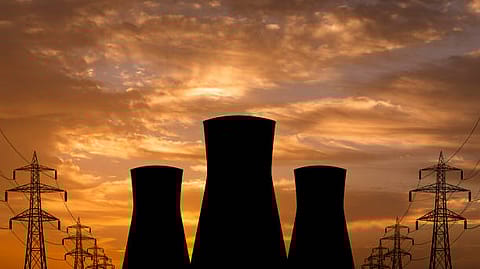
To accelerate capacity addition, The government announced a Nuclear Energy Mission in the Union Budget 2025–26, allocating ₹20,000 crore to develop at least five indigenously designed and operational small modular reactors by 2033. | Credits: Getty Images
The future will not run on oil. It will run on electricity. Artificial intelligence, automobiles, industrial production, and even everyday consumption are all becoming increasingly electricity-dependent. In the post-AI world, electricity is the backbone of economic power. The countries that can generate it reliably and, more importantly, control the systems that produce it will truly be energy sovereign. China understands this clearly. The question is whether we do.
According to the ‘Global Energy Review 2026’, global electricity demand is expected to grow by around 3%. In China, demand is rising at roughly 5%, a moderation from the 7% growth recorded in 2024. As India industrialises and electrifies, its electricity demand is likely to follow a similar trajectory. Both countries are investing heavily in renewable energy to meet a large share of this growth. Solar and wind are expanding rapidly and will continue to do so, but they come with a structural limitation: intermittency. Solar does not generate at night, and wind is not always reliable. Storage technologies are improving, but not yet at the scale required to stabilise a modern, electricity-intensive economy. This is why China is complementing its renewable push with a massive expansion of nuclear power. Unlike renewables, nuclear provides clean, stable baseload electricity.
China’s scale is its strategy
China has moved with extraordinary speed and clarity. Today, it has over 60 nuclear reactors in operation and 36 more under construction, accounting for more than half of all reactors being built globally (see graphic). Its ambition is to rapidly scale capacity, reaching around 100 GW by the early 2030s and nearly 200 GW by 2040. But the real story lies not just in scale, but in execution.
At the centre of this push is control. China has decisively moved away from reliance on foreign reactor designs, such as the American AP1000, and has developed its own third-generation reactor, the Hualong One. Today, close to 90% of its components are manufactured domestically. This reflects a deliberate effort to build a complete ecosystem, from design to manufacturing to deployment. The model is familiar. China creates a large domestic market, guarantees demand, and enables firms to invest. As production scales, costs fall, capabilities deepen, and firms become globally competitive. This is the same playbook that underpinned China’s dominance in solar panels, batteries and electric vehicles. Nuclear power is now following that trajectory.
The hidden risk: dependence over decades
A nuclear power plant is not a one-time purchase; it is a 60-year commitment. Over its lifetime, it depends on a continuous supply of specialised components, replacement parts, software updates, and maintenance services. If these are controlled externally, so is the system.
This creates a structural vulnerability. In an increasingly fragmented global order, control is no longer exercised only through trade barriers or tariffs; it is embedded deep within supply chains. Access to critical components can be restricted at short notice, as seen in semiconductors, where export controls have limited China’s access to advanced chips and chip-making equipment. Maintenance dependencies can also be leveraged. In aviation, aircraft engines supplied by foreign firms require on-time delivery, continuous servicing, software updates, and spare parts from the original manufacturer, giving suppliers long-term leverage, as seen in India’s HAL Tejas programme, where engines are sourced from GE.
Nuclear power is no exception. A reactor depends on critical components such as reactor vessels, pressuriser, and specialised pumps that must be maintained and replaced over decades. If these are sourced externally or even through foreign controlled local companies, the operating country remains tied to foreign suppliers for the plant’s entire lifecycle. Recent US restrictions and the suspension of licences in June 2025 on the export of certain nuclear components to China illustrate how even this sector is not insulated from geopolitical pressures. In the Russia-Ukraine war, it has been seen how established western companies were ordered to stop operations in Russia and pull out. In such scenarios, dependence becomes a structural strategic risk.
Energy security, therefore, is no longer just about producing electricity. It is about controlling the systems that produce it.
India’s ambition and its gap
India, too, recognises the importance of nuclear power and has set ambitious targets to scale capacity to 100 GW by 2047. But ambition alone is not strategy. The gap with China lies in approach. China is building reactors and domestic capability simultaneously. India risks doing only the former.
This raises an uncomfortable but necessary question: has India built nuclear capability, or merely nuclear capacity?
India’s development of indigenous reactor designs, such as the Pressurised Heavy Water Reactor, is a genuine achievement. But control extends beyond design. It includes ownership of critical components, depth in domestic manufacturing, and control over lifecycle services. In many high-value segments, Indian firms possess the capability to participate. What they lack is scale, certainty, and sustained demand. Our procurement systems often favour established global suppliers with proven track records, while domestic firms are expected to build capabilities without demand assurance. The result is a persistent gap between potential and execution.
{{#most-powerful-women-snapshot-individual.slug}} {{/most-powerful-women-snapshot-individual.slug}} {{^most-powerful-women-snapshot-individual.slug}} {{/most-powerful-women-snapshot-individual.slug}} {{#showRanking}} {{current-rank}} {{/showRanking}} {{#photo.0.url}}
{{name}}
What India must do differently
The lesson from China is to recognise the importance of industrial strategy. We must move from fragmented project execution to coordinated scale. A fleet-based approach that builds multiple reactors simultaneously can create predictable demand and incentivize domestic investment.
Localisation efforts must be strategic, focussing on components critical to long-term control rather than attempting blanket indigenisation. Most importantly, policy must move beyond manufacturing to address ownership and control of key technologies and systems.
In the case of the 500 MWe Prototype Fast Breeder Reactor (PFBR), which recently achieved criticality, our nuclear establishment built a fully Indian-owned and controlled manufacturing ecosystem because it had no choice. This demonstrates that when strategic necessity demands it, India has the capability to develop complete domestic ecosystems. Indian-owned and controlled manufacturing companies have proven their ability to design and deliver complex systems for an experimental large-scale reactor. This ecosystem is well-positioned to deliver fleet orders or even develop new designs that the country can fully own and manufacture.
The goal should be to enable Indian companies to compete with global players, ensuring cost competitiveness while reducing the risk of external dependence being used to influence our energy security. Building local capability in nuclear manufacturing will also open up global markets for Indian firms. Over time, this could lead to the emergence of an Indian consortium capable of competing with western consortiums for projects worldwide.
(The author is Economist and Lead Consultant at Pahle India Foundation. Views are personal.)
Follow Fortune India
NEXT STORY