Wind energy & India: Emerging pillars of tomorrow’s green, industrial world
/ 4 min read
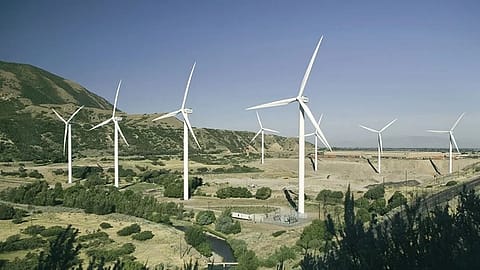
India’s offshore wind programme is now gaining strategic focus, especially with an estimated 70 GW of technical potential off Gujarat and Tamil Nadu
Wind energy & India: Emerging pillars of tomorrow’s green, industrial world
The global wind energy sector is rapidly expanding, with India emerging as a key player. As of 2023, global wind power capacity surpassed 1,000 GW, driven by China, Europe, and the U.S. India aims for 140 GW by 2030, leveraging its manufacturing strength and hybrid policy framework. Offshore wind and talent development are crucial for future growth.
This summary is AI-generated, and Fortune India is not responsible for its content or any associated copyright issues.
The pathway ahead demands continued policy stability, supply-chain depth, grid readiness, and innovation
India’s offshore wind programme is now gaining strategic focus, especially with an estimated 70 GW of technical potential off Gujarat and Tamil Nadu
The global wind-energy industry has entered a new era of accelerated scaling, technological expansion, and supply-chain regionalisation. As of 2023, the world’s installed wind-power capacity crossed 1,000 GW (1 TW), with annual additions, led by China, Europe, and the U.S., hitting a record of around 117 GW in 2023. According to the International Energy Agency (IEA), global wind-power generation reached over 2,300 TWh in 2023, growing approximately 10% year-on-year, making wind the fastest-expanding renewable electricity source after solar. China alone contributed more than 60% of global installations in 2023, highlighting both its manufacturing dominance and aggressive decarbonisation strategy. Europe continues to push offshore deployment and grid integration through the EU Green Deal and REPowerEU, while the U.S. remains an innovation hub, driven by the Inflation Reduction Act’s long-term tax credits and domestic-sourcing incentives.
Technology trends are dramatically reshaping global competitiveness. Sustainability has become the main criterion for technological innovation. This has led to the introduction of wooden wind blades as long as 80 metres and wooden towers. The gearless drive technology is still nearly a monopoly for the EU technology innovators. The average capacity of newly installed onshore turbines now exceeds 4-5 MW, and modern offshore turbines often exceed 12-18 MW, with prototypes reaching the 20-24 MW class. Floating offshore wind is emerging rapidly, supporting deep-sea installations in countries like Japan, Norway, and the U.K.
Digitalisation—predictive maintenance, turbine “health” analytics, AI-enabled yield optimisation, and robotics for blade inspection—is becoming standard. Hybrid energy parks integrating wind, solar, and battery storage, and green hydrogen production are gaining momentum, especially in Europe, the Middle East, and Australia. Supply-chain resilience has also become strategic; nations are localising turbine manufacturing, nacelle assembly, and blade production to avoid pandemic-like disruptions and geopolitical dependency. With the global wind workforce expected to exceed 600,000 skilled professionals by 2028, talent development and specialised training programmes have become central priorities.
Indian wind energy: Capacity growth, repowering & hybrid models
India remains the world’s fourth-largest wind-energy market, with total installed capacity reaching around 54 GW by the end of FY26. The country aims to achieve 140
GW of wind capacity by 2030, as part of its broader target of 500 GW non-fossil electricity capacity by 2030. Annual wind installations have rebounded after Covid-era slowdowns, now supported by hybrid tenders and central procurement schemes. India’s most wind-rich states—Tamil Nadu, Gujarat, Karnataka, Maharashtra, and Rajasthan—account for nearly 90% of installed capacity. Gujarat and Tamil Nadu are emerging as the core hubs for future expansion.
The repowering market has gained momentum, albeit slowly, as many early-generation wind farms (with 225 kW–750 kW turbines) are due for upgrades to modern 2–3 MW machines, improving land and grid productivity by up to 300% per site. Since India is heavily lacking on unified policy on repowering, the successful implementation will be a big challenge. Onshore wind remains the commercial backbone, but policy thrust is shifting toward wind-solar hybrids, RTC (round-the-clock) renewable power, and energy-storage-integrated projects, enabling more reliable renewable power for industries and discoms.
Supply-chain strength is India’s competitive edge. The country hosts a mature manufacturing ecosystem for towers, blades, and nacelles, making it an emerging export hub for wind turbine components. With global OEMs scaling operations and domestic manufacturers investing in larger turbine platforms (3.3 MW-plus), India is well-positioned to serve both domestic demand and international orders. However, land acquisition bottlenecks, state-level policy variations, and grid congestion in renewable-rich states continue to challenge deployment.
To address grid constraints, the Green Energy Corridor Phase-II and interstate transmission system expansion projects are under implementation. Financial discipline is also improving with guaranteed PPAs, payment security mechanisms, and streamlined tendering expected to drive investor confidence. India’s wind sector is transitioning from subsidy-push to market-linked, auction-driven scaling, emphasising cost efficiency, reliability, and long-term PPAs for industries adopting green power.
As the global wind energy industry accelerates toward multi-terawatt expansion, one of the greatest bottlenecks is no longer technology or capital—it is skilled human talent. Europe, the historical leader in wind innovation, faces a significant shortage of engineers, technicians, blade specialists, grid planners, and digital-maintenance experts. The European Union estimates a requirement of over 250,000 skilled wind professionals by 2030, yet current workforce pipelines lag far behind industry needs. This talent deficit threatens manufacturing capacity, offshore wind deployment, repowering timelines, and maintenance efficiency across strategic markets like Germany, Denmark, the Netherlands, and Spain.
India, on the other hand, is emerging as a global talent powerhouse with deep expertise in turbine design, aerodynamics, power electronics, blade manufacturing, structural
{{#most-powerful-women-snapshot-individual.slug}} {{/most-powerful-women-snapshot-individual.slug}} {{^most-powerful-women-snapshot-individual.slug}} {{/most-powerful-women-snapshot-individual.slug}} {{#showRanking}} {{current-rank}} {{/showRanking}} {{#photo.0.url}}
{{name}}
engineering, digital predictive maintenance, SCADA systems, and hybrid renewables integration. With a strong engineering base, robust vocational ecosystem, and decades of operational experience in challenging wind terrains, India has built an innovation-driven, deployment-tested, and cost-efficient workforce advantage. Thousands of Indian engineers and technicians already support OEMs, EPC firms, R&D labs, and service organisations worldwide. India’s strength lies not just in numbers, but in the quality, adaptability, and global readiness of its renewable energy talent.
Offshore wind & future opportunities
India’s offshore wind programme is now gaining strategic focus, especially with an estimated 70 GW of technical potential off Gujarat and Tamil Nadu. The government has already announced viability-gap funding for the first 1 GW, signaling a commitment to kick-start the sector. While India currently has no operating offshore wind farm, global experience, particularly from Denmark, Germany, and the U.K., is shaping policy and supply-chain planning. Offshore wind will play a critical role in powering coastal industrial growth, green hydrogen hubs, and long-term decarbonisation. Technology partnerships, maritime logistics development, and port modernisation will be key for early-stage success. Beyond offshore, India is pursuing wind-powered hydrogen production, digital O&M platforms, bio-composite blades, circular-economy recycling models, and predictive analytics, reflecting its aspirational move towards global leadership in sustainable wind-technology solutions.
Fundamentally, global wind energy is scaling in size, sophistication, and financial maturity, while India, leveraging its manufacturing strength, hybrid-policy framework, and decarbonisation goals, is emerging as a critical pillar of the future global wind economy. The pathway ahead demands continued policy stability, supply-chain depth, grid readiness, and innovation, but the direction is clear: wind power is not just a renewable resource; it is the backbone of the future green, industrial world.
(Bose is the co-founder and managing director of ENREGO ENERGY GmbH, Germany. Views are personal.)
Follow Fortune India
NEXT STORY