Ashok Vaswani’s successor at Kotak Mahindra Bank has some hard work ahead
/ 4 min read
Building and retaining talent; strengthening the liability franchise and retail book are critical issues to improve upon.
THIS STORY FEATURES
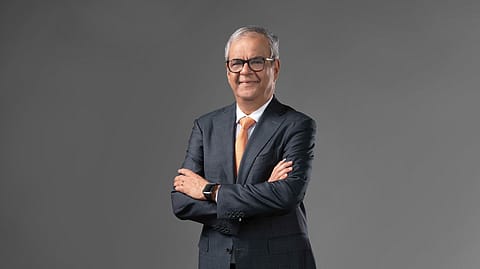
Ashok Vaswani, MD & CEO, Kotak Mahindra Bank | Credits: Kotak Mahindra Bank
Kotak Mahindra Bank (KMB), India’s fourth largest private sector bank by asset size, faces its second leadership crisis in under three years. By the time the year 2026 ends, the bank would have seen the exit of two managing directors and CEOs and one interim CEO.
On June 27, current managing director and CEO Ashok Vaswani had announced to the board of the Bank that, for personal reasons, he will not seek re-appointment upon completion of his current term on December 31, 2026. The Bank said it has initiated the process for the appointment of a new managing director and CEO.
Vaswani, an industry veteran, has held leadership roles at Citigroup, Barclays and fintech Pagaya Technologies. It is not just the building of a stable and talented second level of leadership within KMB, since the earlier-than-expected exit of the founder Uday Kotak, which was the biggest concern for KMB.
Data shows that the bank has been unable to build its liability franchise in a fast and meaningful manner. The high-level of indebtedness in the microfinance sector over the past two years and the implementation of guardrails has forced KMB to reduce its exposure to micro-loans. KMB had to also move away from aggressive unsecured lending activity.
KMB is the only Indian private sector lender which retains the family names of its promoters. While it operates across the spectrum of financial services, including investment banking, asset management, life and general insurance, alternate assets, brokerage and research, the core banking activity is where it struggles to match the ‘Big 3” of HDFC Bank, ICICI Bank, and Axis Bank.
“When it comes to core banking operations, Kotak Mahindra Bank has some catching up to do compared to the leaders. Its strength stemmed from capital market, brokerage and wealth management businesses,” a banking expert at a global consultancy firm, declining to be named, told Fortune India.

The pain points
KMB, under Vaswani, has been able to build the total asset size for the bank while maintaining the quality of the book. But there are segments of the book that need attention.
BSS Sonata Microcredit, the merged entity of BSS Microfinance into NBFC Sonata Finance in 2025, saw a quarterly loss of ₹9 crore in March-ended 2026 quarter, compared to ₹26 crore in the previous December-ended Q3FY26 quarter. BSS Microfinance, in its earlier avatar, reported a profit of ₹76 crore in Q4FY24.
KMB, for which conservativeness and caution has been a part of its DNA even during Uday Kotak’s regime, has been less aggressive in accelerating the growth of high yielding products such as unsecured loans. The Bank has, in this space seen unsecured retail advances (as a percentage of net advances) fall to 8.9% in Q4FY26 from 11.8% in the corresponding period two years ago.
In recent years, KMB has been unable to build its liability franchise. “This is something which will not get corrected quickly. It will take time,” said a banking analyst at an asset management company, on condition of anonymity.
The bank’s CASA (current and savings account) growth has stagnated during Vaswani’s regime, at 43.3% in Q4FY26 from 45.5% in Q4FY24. The bank has consciously been trying to grow the SA book in a granular manner, driven by the affluent and the high-end customers in terms of SA and also the core 811, Anup Kumar Saha, KMB’s whole-time director, said. The 811—KMB’s zero-balance, digital account—forms 13% of the bank’s total savings book.
{{#most-powerful-women-snapshot-individual.slug}} {{/most-powerful-women-snapshot-individual.slug}} {{^most-powerful-women-snapshot-individual.slug}} {{/most-powerful-women-snapshot-individual.slug}} {{#showRanking}} {{current-rank}} {{/showRanking}} {{#photo.0.url}}
{{name}}
While growing in a granular manner is healthier for the bank, it will have a short-term impact on its margin growth into FY27. The bank will hope that the pace of reduction of NIMs will be slow. NIMs for KMB have fallen to 4.6% in FY26 from 5.32% in FY24.
The team churn
Vaswani took charge as CEO from KMB veteran and interim MD and CEO Dipak Gupta—part of bank founder Uday’s Kotak’s original team—on January 1, 2024. Founder director Uday Kotak had stepped down from the post on September 1, 2023.
Several veterans of Uday Kotak’s team—Gupta, KVS Manian, Virat Diwanji, Jaimin Bhatt and Shanti Ekambaram—have either quit or retired from the bank between 2023 and 2025. But Vaswani has not been able to retain other talent such as Milind Nagnur (former COO) and Bhavish Lathia (former CTO).
Now the bank has started the process of finding internal and external candidates who the board will recognise to succeed Vaswani. The RBI, in the recent past, has preferred to choose leaders from the outside to lead YES Bank, RBL Bank and IndusInd Bank.
At Kotak Mahindra Bank, the entry of Anup Kumar Saha as whole-time director, probably signals that the die was already cast for him to play a bigger role at the bank, whenever Vaswani decided to step down. Saha, who has previously played pivotal roles at Bajaj Finance and ICICI Bank to drive customer growth, is seen as a front-runner to succeed Vaswani.
“Anup is as good as any independent candidate (if the regulator has to look for a successor from the outside). The market has high regard and confidence in Saha,” a banking analyst at an equity research firm told Fortune India, declining to be named.
One of the key concerns for the new successor will also be to boost investor confidence in the bank. The KMB stock has barely risen 4% during Vaswani’s term so far. The total shareholder value for the bank, on a month-to-month basis has moved from -4.38% on January 31, 2024 to -14.95% on March 30, 2026 before inching up to 4.03% on July 3, 2026.
One of the biggest incomplete pieces for KMB has been its inability to grow inorganically. The bank has been unable to convert any large acquisition since 2016, when it completed the ING Vysya Bank deal.
In October 2024, it acquired the personal loan book of Standard Chartered Bank, for ₹3,330 crore to boost the retail book. Just recently, on July 1, KMB also acquired the retail banking, affluent private banking, and wealth management businesses of Deutsche Bank in India for ₹282 crore.
“These are small deals, not significant enough to move the needle for the bank. Saha, or any outsider, will need to come and build retail book and the liability franchise in a big way,” the banking analyst said.
NEXT STORY