India’s financial sector in “comforting situation” compared to the US private credit situation: NPS chairman Dinesh Khara
/ 2 min read
The RBI, in its June Financial Stability Report, had mentioned about fault lines in private credit with defaults and rising redemption requests.
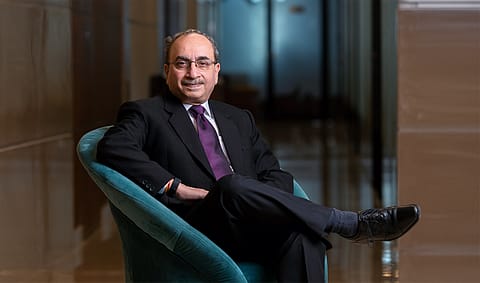
Dinesh Kumar Khara, Former chairman of State Bank of India. | Credits: Padmini B
India’s strict leverage regulations for private credit funds introduced by the market regulator Securities and Exchange Board of India (Sebi), has ensured that the country’s financial sector is in a “comforting situation”, compared to events developing in the United States, according to experts.
“When it comes to the leverage capability of the private credit funds, the possibility of a domino effect on the banking sector is one of the concerned areas for a regulator. The regulator would like to evaluate the maturity level of how managers manage the money and how responsibly they conduct themselves in the market,” Dinesh Kumar Khara, chairman and trustee of the National Pension System (NPS) Trust said, at the IVCA private credit summit 2026 in Mumbai.
In the US, in recent weeks, there is growing concern on whether stresses in this asset class could spill over to the broader financial system due to their rapid expansion and linkages with the overall banking network.
Last week, the Reserve Bank of India (RBI)—in its Financial Stability Report of June 2026—raised some issues impacting this sectors. “Some fault lines have emerged in private credit with defaults and rising redemption requests,” the RBI noted. But, in this backdrop, RBI Governor Sanjay Malhotra said the Indian economy has shown “remarkable resilience”, supported by strong macroeconomic fundamentals, structural reforms and prudent macroeconomic management.
NPS’ Khara lauded the central bank for acting swiftly during times of global financial crises.
"We have seen the impact of this in the US and it is impacting the banking sector there. Fortunately for us, in India, we are nowhere comparable to the US situation. It is a very comforting situation here. Part of it is also due to the steps taken till now,” Khara said during a fireside chat with Srini Srinivasan, managing director of Kotak Alternate Asset Manager, who is also IVCA chairperson.
RBI, in its June report, said that private credit has expanded notably in recent years. Estimates vary about the size of the private credit market—ranging from $1.5 trillion to $2 trillion—due to differing definitions across jurisdictions and data challenges. The private credit ecosystem comprises a diverse set of interconnected banks and non-bank participants.
“The interlinkages between these entities are difficult to spot and assess given the opacity in these markets and multiple with varying levels of leverage…..while the current stress in private credit may not cause systemic risk, continued monitoring is vital to identify vulnerabilities and limit broader financial system impact,” the RBI FSR noted.
The banking regulator has also noted that since NBFIs (non-bank financial intermediaries – or NBFCs) are lightly regulated, opaque, price-sensitive, highly leveraged, and have no access to central bank liquidity facilities, their actions could amplify losses during stress episodes and create instability.
“Thus, as central banks unwind quantitative easing, safeguarding financial stability may become increasingly challenging amid the growing systemic importance of NBFIs and their increasing linkages with the banking sector,” the RBI had said.
“India’s private credit market is in a nascent stage, but as it grows we need to learn from developments in the US and need to keep an eye so that no systemic risks are created within the system here,” a private credit industry source said.
NEXT STORY