Explained: Why gold prices have hit record highs and what lies ahead
/ 3 min read
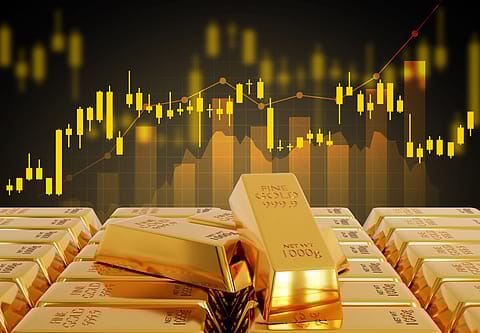
Gold prices could stabilise or see a modest correction if geopolitical tensions ease, though this is considered less likely given current risk forecasts.
Explained: Why gold prices have hit record highs and what lies ahead
Gold prices have reached record highs due to softer US inflation data, which has fueled expectations of Federal Reserve interest rate cuts. Geopolitical and economic uncertainties have also increased demand for gold as a safe-haven asset. Central banks are diversifying away from the dollar, further boosting gold's appeal while silver has also hit an all-time high.
This summary is AI-generated, and Fortune India is not responsible for its content or any associated copyright issues.
Gold rally followed the release of US inflation data showing that price pressures are cooling faster than expected.
Gold prices could stabilise or see a modest correction if geopolitical tensions ease, though this is considered less likely given current risk forecasts.
Gold surged to a record high as softer-than-expected US inflation data reinforced expectations of interest rate cuts by the Federal Reserve this year while persistent geopolitical and economic uncertainties boosted demand for safe-haven assets. Silver also touched a fresh all-time peak during the session.
What happened to gold prices
Spot gold climbed to a record $4,634.33 per ounce before paring gains to trade at $4,591.49 as of 01:31 PM Eastern Time, as per Reuters report. US gold futures for February settled 0.3% lower at $4,599.10 after the initial surge. The rally followed the release of US inflation data showing that price pressures are cooling faster than expected.
Gold prices in the Indian market were steady. As of Wednesday, gold was priced at ₹14,362 per gram for 24-carat gold, ₹13,165 per gram for 22-carat gold and ₹10,772 per gram for 18-carat gold across major cities, including Chennai, Bengaluru, Hyderabad, Mumbai, and Delhi.
Why did inflation data matter
The US core Consumer Price Index (CPI) rose 0.2% on month and 2.6% on year in December, below analysts’ expectations of 0.3% and 2.7%, respectively. The softer print strengthened market bets that the Federal Reserve could begin cutting interest rates later this year. Lower interest rates tend to support gold prices by reducing the opportunity cost of holding non-yielding assets like bullion.
What’s driving sustained demand for gold
Beyond rate expectations, analysts point to a broader set of structural and geopolitical factors underpinning gold’s rally.
Shantanu Awasthi, Co-founder and CEO of Mavenark, said gold continues to benefit from global uncertainty, currency disruptions and shifting reserve strategies among central banks. According to him, gold has delivered strong long-term returns, posting about 54% year-to-date gains in 2025 and double-digit annualised returns over the past 10–20 years, often matching or outperforming equities while bonds lagged.
A key driver has been uncertainty around US economic and foreign policy, including concerns over fiscal deficits and political pressure on the Federal Reserve, which have weighed on the US dollar.
Why are central banks buying more gold
Central banks worldwide have been accelerating gold purchases as they diversify away from dollar-denominated assets amid sanctions risks and geopolitical fragmentation. Central banks added an estimated 166 tonnes of gold in the second quarter of 2025 alone, with countries such as Poland, Turkey, and India leading purchases. Surveys indicate that nearly 95% of central banks plan to increase gold holdings further.
The trend toward de-dollarisation, particularly among BRICS+ nations, has added momentum, even as US policy responses have, paradoxically, accelerated reserve diversification. Gold holdings at global central banks now exceed 36,000 tonnes.
How geopolitics is adding to the rally
Geopolitical risks remain high. Concerns over the independence of the US Federal Reserve intensified after President Donald Trump administration opened a criminal investigation into Fed Chair Jerome Powell, drawing criticism from former Fed officials and global central bankers.
At the same time, Trump has threatened to impose a 25% tariff on countries trading with Iran, raising the risk of renewed tensions with China, Iran’s largest trading partner. In Europe, Russia launched missile and drone strikes across Ukrainian cities overnight, keeping the war-related risk premium intact. “These factors continue to support gold’s safe-haven appeal,” analysts said.
{{#most-powerful-women-snapshot-individual.slug}} {{/most-powerful-women-snapshot-individual.slug}} {{^most-powerful-women-snapshot-individual.slug}} {{/most-powerful-women-snapshot-individual.slug}} {{#showRanking}} {{current-rank}} {{/showRanking}} {{#photo.0.url}}
{{name}}
What could happen next
Gold prices could stabilise or see a modest correction if geopolitical tensions ease, though this is considered less likely given current risk forecasts. If uncertainty persists until the US midterm elections in late 2026, central bank buying could continue to support prices before a period of consolidation. Analysts see if global disruptions intensify, scope for further sharp gains, with some forecasts placing gold near $5,000 per ounce in the first half of 2026.
Silver at all-time high
Silver mirrored gold’s rally, rising 2.1% to $86.74 per ounce after touching an all-time high of $89.10 earlier in the session, supported by both safe-haven demand and industrial use expectations. Silver prices extended their rally on Wednesday, rising as much as 4% on the Multi Commodity Exchange (MCX), driven by escalating geopolitical tensions and increased safe-haven demand, signalling a strong start to 2026 after a robust performance last year. MCX silver prices jumped ₹10,800 in early trade to hit a fresh record high of ₹2,86,100 per kg.
Follow Fortune India
NEXT STORY