CREDAI seeks affordable housing definition based on size, not price; expects policy framework in six months
/ 3 min read
The industry body is in discussions with the government on a new affordable housing policy and expects changes to the existing framework within the next six months, CREDAI President Shekhar G. Patel said at a press conference ahead of NATCON 2026 in Kolkata.
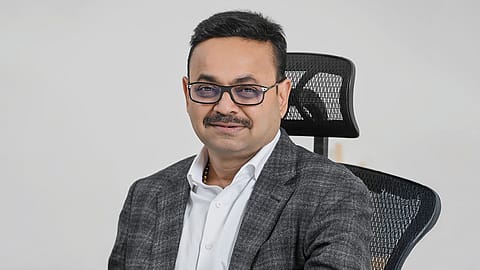
CREDAI President Shekhar G. Patel | Credits: CREDAI
The Confederation of Real Estate Developers’ Associations of India (CREDAI), which represents more than 13,000 developers, is seeking a change in the definition of affordable housing, urging the government to remove the ₹45 lakh price cap and retain only the prescribed size criteria.
Speaking at a press conference ahead of NATCON 2026 in Kolkata, CREDAI President Shekhar G. Patel said the industry body is in discussions with the government on a new affordable housing policy and expects changes to the existing framework within the next six months.
“We are in discussion with the housing and finance departments, and currently our affordable housing definition is 60 square metre in metropolitan cities, 90 square metre in other cities, and ₹45 lakh price cap,” Patel told reporters.
He said the government has understood that the ₹45 lakh price ceiling is no longer relevant and indicated that changes could be made within the next six months.
Patel said CREDAI’s suggestion is to define affordable housing based on the size of the home rather than its price.
“Historically in India and all the states also, the affordable housing definition does not have a price cap. Because the people need area requirements,” he said.
CREDAI has suggested retaining a 60 sq m limit for metropolitan cities and 90 sq m for other cities.
“60 metre has something with the family needs 60 metre in metropolitan city or 90 metre in other cities of India. That's the definition we have suggested, and we have suggested that don't keep the price line,” Patel said.
Policy expected in six months
On the timeline for the proposed changes to the affordable housing policy, Patel said several government departments are involved in the process.
“I think the government, there are three-four different departments involved. One is GST Council, who decides the price cap for GST,” he said.
He added that CREDAI is hoping for changes to the policy within six months.
{{#most-powerful-women-snapshot-individual.slug}} {{/most-powerful-women-snapshot-individual.slug}} {{^most-powerful-women-snapshot-individual.slug}} {{/most-powerful-women-snapshot-individual.slug}} {{#showRanking}} {{current-rank}} {{/showRanking}} {{#photo.0.url}}
{{name}}
“In this six-month period, we are hoping for the policies,” Patel said.
Patel said the industry is currently unable to supply enough affordable housing units despite strong demand.
“Somehow in affordable housing segment, we are not able to supply enough units what people require,” he said.
He attributed the supply constraints to land availability, taxes, approvals and other factors, adding that CREDAI is working with state and central governments to address these challenges.
“We have constraints of land, taxes and approvals and a lot many constraints, but I think we are working with the state governments and the central government to dissolve this constraint for the betterment of our citizens,” Patel said.
AI, technology to reshape real estate
Patel also said technology and innovation are expected to play a growing role in the real estate sector, with artificial intelligence potentially improving decision-making, efficiency and business responsiveness.
“Real estate is entering a phase where technology and innovation will influence every part of the business, from how we understand customers and market projects to how we plan, build and operate them,” said Patel.
“AI, in particular, has the potential to enable better decision-making, improve efficiencies and create more responsive businesses. For the industry, the opportunity is not simply to adopt new technologies, but to use them meaningfully to build a more productive, transparent and future-ready sector,” he added.
He also highlighted the growing role of cities beyond traditional metropolitan centres in India’s next phase of urbanisation, citing Kolkata and eastern India as key growth opportunities.
“At the same time, the next phase of India’s urban growth will increasingly extend beyond the traditional metropolitan centres. Kolkata, with its economic depth and position as a gateway to eastern India, can play an important role in this transition,” said Patel.
“As infrastructure and connectivity improve across West Bengal, they can strengthen economic corridors, bring emerging cities into larger development networks and unlock new opportunities for housing, businesses and investment,” he added.
“Bringing NATCON to Kolkata is about focusing the industry’s attention on this opportunity and creating a dialogue on how real estate and infrastructure can together contribute to more connected and competitive cities, in line with the vision of Viksit Bharat,” he further added.
The three-day flagship convention, NATCON, focused on AI and innovation, is being held from October 2 to 4 at ITC Royal Bengal in Kolkata. It marks the first time in more than a decade that CREDAI’s flagship annual event is being hosted in India rather than overseas.
The convention was originally scheduled to take place in Amsterdam before being moved to India. More than 1,000 delegates from the real estate industry and allied sectors are expected to attend.
Follow Fortune India
NEXT STORY