Housing sales fall 6% in Q2 as West Asia war weighs on demand; launches rise 7%: Anarock
/ 2 min read
Sales across India’s top seven cities slipped to 90,715 units in Q2 2026 even as developers launched over 1.06 lakh homes, signalling a shift towards a more balanced housing market led by premium project
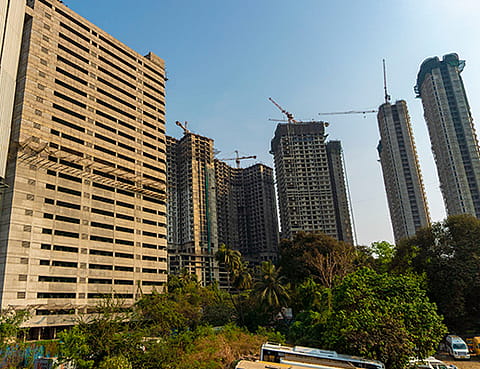
According to Anarock, housing absorption stood at nearly 90,715 units in Q2 2026, compared with 96,285 units in the corresponding period last year | Credits: IBEF
Residential housing sales across India’s top seven cities declined 6% year-on-year in the April-June quarter, as geopolitical tensions in West Asia and uncertainty surrounding the IT sector dented homebuyer sentiment, according to Anarock Research. Housing absorption stood at nearly 90,715 units in Q2 2026, compared with 96,285 units in the corresponding period last year. On a sequential basis, sales dropped 11%, as per the real estate research firm.
Despite the moderation in demand, developers continued to replenish inventories. New launches increased 7% year-on-year to around 1.06 lakh units during the quarter from 98,625 units a year earlier, although supply was down 16% from the January-March quarter. Mumbai Metropolitan Region (MMR) and Bengaluru remained the biggest residential markets, accounting for 48% of total sales and 53% of fresh supply during the quarter.
Anarock Chairman Anuj Puri attributed the slowdown in demand to geopolitical uncertainty and its ripple effects on economic activity.
“These readings are along expected lines, as the Middle East war’s impacts on the entire sector were all too obvious. What we have currently is a more balanced housing market where new supply is catching up with absorption as sales growth moderated across most top cities. Notably, the strongest sales momentum is now in premium housing, GCC-led employment hubs, and infrastructure-driven corridors. The Middle East war’s disruptions and AI-related uncertainties in the IT/ITeS sector have pushed more buyers onto the fence,” he said.
Puri added that large and listed developers continued to launch projects on the sizeable land parcels acquired in 2025, keeping annual supply growth intact.” “However, the 16% sequential fall in launches suggests developers have begun moderating fresh supply amid weaker buyer sentiment,” he noted
Kolkata, Hyderabad buck the trend; NCR leads price growth
Only three cities registered annual sales growth during the quarter. Kolkata posted the strongest increase at 10%, followed by Hyderabad at 2% and Bengaluru at 1%. Pune recorded the sharpest decline, with sales falling 15% year-on-year, while MMR saw an 8% decline despite remaining the country’s largest residential market with 28,710 units sold.
Developers continued to focus on higher-ticket projects. Homes priced between ₹80 lakh and ₹1.5 crore accounted for the largest share of new launches at 27%, followed by the ₹1.5-2.5 crore segment at 25%. Affordable housing, priced below ₹40 lakh, contributed just 6% of total supply.
Average residential prices across the top seven cities rose 7% year-on-year but only 1% sequentially. NCR recorded the steepest annual price appreciation at 13%, followed by Bengaluru at 8%. Meanwhile, unsold inventory increased 10% annually to over 6.16 lakh units, with Bengaluru registering the highest inventory growth of 34%, reflecting the city’s aggressive project pipeline.
NEXT STORY