India's real estate equity inflows hit record $8.5 billion in H1 2026, up 32%: CBRE
/ 2 min read
During the second quarter of 2026 (April-June), total equity inflows stood at $3.4 billion, remaining broadly stable compared with the corresponding period last year.
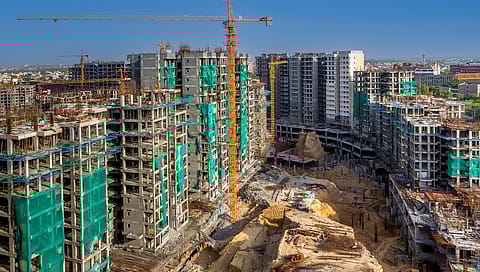
Land/development sites and built-up office assets together accounted for around 94% of total equity investment inflows during the quarter. | Credits: Narendra Bisht
India's real estate sector attracted equity capital inflows of $8.5 billion during the first half of 2026 (January-June), the highest half-yearly investment on record, driven by sustained demand for land acquisitions and office assets, according to CBRE South Asia.
The investments rose 32% year-on-year from $6.4 billion in the first half of 2025, the real estate services and investment firm's India Market Monitor – Investments report for Q2 2026 said.
CBRE attributed the record inflows to continued momentum in land and development site acquisitions, along with investments in built-up office assets. "This momentum reflects the underlying resilience and depth of India's real estate capital markets," said Anshuman Magazine, Chairman & CEO, India, South-East Asia, the Middle East & Africa, CBRE.
"Domestic investors have continued to demonstrate strong conviction in the sector's long-term fundamentals, even as the broader environment remains dynamic. We expect this momentum to carry into the second half of the year, with select foreign capital expected to re-engage as global conditions stabilise," he added.
During the second quarter of 2026 (April-June), total equity inflows stood at $3.4 billion, remaining broadly stable compared with the corresponding period last year.
Land/development sites and built-up office assets together accounted for around 94% of total equity investment inflows during the quarter. Developers emerged as the largest contributors to capital deployment, accounting for about 34% of investments, followed closely by domestic institutional investors with a 32% share.
The report also noted that institutional capital inflows increased 51% quarter-on-quarter in Q2 2026, signalling stronger participation from organised investors.
Among cities, Bengaluru attracted the highest investments during the quarter, followed by Delhi-NCR and Mumbai. Together, the three markets accounted for nearly 60% of total capital inflows.
Domestic investors, led primarily by developers, contributed about 92% of total investments during the quarter, underscoring the strength of local capital. Global investors accounted for the remaining inflows.
According to CBRE, more than 88% of investments in land and site acquisitions were directed towards residential and office developments, while the remainder was allocated to data centres, mixed-use projects, and industrial and logistics assets.
In addition, investment and development platforms worth around $1.6 billion were established across the residential and office segments during the quarter, reflecting sustained long-term investor confidence.
{{#most-powerful-women-snapshot-individual.slug}} {{/most-powerful-women-snapshot-individual.slug}} {{^most-powerful-women-snapshot-individual.slug}} {{/most-powerful-women-snapshot-individual.slug}} {{#showRanking}} {{current-rank}} {{/showRanking}} {{#photo.0.url}}
{{name}}
"India's real estate investment landscape continues to demonstrate sustained growth with strong institutional investments in core assets and hectic activity in land transactions," said Gaurav Kumar, Managing Director & Co-Head, Capital Markets, India, CBRE.
"Global investors and domestic players have been unanimous in their aggressive intent in expanding their real estate portfolios across all asset classes. We expect the market to sustain this momentum going forward on account of a sophisticated capital pool that is now deeply committed to the Indian real estate market," he added.
NEXT STORY