The FAQs are AI-generated, and Fortune India is not responsible for its content or any associated copyright issues.
How KreditBee scaled a high-volume lending business into a unicorn
/ 4 min read
Inside KreditBee’s high-frequency, low-NPA playbook in India’s risky digital lending boom
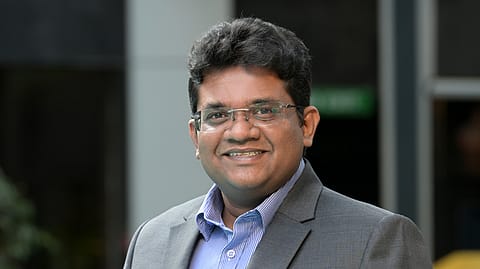
Madhusudan Ekambaram, Co-founder, KreditBee
KreditBee recently made headlines after entering the unicorn club, raising $280 million in a Series E round in April 2026 at a valuation of about $1.5 billion. The milestone comes as the company continues to scale its lending business in India’s rapidly expanding digital credit market.
But the timing is notable. The Reserve Bank of India, in its December 2025 Financial Stability Report, flagged rising risks in the same segment, with unsecured loans accounting for over 53% of retail loan slippages, a category where fintech-led lenders have a significant presence.
Founded in 2018, the company has underwritten about 8.5 crore individuals and lent to roughly 1.8 crore customers. It now collects repayments from around 55 lakh active borrowers every month. The scale is driven by sheer throughput. As cofounder Madhusudan Ekambaram explains, the app sees close to 70,000 new downloads daily, translating into thousands of first-time loans and a larger base of repeat borrowing. “Every day I end up making close to about 30,000 loans to unique borrowers,” he says.
The numbers are large, but the more notable aspect is how the company has combined that scale with early profitability and relatively stable asset quality.
A digital model built for volume
When KreditBee entered the market, retail lending in India still depended heavily on physical processes, that includes meeting borrowers, verifying documents in person, and underwriting through branch networks. The company chose to bypass that entirely.
“We didn’t want to meet any borrower. We would underwrite faceless and give out money,” says Ekambaram.
The model found traction quickly. Within five months of launch, KreditBee was disbursing close to ₹100 crore a month. Demand rose sharply enough that approval rates had to be tightened to below 5% at one stage to manage risk.
What the company built was not a high-ticket lending business, but a high-frequency one. Personal loans form the core, with ticket sizes ranging from around ₹25,000 for self-employed borrowers to roughly ₹80,000 for salaried users. Alongside that, the company offers business loans averaging about ₹5 lakh, two-wheeler loans at around ₹1 lakh, and loan against property at approximately ₹20 lakh, with tenures stretching from just over a year to as long as eight years depending on the product.
Finding demand beyond the metros
A significant part of KreditBee’s expansion has come from non-metro markets. While urban customers remain heavily targeted by banks and large NBFCs, access to formal credit in smaller cities has been more fragmented.
“Only about 18% of my customers are from metro cities, 82% of the customers are from this mid India, T1 to T4 cities,” Ekambaram says.
This distribution aligns with broader shifts in digital infrastructure. The spread of low-cost mobile data, Aadhaar-based eKYC, and basic banking access created the foundation for app-based lending to reach Tier 2 to Tier 4 cities at scale. KreditBee’s model effectively tapped into that gap, offering relatively small-ticket loans to a segment that was under-served but not necessarily under-demanded.
{{#most-powerful-women-snapshot-individual.slug}} {{/most-powerful-women-snapshot-individual.slug}} {{^most-powerful-women-snapshot-individual.slug}} {{/most-powerful-women-snapshot-individual.slug}} {{#showRanking}} {{current-rank}} {{/showRanking}} {{#photo.0.url}}
{{name}}
Stress-tested through two cycles
High-volume lending, particularly to customers with limited credit history, is inherently vulnerable to economic shocks. The pandemic exposed that fragility across the sector.
In early 2020, just before the nationwide lockdown, KreditBee was in the process of closing a $100 million funding round, with six out of eight investors having signed definitive agreements. The lockdown halted that round. At the same time, the company had disbursed approximately ₹4,600 crore in the six months leading up to March 2020 and began receiving calls from lenders seeking repayments.
“I couldn’t even sleep for that week,” Ekambaram says.
The response was operational rather than strategic. Lending was paused, and the entire organisation shifted focus to collections and customer engagement. “I told them that I have only one work… you have to call up the customer,” he says.
Structured repayment options, ranging from EMI rescheduling to partial settlements, helped stabilise collections. Within six months, KreditBee returned to the market and raised $150 million, backed by nine term sheets.
A second test came during the microfinance-linked stress cycle of 2024–25, when parts of the unsecured lending ecosystem again came under pressure. According to the company, its asset quality remained stable through that period.
From first-time borrowers to prime customers
Perhaps the most significant shift in KreditBee’s model has been the evolution of its borrower base. In its early years, around 70% of its loan book consisted of new-to-credit customers, which are borrowers without prior credit history. Today, that share has reduced to roughly 1.5% of assets under management.
At the same time, borrowers with a credit score of 700 and above now account for about 98% of the portfolio, with 730-plus making up around 92% and 750-plus roughly 60%.
“Today, the new to credit is only one and a half percent of my AUM, which used to be 70 percent,” Ekambaram says.
This shift has been driven by a gradual reduction in lending rates as the company’s cost of funds improved. Instead of retaining those gains entirely, KreditBee lowered rates to attract better-quality borrowers. “You have to pass it back to the customers… so that you can always get a better-quality customer,” he says.
Profitability in a growth-heavy sector
Unlike many fintech startups that prioritised scale before profitability, KreditBee reports that it has been profitable since FY19, its first full year of operations, except for a slowdown during FY21 when lending activity was paused.
As per the company, it has seen a significant rise in revenue from around ₹2,700 crore in FY25 while maintaining profitability. It is also growing at about 25–30% annually, with a return on equity of over 18%, positioning itself closer to established NBFC benchmark.
“We just stick to the business fundamentals,” Ekambaram says.
What's next for KreditBee?
KreditBee is now preparing for a public listing, following the merger of its technology and NBFC entities. The IPO is expected by the end of the year or early next year, subject to market conditions.
At the same time, the company is expanding beyond personal loans into adjacent categories such as gold loans, two-wheeler financing, and consumer durable loans. The idea is to build deeper relationships with existing customers while increasing product coverage.
“If we are able to offer all these products at a maximized digital way, we would call ourselves… a digital bank,” Ekambaram says.
Frequently Asked Questions
NEXT STORY