Apple partners with Google to fix Siri; Elon Musk cries foul
/ 2 min read
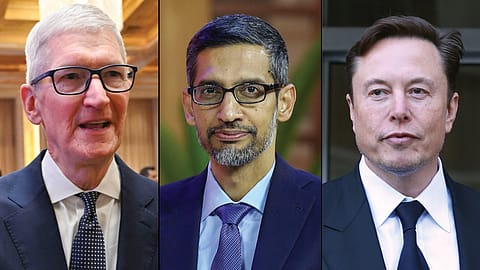
As Google enters the fold as a foundational partner, the door seems firmly shut for other players like xAI’s Grok to gain deep system-level integration on the iPhone.
Apple partners with Google to fix Siri; Elon Musk cries foul
Apple has partnered with Google to enhance Siri using Google's Gemini AI models, a move criticized by Elon Musk as concentrating too much power with Google. The deal, worth over $1 billion annually, aims to improve Siri's capabilities by 2026, while maintaining Apple's existing partnership with OpenAI for complex queries.
This summary is AI-generated, and Fortune India is not responsible for its content or any associated copyright issues.
Under this new multi-year agreement, reportedly worth over $1 billion annually, Google’s Gemini models will serve as the "foundation" for Apple’s own AI features. This means the "new Siri" (expected later in 2026) will be built on top of Google’s logic to handle personal context and multi-step tasks
As Google enters the fold as a foundational partner, the door seems firmly shut for other players like xAI’s Grok to gain deep system-level integration on the iPhone.
Apple and Google just signed a deal where the iPhone maker will use Google’s Gemini AI models to power future versions of Siri and Apple Intelligence. The deal, which was officially confirmed on January 12, drew sharp criticism from none other than Elon Musk, the owner of X (formerly Twitter). Musk called it "an unreasonable concentration of power for Google, given that they also have Android and Chrome."
Even though Apple has never admitted it publicly, the Cupertino giant has always had an AI problem. On a lighter note, while others were building ChatGPT, Gemini, and Copilot, Apple's Siri had seemingly only mastered the art of setting kitchen timers. Internally, however, the situation was serious. Siri delays stacked up, features slipped, and Apple reached a crossroads: it had to either spend years on private R&D to catch up, or partner with a rival who had already done the heavy lifting.
Apple chose option two.
The "core" vs. the "consultant"
Under this new multi-year agreement, reportedly worth over $1 billion annually, Google’s Gemini models will serve as the "foundation" for Apple’s own AI features. This means the "new Siri" (expected later in 2026) will be built on top of Google’s logic to handle personal context and multi-step tasks.
This partnership does not replace Apple’s existing deal with OpenAI. Instead, it creates a two-tier system: Gemini acts as the silent, foundational brain for system tasks, while ChatGPT remains an optional "consultant" that Siri can call upon for complex, creative, or world-knowledge queries.
Antitrust cases
The deal arrives at a complicated time for regulators. Google is already fighting multiple antitrust cases in the US and abroad related to its market power in search, advertising, and browsers. By becoming the intelligence layer for its biggest mobile rival, Google cements its dominance even further—a fact that sent Alphabet's valuation soaring past $4 trillion shortly after the news broke.
The xAI factor
This consolidation of power is exactly what has Elon Musk up in arms. Musk’s own AI company, xAI, is currently suing Apple and OpenAI over their earlier partnerships, alleging a "conspiracy" to lock out competitors.
As Google enters the fold as a foundational partner, the door seems firmly shut for other players like xAI’s Grok to gain deep system-level integration on the iPhone. Musk has previously threatened to ban Apple devices at his companies if OpenAI was integrated at the OS level; it remains to be seen if this deeper integration with Google—historically a fiercer rival to Musk than OpenAI—will result in the development of the long-rumoured "X Phone" as a retaliation to what he views as an AI monopoly.
Follow Fortune India
NEXT STORY