‘Import duty cut on lithium-ion battery manufacturing equipment to boost investments, enhance India’s competitiveness’: IESA President Ashok Chandak
/ 2 min read
The industry body says lower duties on capital equipment will reduce project costs, accelerate battery manufacturing capacity, attract domestic and global investments, and strengthen India’s broader electronics and semiconductor manufacturing ecosystem.
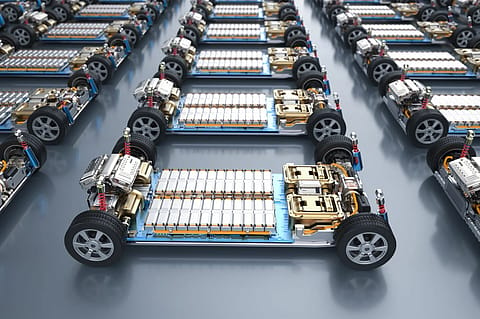
According to IESA, capital equipment accounts for a significant share of the initial investment required to establish lithium-ion battery manufacturing facilities | Credits: Robocraftstore
The Centre’s decision to reduce import duties on capital equipment used in lithium-ion battery manufacturing is expected to significantly improve the economics of setting up battery manufacturing facilities in India and attract fresh investments into the sector, according to Ashok Chandak, President of the India Electronics and Semiconductor Association (IESA) and Semiconductor Equipment and Materials International (SEMI) India.
The industry body said the government’s move aligns with its broader Make in India agenda by encouraging domestic manufacturing of advanced battery technologies, a critical component for sectors ranging from electric vehicles (EVs) and consumer electronics to renewable energy storage. The measure is also expected to reduce reliance on imported battery cells while strengthening India’s manufacturing capabilities across the electronics value chain.
Lower capital costs to improve project viability
Welcoming the government’s decision, Chandak described the import duty reduction as a strategic reform that would lower project costs, accelerate capacity creation and improve the global competitiveness of battery manufacturing in India.
He noted that capital equipment accounts for a significant share of the initial investment required to establish lithium-ion battery manufacturing facilities. Lower duties would therefore improve project economics, shorten payback periods and encourage both domestic and international companies to invest in battery cell manufacturing and battery-pack assembly operations in the country.
As India works towards creating a multi-hundred gigawatt-hour (GWh) battery manufacturing ecosystem, the policy has the potential to save the industry hundreds of crores of rupees in capital expenditure while accelerating capacity expansion and increasing domestic value addition, Chandak said.
Benefits expected across EVs, electronics and energy storage
According to IESA, the impact of lower battery manufacturing costs will extend well beyond the battery industry. Lithium-ion batteries account for nearly 15-40% of the bill of materials in products such as electric vehicles, smartphones, laptops, wearables and several categories of portable electronics.
Lower production costs could improve the competitiveness of finished products across sectors including telecom equipment, medical devices, drones, industrial electronics and battery energy storage systems (BESS). The policy is also expected to support import substitution by encouraging domestic battery cell manufacturing, reducing India’s dependence on imported cells that currently account for a substantial share of domestic demand.
Indirect boost for semiconductor ecosystem
While the measure does not directly target semiconductor manufacturing, Chandak said it complements India’s broader ambition of becoming a global hub for electronics and semiconductor production.
“Batteries are a core component of modern electronic products, and a competitive domestic battery ecosystem complements India’s semiconductor and electronics manufacturing ambitions. Together, these initiatives will support end-to-end product creation, deepen supply chain resilience and enhance India’s position as a trusted global manufacturing hub,” he said.
The comments come as India continues to strengthen its electronics manufacturing ecosystem through a series of policy interventions aimed at boosting domestic value addition, attracting global investments and building resilient supply chains. Alongside the government’s semiconductor mission and production-linked incentive (PLI) schemes, the latest duty rationalisation is expected to reinforce India’s long-term strategy of developing an integrated manufacturing ecosystem spanning semiconductors, batteries, electronics and clean energy technologies.
NEXT STORY