India’s ‘new industrial revolution’ takes shape across 6 sectors; space economy targeted at $40-45 bn by 2030: Jefferies
/ 2 min read
Space, semiconductors, data centres, electronics, solar manufacturing and aerospace are emerging as key growth engines as policy support, private investment and localisation reshape India’s industrial landscape
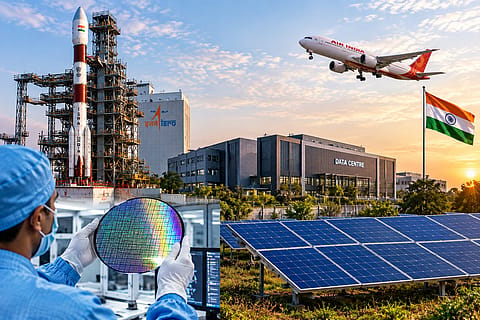
India’s emerging industrial ecosystem spans space, semiconductors, data centres, electronics, solar manufacturing and aerospace, identified by Jefferies as key growth sectors
India is witnessing the emergence of what global investment bank Jefferies has termed a “new industrial revolution”, with six sectors — space, semiconductors, data centres, electronics, solar manufacturing and aerospace — gaining traction on the back of a large domestic market, increasing private-sector participation and sustained government support.
In its September 9 report, India’s New Industrial Revolution, Jefferies said government measures including opening the space sector to private players, tax holidays for data centres, large incentive schemes for semiconductors, electronics and solar, localisation requirements and government GPU purchases are creating the conditions for new industrial ecosystems.
Space economy, semiconductor investments gain momentum
India’s space sector is moving towards greater private participation, with Jefferies noting that the country is among a handful of spacefaring nations with globally competitive capabilities. The brokerage expects the space economy to expand nearly fivefold to $40-45 billion by 2030. Companies such as Skyroot, Pixxel and Agnikul are progressing from early innovation towards commercial execution.
The semiconductor ecosystem, meanwhile, is shifting from policy intent to execution. Around $20 billion of investments are already in the pipeline, including a chip fabrication plant under construction and several outsourced semiconductor assembly and test (OSAT) projects starting production. Jefferies said a further $13 billion incentive plan could help deepen the ecosystem and boost domestic value addition.
Data centres emerge as $45 bn investment opportunity
India’s data-centre capacity has expanded fivefold in five years to around 2 GW, driven by cloud adoption, digitisation and data-localisation requirements. Jefferies expects capacity to increase another fivefold to around 10 GW over the next five years, creating a $45 billion investment opportunity across power, cooling, construction and network infrastructure.
The electronics industry is also moving beyond assembly towards higher domestic value addition and component manufacturing. Jefferies expects domestic value addition in mobile components to rise from below 20% currently to around 50% over the next six years.
Solar, aerospace strengthen India’s global manufacturing ambitions
India has emerged as the world’s second-largest solar PV manufacturer, with around 35 GW of solar cell capacity operational and another 100 GW under construction. Jefferies expects nearly 90% of the solar manufacturing value chain to be localised by 2030.
Aerospace is another sector where India is gaining ground, helped by cost-competitive manufacturing and engineering talent. Boeing and Airbus already source around $1.4-1.6 billion annually from India, while Indian companies are increasingly supplying global OEMs and Tier-1 companies.
Jefferies’ broader assessment is that the combination of domestic demand, rising private participation and government support is helping India build new industrial capabilities with increasing potential to compete in global markets.
Editorial note: The supplied report does not contain a direct spokesperson quote. I have therefore used Jefferies’ stated assessment rather than fabricating a quote or attributing comments that are not present in the source.
Follow Fortune India
NEXT STORY