Microsoft launches fourth India cloud region in Hyderabad to accelerate AI adoption
/ 2 min read
New datacentre expands Microsoft's hyperscale cloud footprint as the company doubles down on its $20.5 billion India investment amid rising enterprise demand for AI and cloud services
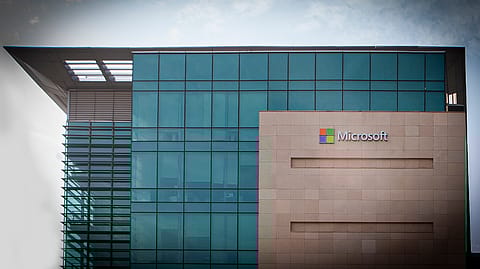
The new region becomes Microsoft's fourth cloud region in India, joining its existing facilities in Pune, Chennai and Mumbai. (File image)
Microsoft on Thursday announced the general availability of its India South Central cloud region in Hyderabad, expanding its hyperscale cloud infrastructure in the country as it looks to capitalise on surging enterprise demand for artificial intelligence (AI) and cloud services.
The new region becomes Microsoft's fourth cloud region in India, joining its existing facilities in Pune, Chennai and Mumbai. Built with three Availability Zones, the Hyderabad region is designed to support mission-critical workloads while offering enterprises greater data residency, security, compliance and resilience for AI applications.
The launch comes as Microsoft ramps up its India strategy following its previously announced $20.5 billion investment in the country's cloud and AI infrastructure. The company said the new region strengthens India's foundation for "scalable and sovereign-ready AI" and will help businesses modernise critical systems, develop AI-powered services and accelerate digital transformation.
Part of Microsoft's AI push
"Whether it is a Frontier Firm already running AI at scale or an enterprise taking its first steps, the question we hear most often is: how do we move faster from experimenting with AI to creating durable business value with AI?" said Puneet Chandok, president, Microsoft India and South Asia.
"That requires trusted infrastructure close to where data lives, teams work and decisions are made. The Microsoft India South Central datacenter region is a critical part of that foundation, backed by Microsoft's $20.5 billion investment commitment to India's cloud and AI future," Chandok said.
Microsoft said it now operates the largest hyperscale cloud presence in India, while also running two cloud regions in partnership with Reliance Jio. The Hyderabad region is part of Microsoft's global network spanning more than 80 regions across 34 countries, over 500 datacentres and more than 800,000 kilometres of terrestrial and subsea fibre infrastructure.
Enterprise AI demand gathers pace
The technology giant said demand for cloud and AI services continues to strengthen in India, with Azure recording strong double-digit growth over the past two years. According to the company, more than 90% of Nifty 100 companies use Microsoft 365 Copilot, while Infosys, TCS, Wipro and LTIMindtree have collectively signed up for over 400,000 Copilot seats, reflecting a shift from AI pilots to enterprise-wide deployments. Globally, Microsoft 365 Copilot has crossed 30 million paid seats, the company added.
The Hyderabad region has already attracted early customers including Adani Group, Bajaj Finance, HDFC Bank and PB Pay, which said the new infrastructure would help improve resilience, support AI innovation and strengthen data residency for critical workloads.
Cloud market poised for rapid growth
Industry research firm IDC expects India's public cloud services market to reach $45.7 billion by 2030, expanding at a compound annual growth rate of 22.2%, with AI-related spending forecast to grow at roughly twice that pace.
"Microsoft's fourth India cloud region marks a decisive shift in how hyperscale capacity is being localized for the AI era," said Dr William Lee, Senior Research Director at IDC, adding that proximity, sovereignty and resilience have become essential requirements as enterprises scale AI workloads.
Microsoft also said the Hyderabad facility has been designed with zero-water cooling technology as part of its sustainability commitments. The company aims to become carbon negative, water positive and zero waste by 2030, and has already contracted more than 1 GW of renewable energy capacity in India, with over 630 MW operational.
NEXT STORY