Nvidia’s $150 billion buyback: Why Jensen Huang is returning cash to shareholders
/ 3 min read
Chipmaker’s record cash haul from AI boom fuels massive repurchase plan aimed at boosting earnings power and signaling long-term confidence
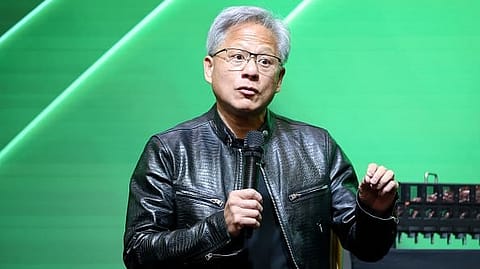
Jensen Huang, founder and CEO, Nvidia | Credits: Getty Images
Nvidia has expanded its share buyback programme by another $150 billion, taking the total remaining authorisation to $235 billion through fiscal 2028. The move comes just four months after the company added $80 billion to the programme, as Nvidia’s cash generation has continued to rise with demand for artificial intelligence (AI) computing.
In May 2026, Nvidia’s board approved an additional $80 billion in buyback authorisation. At the end of its first quarter of fiscal 2027, the company had $38.5 billion remaining under its earlier authorisation. During that quarter, Nvidia returned about $20 billion to shareholders through repurchases and dividends.
By the end of the second quarter, Nvidia had about $99 billion remaining under its share repurchase authorisation. It repurchased 94.4 million shares for about $19.7 billion during the quarter and returned about $26 billion to shareholders through buybacks and dividends.
On September 28, Nvidia added another $150 billion. The company now has $235 billion of remaining authorised capacity and expects to execute the programme through fiscal 2028.
Why is Nvidia expanding the buyback?
The reason given by Nvidia is its cash generation and its expectations for the AI infrastructure market.
Nvidia reported $96.2 billion in revenue for the second quarter of fiscal 2027, up 106% from a year earlier. Data Centre revenue was $89 billion, up 117%. Net income stood at $59.7 billion.
Huang said the company can use the cash generated by this growth both to invest in its business and return capital to shareholders. “NVIDIA’s growth is being driven by a once-in-a-generation platform shift to AI and accelerated computing. Our cash generation gives us the capacity to invest in the technologies that advance this transformation and return capital to shareholders. This authorization reflects our confidence in the long-term opportunity ahead,” Huang said in the announcement.
Nvidia’s buybacks also reduce the number of shares outstanding. With fewer shares, the company’s earnings are divided across a smaller share base, which can increase earnings per share. The valuation also provides context for the timing. Nvidia’s forward price-to-earnings ratio was around 16.5 times on September 26, according to LSEG data cited by Reuters, compared with its 15-year average of about 30 times.
What has Jensen Huang said about Nvidia’s AI growth?
The buyback comes against a backdrop of increasingly strong statements from Huang about demand for AI computing.
{{#most-powerful-women-snapshot-individual.slug}} {{/most-powerful-women-snapshot-individual.slug}} {{^most-powerful-women-snapshot-individual.slug}} {{/most-powerful-women-snapshot-individual.slug}} {{#showRanking}} {{current-rank}} {{/showRanking}} {{#photo.0.url}}
{{name}}
When Nvidia announced the $80 billion buyback increase in May, Huang said, “The buildout of AI factories — the largest infrastructure expansion in human history — is accelerating at extraordinary speed. Agentic AI has arrived, doing productive work, generating real value and scaling rapidly across companies and industries. NVIDIA is uniquely positioned at the center of this transformation as the only platform that runs in every cloud, powers every frontier and open source model, and scales everywhere AI is produced — from hyperscale data centers to the edge.”
In August, after Nvidia reported its second-quarter results, Huang said, “AI has reached its inflection point. It’s doing useful work. Its tokens are productive and profitable. Now, compute is revenue.”
He added, "And demand is accelerating. This time last year, one lab alone was driving the buildout; today, we have a golden age of new AI labs and startups, multiple frontier labs scaling in parallel, a thriving open-model ecosystem and physical AI coming online — with strong momentum across the U.S. and around the world. The AI infrastructure buildout is at full steam. Vera Rubin, now in full production, was built to power exactly this moment.”
Follow Fortune India
NEXT STORY