The "accordion" effect: Microsoft’s Brad Smith warns of widening AI gap
The "accordion" effect: Microsoft’s Brad Smith warns of widening AI gap
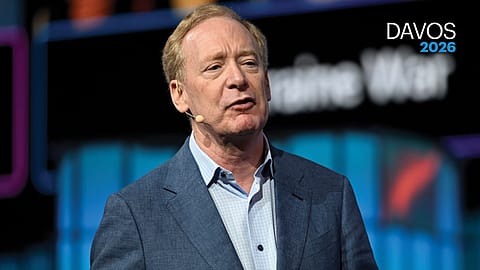
Microsoft's Brad Smith warns that AI advancements are creating a widening digital divide, with the Global South at risk of being left behind. At the World Economic Forum, he emphasized the need for investment in infrastructure like data centres to prevent AI from exacerbating historical inequalities.
Citing Microsoft’s newly released AI Diffusion Report 2026, Smith noted a widening digital divide: while 25% of the population in the Global North uses generative AI, only 14% does so in the Global South
While AI is driving a productivity boom in advanced economies, it risks leaving the Global South in the dark—literally and figuratively. That was the stark warning from Microsoft vice chair Brad Smith at the World Economic Forum, where leaders discussed the uneven "diffusion" of artificial intelligence.
The infrastructure chasm
Citing Microsoft’s newly released AI Diffusion Report 2026, Smith noted a widening digital divide: while 25% of the population in the Global North uses generative AI, only 14% does so in the Global South.
"The world is a quilt with different colours of fabric," Smith said, drawing a historical parallel to the colonial era. He said that colonial powers built railroads in places like India and Africa to extract resources but failed to build power plants for the local population. Smith warned that unless the world invests in the "infrastructure of the future"—data centres and electricity—in the Global South, AI will exacerbate historical inequalities rather than close them.
"Not in my backyard" problem
Smith also highlighted a paradox in the developed world: while demand for AI grows, local resistance to the necessary infrastructure is rising. In the US alone, local communities blocked $98 billion in private sector data centre investment in just the third quarter of last year due to concerns over resources. "People ask: Is the water pressure in our showers going to be impacted? Will my family get these jobs?" Smith noted. He said that for AI to be politically sustainable, tech companies must prove that data centers benefit local communities—by lowering energy rates and replenishing water—rather than just serving global algorithms.
The panel, which included IMF managing director Kristalina Georgieva, concluded that while the "race" for AI supremacy grabs headlines, the real battle is for access. Georgieva described the current situation as an "accordion of opportunities," where the gap between the prepared and the unprepared threatens to stretch until it snaps, leaving the middle class in wealthy nations squeezed and developing nations entirely behind.