We are now in a knife fight: Hexaware CEO R Srikrishna
/ 6 min read
The Carlyle-owned IT services company’s chief executive Srikrishna Ramakarthikeyan reckons the easy days for Indian IT services companies are over, but feels the AI doomsday script is overdone
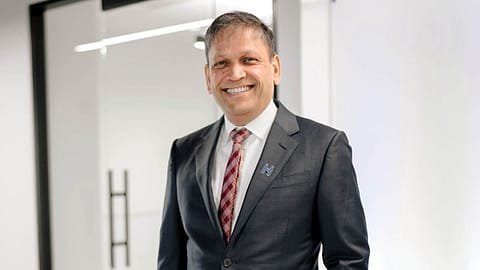
Hexaware CEO Srikrishna Ramakarthikeyan
Last April at Hexaware Technologies’ annual customer group meet, a roomful of the firm’s biggest customers was listening to its chief executive officer telling them to stop chasing the next artificial intelligence (AI) model. “You should not be chasing the next best technology. Draw a line six months ago, or three months ago. I can guarantee you that 95% of what you need to do will be met by the capabilities that existed six months ago,” Srikrishna Ramakarthikeyan (a.k.a Keech) told those in attendance. He repeated the same advice this April. “The figure has since moved up. It is now 99[%],” Keech tells Fortune India.
It is rather odd for the head of an IT services company, ranked 11th in terms of market cap, to say, that at a time when the IT industry is being told daily that AI is eating its lunch. Coding assistants from OpenAI, Anthropic and the likes are doing tasks once billed as engineering hours. Valuations of Indian IT firms have plummeted with the IT index down 25% year-till-date vs -9% for benchmark Nifty 50 and down 4% vs 50% over the past five years. The question on the Street is that if code is just a prompt away, what is the right valuation for IT services stocks? The stock of Hexaware, which ended CY25 with a revenue growth of 7% to Rs 13,430 crore and profits of Rs 1,368 crore, is down 27% year-to-date.
The 56-year-old, an alumnus of IIT Madras and IIM Calcutta, isn’t quite buying the doomsday prophecy but isn’t dismissive about it either.
“It is not the same as in the past, that’s for sure. Earlier, you could re-skill people, form some new partnerships and you’re good to go. That is not the case. I think you need to change how you operate,” he says. “Starting from what you sell, how you sell, how you solution, how you deliver, what the talent required in the leadership is, what the talent required in sales teams are, in accounting. I think it’s a top to bottom, a little bit zero-base thinking needed for our industry,” tells the CEO, who took over the mantle in July 2014.
Ramakarthikeyan points out something, which he believes, that doomsayers have ignored: the very labs that build these models, the ones supposedly sounding the death knell for IT services, are themselves setting up services arms. Anthropic is doing it. OpenAI is doing it. “In many ways, it reiterates the need for services,” he says. “I mean, if you look at even at Anthropic, he [the CEO] said that software engine will be dead in six months. If that is the case, then why do you need a services firm to address the need for enterprises? So, the fact that they’re forming service firms, I think, reiterates something that everybody has been worrying about, that what would be the role of a services firm? Here is the direct proof, even the guys who create these technologies feel like you need that bridge between the capabilities of technology and making it real for enterprises,” elaborates Ramakarthikeyan.
Every hyperscaler, be it Microsoft, Amazon Web Services or Google Cloud, runs a professional services arm of its own, and yet none of them put Indian IT out of business. “The best historical analogy for Anthropic and OpenAI doing services firms is that all hyperscalers have a services business. Has it cannibalised the IT services industry? It is not. In fact, I would argue that it is enabled growth in the services industry in two different ways,” he says.
What they did was take the top end of the work, leaving the rest of the iceberg for somebody else. “A lot of these professional services arms of hyperscalers, they will take maybe 10% of the top end of the work. That creates another 90% that may not have existed in the past. And they also only do it with 10% of the firms,” he points out. “But when they do pick up the 10%, the other 90% they are subbing to, oftentimes, Indian IT services companies or Accenture. Accenture has a joint venture with Microsoft called Avanade. Where does Avanade get its work from? It get’s it from Microsoft professional services firm.” The CEO expects a similar pattern with Anthropic and OpenAI. “It’s a bit of circular economy to come back to people like us,” says Ramakarthikeyan.
This is also where the knife fight comes in.
When orders don’t come easy
Hexaware, like the rest of Indian IT services industry, has spent decades in a business where doing business was relatively easier. “In 30 years, our industry was used to getting business. Walking in from the door. Those days are over. We are in a knife fight. You need people who are prepared for a knife fight,” says Ramakarthikeyan.
What does it take to be good in a knife fight? It looks, oddly enough, like Silicon Valley. “We need leadership who are geeks. We need a team that looks like, more like a, you know, think of Elon Musk, think of Mark Zuckerberg. These are geek CEOs. I think we need, at every level in the leadership in our organisation, we need people with a very different attitude. We need geeks. And I’m saying not just at leadership, but every client leadership, whether it is the person who’s selling, whether it’s the person who’s delivering to clients. I think we need people who think and act differently,” believes Ramakarthikeyan.
That sort of talent transformation, he reckons, will not come from the lake Indian IT firms has always fished in. “Some of this will happen by retraining our people. Some of our people will wake up. Some won’t. And we need to change. And again, the change in the past. Earlier, what did it mean if you want to change your talent? You go and hire from TCS, or from Infosys, or from Persistent. That won’t work anymore. I think we need to go and fish in different ponds right now. We need to take some bets. Do some experimentation. Not everything will work,” explains the CEO.
{{#most-powerful-women-snapshot-individual.slug}} {{/most-powerful-women-snapshot-individual.slug}} {{^most-powerful-women-snapshot-individual.slug}} {{/most-powerful-women-snapshot-individual.slug}} {{#showRanking}} {{current-rank}} {{/showRanking}} {{#photo.0.url}}
{{name}}
When skill matters over domain
Doman expertise will have to be in-depth. “It’s not good enough to say I understand banking. It’s now about understanding FCPA, howanti-money laundering applies in the Middle East or other geographies..”
It is here he reaches for the Anthropic hackathon. “Claude did a hackathon. The person that won it was a lawyer. He’s not a technical person. But defining the problem is still something that we need to do. So, I think domain is a critical component. Understanding customer businesses.”
The third leg of the new playbook is agility. “Right now, the most important focus for us as a strategy is agility. What it means for us, we’ve defined what it means for us. What it means for us is every month we launch one new service. And we will take it to 100 customers in one quarter so that we know if it works or not. I don’t think every service will scale, but how do we find out quickly whether it works or not?”
He says it with the satisfaction of a man who knows the larger players cannot easily replicate this rhythm. “I am unenvious of people that have larger shifts to make a change. Because at some point of time, scale becomes an anchor around your neck. We’ve seen this thesis with lots of companies in the past.” For evidence, he points to the long line of mergers that produced DXC Technology, and went nowhere. “Think of those so many companies that existed, which all kept merging and that merged entity is now also irrelevant. Different companies, each of which had scale. CSC, HP Services, EDS, Compact Services, Digital Services. There were so many companies that got merged into this and it has become irrelevant.”
The view from the Street
Once seen as a must-have, IT services can be arguably described as a special situation play. Ramakarthikeyan shrugs. “We are in a “show me time”,” he says. “Over the next several quarters, the results from our industry will nowhere e close to the doomsday scenarios that the market expects. After four or five quarters, though it won’t be secular, many of us will be demonstrating that it is kind of business as usual with some deflation. But there are lots of new opportunities. Once we demonstrate that for several quarters, I think the thesis will turn again.”
What enterprises will pay for, in his view, is not the technology but the trust. “I think that trust is the most defensible mode in the post AI world. Trust with customers, not trust in AI, but trust in human relationships. AI, by definition, is a non-deterministic technology. You ask the same question at two different times of the day, you will get somewhat different answers. That is a feature, it is not a bug…that is the technology. That will work for creativity, it will work for certain use cases, it’s not going to work for most cases. So, I think a trusted partner who can translate this into certainty for our customers, I think is going to be an immense model for our industry.”
For an industry that grew up on the back of cheap engineers and standing master service agreements, whether Hexaware, or for that matter the rest of Indian IT industry, has the legs to run that race is an open question. But Ramakarthikeyan has, at least, stopped pretending the old race is still on.
Follow Fortune India
NEXT STORY