The FAQs are AI-generated, and Fortune India is not responsible for its content or any associated copyright issues.
India’s chairship aims to harness BRICS’ potential for greater global welfare, says Jaishankar
/ 2 min read
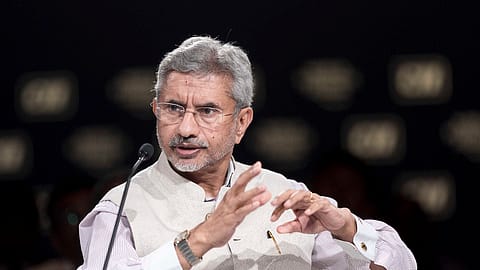
S Jaishankar, minister of external affairs | Credits: Narendra Bisht
India’s chairship aims to harness BRICS’ potential for greater global welfare, says Jaishankar
This summary is AI-generated, and Fortune India is not responsible for its content or any associated copyright issues.
In 2026, BRICS will complete 20 years since its inception. Over the years, BRICS has expanded its agenda and membership, responding to changing global realities
S Jaishankar, minister of external affairs | Credits: Narendra Bisht
India’s External Affairs Minister S. Jaishankar on Tuesday said that India’s BRICS chairship will seek to bring together the potential of BRICS nations to promote greater global welfare, speaking at the launch of the BRICS summit 2026 logo.
As India prepares to assume the BRICS Chairship this year, the external affairs minister said, “The current global environment presents complex and interlinked challenges, including geopolitical uncertainties and complicated economic landscapes.”
In this context, “BRICS remains an important forum that encourages dialogue and cooperation, and practical responses,” he said.
20 years of BRICS
In 2026, BRICS will complete 20 years since its inception. Over the years, BRICS has expanded its agenda and membership, responding to changing global realities.
“India approaches its chairship with a humanity-first and people-centric approach inspired by the guidance of Prime Minister Narendra Modi. Our chairship theme, ‘Building thought resilience, innovation, cooperation and sustainability,’ reflects our belief that cooperation among BRICS members can help address shared challenges in a balanced and inclusive manner,” Jaishankar said.
Logo of BRIC 2026
On the BRICS 2026 logo, the minister said that the theme underscores the importance of strengthening capacities, promoting innovation, and ensuring sustainable development for the benefit of all.
“The logo that we unveiled today reflects this approach. It combines elements of tradition and modernity, and the petals incorporate the colours of all BRICS member countries, representing unity and diversity, and a strong sense of shared purpose,” he said.
What to expect from India’s leadership?
Notably, India’s chairship of the BRICS summit comes at a time when global uncertainties are unfolding rapidly and are continuously impacting trade and economies across the world. In this context, India’s BRICS leadership remains crucial.
Experts suggest that as new countries join BRICS, keeping consensus will be harder. It will be worth watching how India balances different interests and keeps the grouping focused, rather than letting it turn into a loose talking shop.
Another important aspect is the economic side. Steps around trade in local currencies, cooperation through the New Development Bank, and coordination on supply chains will be closely tracked. Any concrete outcomes here will matter more than broad statements.
The other one is geopolitics. The BRICS includes countries with very different relationships with the West and with each other. How India positions BRICS as an independent platform, without turning it into an anti-West bloc, will be closely watched.
RANK
COMPANY NAME
REVENUE
(INR CR)
(INR CR)
{{#current-rank}} {{current-rank}} {{/current-rank}} {{^current-rank}} {{rank}} {{/current-rank}} {{name}} {{#revenue}} {{revenue}} {{/revenue}} {{^revenue}} {{noi}} {{/revenue}}
Frequently Asked Questions
Explore the world of business like never before with the Fortune India app. From breaking news to in-depth features, experience it all in one place. Download Now