Ships queue up at Asian ports due to closure of Strait of Hormuz
/ 3 min read
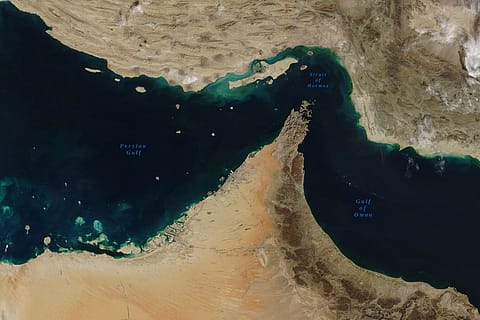
Strait of Hormuz | Credits: Shutterstock
Ships queue up at Asian ports due to closure of Strait of Hormuz
The closure of the Strait of Hormuz due to the Gulf conflict has led to significant shipping disruptions, with vessels queuing at Asian ports like Singapore and Malaysia. The strategic waterway's closure has halted the transit of hundreds of ships, causing delays and congestion as operators seek alternative routes and anchorages, impacting global trade and energy supplies.
This summary is AI-generated, and Fortune India is not responsible for its content or any associated copyright issues.
While a trickle of ships has made its way in or out of the Gulf so far this month, a growing number of vessels bound for Gulf ports have chosen to anchor, mostly at transshipment ports like Singapore, fearing for the safety of their crew and assets, according to the Singapore broadsheet.
Strait of Hormuz | Credits: Shutterstock
With the Strait of Hormuz almost closed amid the ongoing war in the Gulf region, merchant vessels, including oil tankers, have started to queue up at ports across Asia while operators wait for clarity, a media report said Thursday.
Sourcing data that showed longer queues and delays at major Asian ports, including at the richest city-state, The Straits Times pointed out that more vessels carrying Gulf-bound cargoes could seek anchorage in Singapore and Malaysia’s Tanjung Pelepas and Klang ports in the coming weeks, if the crisis drags on.
Starting February 28, the US and Israel launched joint strikes against Iran, which in turn, retaliated, spreading the war to the entire Gulf region. The Strait of Hormuz is a strategically important choke point for the world's energy supplies.
The strait, a narrow shipping lane that connects the Persian Gulf with the Indian Ocean, remains effectively closed, bringing to a near halt the transit of hundreds of vessels per day, including container, dry bulk and liquid cargo ships.
While a trickle of ships has made its way in or out of the Gulf so far this month, a growing number of vessels bound for Gulf ports have chosen to anchor, mostly at transshipment ports like Singapore, fearing for the safety of their crew and assets, according to the Singapore broadsheet.
It takes about five to seven weeks for ships to travel from the Gulf region to Singapore, depending on the size and type of vessel, and vice versa.
Portcast, a Singapore-based supply-chain intelligence platform, said that as the shipping disruption situation evolves and vessels reroute to avoid uncertainty, the effects are showing up at ports across Asia in the form of longer queues, slower berth access, and more delays.
“The data from (major Asian ports) the past few weeks shows that congestion is building,” the daily cited Devansh Bhikajee, marketing director at Portcast, as saying.
He said while the Hormuz is not fully closed, the disruption has been significant enough to alter vessel behaviour at scale. “Ships are holding, rerouting, or bunching at alternative ports while operators wait for clarity,” Bhikajee told Singapore’s mainstream daily.
The seven-day average of vessels waiting at anchorage in Singapore has risen to 30.3 as of March 25, compared with 20 before February 28 when the conflict started.
Anchorage refers to a designated, safe and usually charted area of water where ships drop anchor to wait for a berth, harbour pilot or permission to enter port.
{{#most-powerful-women-snapshot-individual.slug}} {{/most-powerful-women-snapshot-individual.slug}} {{^most-powerful-women-snapshot-individual.slug}} {{/most-powerful-women-snapshot-individual.slug}} {{#showRanking}} {{current-rank}} {{/showRanking}} {{#photo.0.url}}
{{name}}
The worst-hit ports include Busan in South Korea where the average reached 12.9 versus 5.4 before February 28.
While the Gulf region is known for oil and gas exports, it also accounts for about 13% of global seaborne trade volume for chemicals, including fertilisers, 3% containers and 2% dry bulk cargo.
Just a day before the conflict started, 141 ships transited the Hormuz, with more than 80% headed to Asian ports and the rest to Europe and other regions.
Lloyd’s List Intelligence, a London-based real-time vessel tracking firm, estimates only 105 ships have passed through the strait between February 28 and March 18, compared with 1,900 in the same period of 2025, according to media reports.
In Tehran, Iranian Foreign Minister Seyed Abbas Araghchi on Wednesday said his country has permitted certain countries – China, Russia, India, Iraq and Pakistan – that it considers friendly to pass through (the Strait of Hormuz). He also made it clear that ships linked to Iran's adversaries will not be allowed to transit through the strategic waterway. Portcast said that as mainline vessels continue to avoid direct Gulf calls, Gulf-bound shipments are likely to be discharged at regional relay hubs and transshipment ports.
“This will create congestion at alternative hubs absorbing diverted volumes and bottlenecks at Asian transshipment ports such as Singapore, and Malaysia’s Tanjung Pelepas and Port Klang, if carriers continue to restrict Gulf-bound loadings,” said Bhikajee.
Meanwhile, the Port Authority of Singapore (PSA Singapore) said in a statement that it has been closely monitoring the situation in West Asia.
“We have also offered bespoke solutions to beneficial cargo owners and supply chain stakeholders who need help with shipments affected by disruptions,” The Straits Times quoted the PSA spokesperson as saying.
Follow Fortune India
NEXT STORY