US Supreme Court upholds birthright citizenship, hands Trump major setback on immigration
/ 3 min read
Top court says children born on American soil remain citizens regardless of parents' immigration status; rejects bid to reinterpret 14th Amendment.
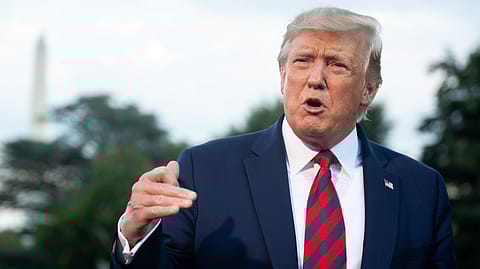
U.S. President Donald Trump | Credits: Getty
The U.S. Supreme Court on Tuesday struck down President Donald Trump's executive order restricting birthright citizenship, reaffirming a constitutional guarantee that has stood for more than 150 years and delivering a major setback to one of the centrepieces of his second-term immigration agenda.
In a 6-3 ruling, the country's highest court held that the 14th Amendment guarantees automatic citizenship to children born in the United States, including those whose parents are in the country unlawfully or only temporarily, rejecting the Trump administration's argument that birthright citizenship should be limited to children with at least one parent who is a U.S. citizen or lawful permanent resident.
Writing for the majority, chief justice John Roberts said the court saw no reason to depart from more than a century of legal precedent established by the landmark 1898 United States v. Wong Kim Ark ruling.
"Citizenship, then and now, was the right to have rights — to freely participate in our political community," Roberts wrote.
He added that children born in the United States to parents "unlawfully or temporarily present are 'subject to the jurisdiction' of the United States and are citizens at birth under the Fourteenth Amendment's Citizenship Clause."
Trump's signature immigration push blocked
Trump had signed the executive order within hours of returning to the White House in January 2025, seeking to deny automatic citizenship to babies born in the U.S. if neither parent was an American citizen or a lawful permanent resident.
The administration argued that the Constitution's phrase "subject to the jurisdiction thereof" excluded children of undocumented immigrants and temporary visa holders, contending that citizenship should depend on a family's permanent allegiance to the United States.
The Supreme Court rejected that interpretation.
Roberts said there was "scant evidence" supporting what he described as the administration's "dramatically revisionist view" of the Citizenship Clause.
"Not surprisingly, then, in the 128 years since, we have repeatedly understood the rule of Wong Kim Ark to guarantee citizenship to all children born in the United States and subject to its power," Roberts wrote. "We see no reason to depart from that view today."
Justice Brett Kavanaugh agreed that Trump's order was unlawful, though he said it conflicted with federal statute rather than the Constitution. Conservative Justices Clarence Thomas, Samuel Alito and Neil Gorsuch dissented.
{{#most-powerful-women-snapshot-individual.slug}} {{/most-powerful-women-snapshot-individual.slug}} {{^most-powerful-women-snapshot-individual.slug}} {{/most-powerful-women-snapshot-individual.slug}} {{#showRanking}} {{current-rank}} {{/showRanking}} {{#photo.0.url}}
{{name}}
Constitutional guarantee reaffirmed
Ratified in 1868 after the Civil War, the 14th Amendment states that "all persons born or naturalized in the United States, and subject to the jurisdiction thereof, are citizens of the United States."
The provision overturned the infamous 1857 Dred Scott decision, which had denied citizenship to Black Americans, and has since been interpreted as guaranteeing birthright citizenship with only narrow exceptions, such as children of foreign diplomats.
Legal experts had warned that upholding Trump's order could have affected the legal status of around 250,000 babies born each year, while forcing millions of families to prove the citizenship status of newborn children.
Trump vows legislative push
Reacting to the ruling, Trump criticised the decision and urged lawmakers to pursue the issue through Congress instead.
"Too bad for our Country, but we can easily make it up in Congress through Legislation," Trump wrote on his Truth Social platform, adding that lawmakers should begin work immediately to end birthright citizenship.
The decision marks the second major Trump policy struck down by the Supreme Court during his second term, following the court's earlier ruling against his use of emergency powers to impose sweeping tariffs.
Democratic attorneys general and immigration advocates welcomed the verdict, calling it a reaffirmation of a foundational constitutional principle.
California Attorney General Rob Bonta said the ruling confirmed that "every child born in this country, no matter their background, is equal under the law and can pursue the American Dream."
The judgment also carries a personal dimension for several senior members of Trump's administration, including Secretary of State Marco Rubio, FBI Director Kash Patel and Second Lady Usha Vance, all of whom are children of immigrants who acquired U.S. citizenship under the birthright principle.
NEXT STORY