
Can the Tata Sierra EV bring about a Nexon EV-like fortune for Tata Motors?
ADVERTISEMENT
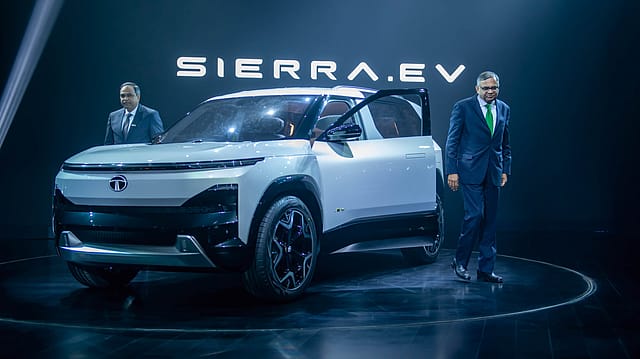
Tata Motors has launched its latest EV offering, the Sierra EV.
With that, the country’s second-largest automaker is all set to ramp up its offering in the country’s fastest-growing automotive segment, the mid-size-SUV, where the ICE version of the Sierra has already made some dent, even though Tata might have been late to the party.
The Sierra’s internal combustion engine (ICE) version already had over 100,000 bookings, and with the new Sierra EV offering a range in excess of 500 km—covering Mumbai to Goa in a single charge—Tata Motors could be in to win back its fast-slipping dominance in the country’s electric vehicle market.
About two years ago, Tata Motors cornered 80% of the domestic electric vehicle market. Since then, though, as the country’s carmakers have turned their attention to electric vehicles, the carmaker has seen its market share slip, even as volumes have grown. Today, the company has a market share of about 40%, followed closely by home-grown carmaker Mahindra, which has steadily ramped up its electric offerings.
“The mainstream customer has arrived,” Shailesh Chandra, Managing Director & CEO - TMPVL & TPEM, said during the launch of the Sierra EV about the country’s electric vehicle buyer. “Today, our EV bookings are over three times what they were one year ago.”
With the Sierra EV, Tata Motors will also be hoping to repeat its success with the Tata Nexon EV. The Nexon, once designed as a bridge in its transformation journey, has been among Tata Motors’ best-selling vehicles over the last decade, prompting the Tata Group to launch its electric variant. The Nexon was launched in 2017 as a bridge product to help the automaker transform its automobile business.
The Nexon EV soon became the country’s best-selling EV and helped the automaker emerge as the largest EV maker in the country. In five years since its launch, the automaker has sold over 100,000 electric Nexons, the first electric vehicle to surpass that figure. On average, Tata now sells around 2,500 electric Nexons a month.
While the company has launched multiple electric vehicles since, including the Curvv, Harrier, Tiago, and Punch, the Nexon has remained the automaker's flagship electric vehicle, especially as the country transitions to electric vehicles. Triggered by the West Asia conflict and the improved cost competitiveness of electric vehicles (EVs), electric vehicle sales are expected to more than double by the next fiscal, according to ratings agency Crisil.
The Sierra EV’s launch also comes at a time when the company has laid out a five-year roadmap targeting 15% volume growth and 5-6% market share growth. Alongside a structural cost reduction, which will reduce costs by 5-6 percent, the company hopes to free up cash flow by over ₹10,000 crore over the next five years.
To do that, Tata Motors will launch six new vehicles and over 20 refreshes, along with a multi-powertrain approach, with the bulk of its incremental volumes coming from electric and CNG powertrains. Then, there is also a plan to ramp up its dealer network to 3,200 outlets from 1,669 currently, and to increase the number of service centers to over 3,000 from 1,211 now.
“What makes the Sierra different is also the category that it appeals to,” Puneet Gupta, the Director at S&P Global Mobility of India & ASEAN region at S&P Global, had told Fortune India. “A large number of the buyers today are under the age of 45 years, and while products like Suzuki Victoris might bring volumes, even cannibalizing the sales of Grand Vitara, Tata is also well positioned to deliver strong performance given the features and styling it offers in Sierra, and clearly, its offering is differentiated from the traditional styling of compact SUVs.”
Unlike many automakers that focus on one or two powertrains per model, Tata has steadily expanded powertrain options across multiple models. For instance, the Tata Nexon currently offers EV, petrol, diesel, and CNG powertrains, a factor instrumental to its success. The Tata Punch is sold across multiple powertrains. Multiple powertrains coupled with a diverse variant strategy have been critical to Tata Motors’ success.
The automaker is also expected to offer a Battery-as-a-Service program, allowing customers to purchase an electric vehicle at a lower upfront cost and pay for the battery on a pay-per-use basis. This reduces the upfront cost of buying an EV and offers flexible payment options. The battery cost is financed on a per-kilometer basis for a certain tenure and interest rate, depending on the financier. Charging expenditures are not included in the battery usage costs.