
Nissan bets big on India with Tekton SUV, targets 2 lakh domestic and export sales as expansion gathers pace
ADVERTISEMENT
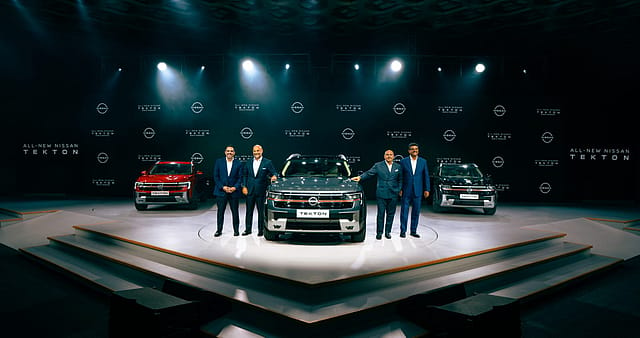
Nissan has unveiled the Tekton, its new midsize SUV, as it looks to strengthen its presence in India's fast-growing passenger vehicle market. The SUV, positioned in the highly competitive C-segment SUV space, is expected to go on sale later this year, with the company saying pricing will be announced closer to its market launch. Alongside the global debut of the model, Nissan outlined an ambitious growth strategy for India, positioning the country as both a key domestic market and a manufacturing hub for exports.
India at the centre of Nissan's growth strategy
The company is targeting 100,000 domestic sales and another 100,000 units through exports, with India serving as an export hub for markets across Africa, the Gulf Cooperation Council (GCC) region and Saudi Arabia.
"The Tekton is strategically important for us because it strengthens our product lineup, supports volume growth and helps us expand in markets where we see long-term demand. We expect India, Africa and the GCC markets to continue growing," said Guillaume Cartier, Chief Performance Officer at Nissan.
Cartier said the company expects domestic and export volumes to be evenly split, while indicating that internal targets are even more ambitious. "Our plan is to achieve 100,000 domestic sales and 100,000 export units from India. The same broad split applies to the Tekton. Internally, however, our expectations are even higher. If the Tekton performs like the Magnite, we believe we can exceed those numbers," he said.
However, Cartier acknowledged that geopolitical tensions remain a key uncertainty for Nissan's export strategy. "The global market is highly unpredictable. Developments can change overnight, particularly with the ongoing tensions in the Gulf. But when we make investments over a four- or five-year horizon, we take a broader macroeconomic view," he said.
Betting on ICE while evaluating EV options
On the domestic front, Nissan Motor India Managing Director Saurabh Vatsa said the Tekton has been positioned to compete in the core of India's highly competitive midsize SUV segment.
"The CSUV segment has 19 players today, but five of them account for almost 80% of the volume. We are going into the core of the segment. We've kept it simple with 12 variants, two powertrains, four interior themes and 11 colour options," Vatsa said.
He said the company had intentionally kept the variant lineup simple despite increasing demand for multiple powertrain combinations. "We wanted to launch the vehicle and keep the variant build-up fairly simple and easy for consumers to understand," he said. While several automakers are stepping up investments in electric vehicles, Vatsa said Nissan's immediate priority remains the internal combustion engine (ICE) market, noting that conventional vehicles continue to dominate passenger vehicle sales in India. "About 93% of the total industry volume remains ICE even today. We are focusing on bringing volume into that 93% of the business while ensuring Nissan caters to consumer requirements," he said.
Looking ahead, Cartier said Nissan expects to finalise its India electrification strategy before 2028 and is evaluating multiple pathways to meet future regulatory requirements. "We have three options before us—we can utilise CAFE credit mechanisms, pursue partnerships, or introduce a Nissan EV. The decision will ultimately depend on customer demand. We don't believe the market is mature enough to launch an EV immediately, but Nissan has the technology to meet future requirements," he said.
Cartier added that Nissan remains open to hybrid technology but is not convinced plug-in hybrid electric vehicles (PHEVs) are the right solution for India at present because of their higher costs and uncertain customer demand. "When I look at India, I will not bet on PHEVs. Hybrid, I'm not against. EV, I think we need, but we need to separate what is regulation-driven from what customers actually want," he said.
On Nissan's potential collaboration with Honda, Cartier confirmed that discussions are continuing beyond the software-defined vehicle (SDV) project announced earlier. "Our software-defined vehicle collaboration with Honda is already public and progressing. Beyond that, we continue to explore other opportunities together, although nothing has been signed yet," he said.
Dealer expansion and digital push
Alongside its product expansion, Nissan plans to significantly increase its retail footprint in India. The company expects to expand its dealership network from 155 outlets to around 200 by mid-August and approximately 250 by the end of the year. "We don't want to over-expand our dealer network, but we also don't want to be under-represented. Our network expansion is aligned with the volume ambitions we've mapped for the market," Vatsa said.
Thierry Sabbagh, Divisional Vice President and President, Middle East, Saudi Arabia (KSA), Commonwealth of Independent States (CIS), and India for Nissan and INFINITI, said the company is also investing in digital retail capabilities to improve the customer experience. "Customer reach today goes beyond physical dealerships. We're investing in digital capabilities and will continue introducing technologies that improve the customer experience," Sabbagh said.
The company said these digital investments include an AI-powered vehicle configurator that allows prospective buyers to customise vehicles online, forming part of a broader strategy to strengthen both its physical retail network and digital customer engagement as it prepares for its next phase of growth in India. Nissan is expected to announce the Tekton's pricing and launch timeline closer to its commercial rollout.