
Tata Motors' June EV sales jump 124%; automaker says India's electric car market has entered the mainstream
ADVERTISEMENT
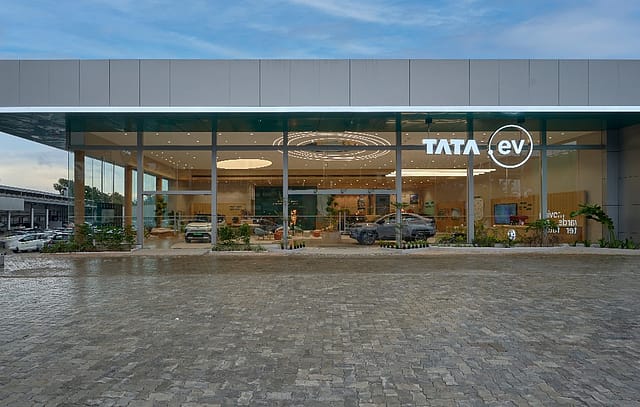
Tata Motors more than doubled its electric passenger vehicle sales in June, reinforcing its leadership in India's EV market as the automaker argued that the segment has moved beyond early adopters and is now seeing mainstream acceptance.
The company sold 12,025 electric passenger vehicles in June, up 124% year-on-year from 5,372 units a year earlier and 10.6% higher than May's 10,870 units. During the April-June quarter, EV sales stood at 32,283 units, more than doubling from 15,794 units in the corresponding quarter last year.
Across its passenger vehicle business, including internal combustion engine (ICE) and electric vehicles, the auto manufacturer sold 56,450 units in June, taking its first-quarter sales to 1,74,299 units, compared with 1,24,984 units in the same period last year, reflecting a nearly 39.5% year-on-year increase.
The June numbers also cement Tata Motors' leadership in India's electric passenger vehicle market. According to VAHAN registration data, Tata accounted for 12,025 registrations in June, ahead of Mahindra (7,645), MG Motor (5,785), Maruti Suzuki (1,896) and VinFast (1,394). In the April-June quarter, Tata registered 32,283 EVs, retaining the top position despite competition intensifying with new launches across price segments.
The sales momentum comes a day after Tata Motors launched the Sierra EV, a model the company believes will strengthen its position in the fast-growing midsize electric SUV segment while supporting its broader ambition of expanding EV adoption in India. Speaking at the launch, Shailesh Chandra, Managing Director, Tata Motors Passenger Vehicles and Tata Passenger Electric Mobility, said India's EV market has undergone a structural shift over the past year.
"So today, as we speak, I think we are really seeing indications of the mainstream customers, the great majority customers, coming forward to buy EVs."
According to Chandra, the transition is being driven not by a single breakthrough but by the cumulative impact of greater product choice, improved charging infrastructure and growing consumer confidence. "When there are multiple players coming with multiple products, customers feel comfortable. One, they have more options. But second, it gives confidence to customers that this technology is going to remain for long because all the players are betting on it."
He added that Tata is also seeing the traditional barriers to EV adoption, including purchase price, range anxiety and battery durability, gradually diminish as newer models offer longer driving ranges, faster charging and lifetime battery warranties.
Supply replacing demand as the bottleneck
While competition in India's EV market has intensified over the past year, Tata Motors believes the challenge is increasingly one of manufacturing capacity rather than consumer demand. "We actually have a problem of supply. It is not that I am waiting for demand," Chandra said. He said the company is steadily expanding production capacity while working with suppliers to ease constraints, particularly for high-demand models.
Tata is aiming to stabilise passenger vehicle production at around 70,000 units a month as it prepares for higher EV volumes and future launches. Beyond the Sierra EV, the company plans to introduce four additional electric vehicles while continuously upgrading its existing portfolio instead of relying solely on new products. "Our strategy is that existing products do not mean sustaining them. We have to increase volumes with every upgrade by strengthening the value proposition," Chandra said.
The Sierra EV, offered with 63 kWh and 75 kWh battery packs, delivers a claimed real-world range of 510-530 km, supports fast charging and comes with a lifetime battery warranty, positioning it in one of the fastest-growing segments of India's passenger vehicle market.
West Asia tensions add momentum
Chandra also pointed to geopolitical developments as an unexpected catalyst for EV adoption. "There has been a faster acceptance. Consumers who were reluctant before are now more amenable because of the fuel price volatility. The West Asia crisis has shifted the market from a push mode to a pull mode."
Unlike Europe and the United States, where EV adoption has slowed following subsidy rollbacks and policy changes, India is being driven by different structural factors, he argued. "As far as India is concerned, the story is completely different from what is happening across the world."
He expects passenger vehicle EV penetration to increase to 7-8% during the current fiscal, up sharply from an estimated 4.5% in FY26, with adoption likely to cross 10% in FY28 as product choices expand and consumer confidence strengthens.