
The Harrier.ev might tip things in Tata Motors’ favour amid eroding market share, report shows
ADVERTISEMENT
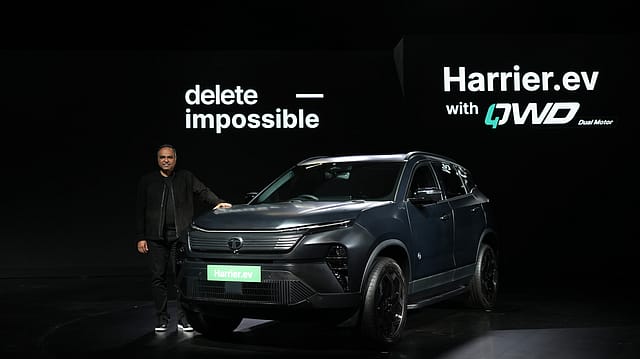
The recently launched Harrier EV— Tata Motors’ ICE Harrier SUV with a retrofitted electric motor—might help the homegrown automaker claw back some of the market share it conceded to JSW MG Motor India, according to a recent sectoral report by brokerage firm Equirus Securities.
The report states that EV penetration in May of this year was 4.1%, compared to 3.7% in April and 2.6% in the year-ago period. The increase in penetration was largely on the back of new launches—namely, Mahindra’s BE6 and XEV 9E, the first vehicles from its Born Electric EV platform, and Hyundai’s Creta Electric—giving the consumer a greater choice.
In May, the sales of electric cars increased 55% year-on-year to about 12,400 units. However, the uptake in adoption of electric cars has culminated in Tata Motors—the market leader in the electric car segment—seeing its market share decline sharply, at 35% in May, compared to 66% in the year-ago period. It was 85.4% in FY22.
The scenario has rapidly evolved in the past year, with JSW MG Motor India’s Windsor becoming a runaway success for the carmaker. It has bumped up its market share to 31% in May, compared to 19% in the year-ago period, the report claims. Tata Motors’ rival homegrown carmaker Mahindra has seen its market share rise to 21% in May, compared to 7% in May last year, thanks to its recent launches. Hyundai Motor India, on the other hand, has witnessed its market share jump to 5% in May, compared to 1% in May last year.
With increasing competitive pressure, things might change for Tata Motors with the recent launch of the Harrier EV. In early June, on the sidelines of the launch, Shailesh Chandra, managing director of Tata Motors Passenger Vehicles and Tata Passenger Electric Mobility, had told Fortune India that its strategy is built on a strong presence across all key segments.“Our strategy is built on a strong presence across all key segments.
In the entry-level EV market (under ₹12 lakh), where we hold around the majority (~75%) market share, we will continue to grow by increasing EV adoption and encouraging ICE buyers to switch,” Chandra had said.
In the mid-segment (₹12–20 lakh), Tata Motors is making its products more competitive through constant feature upgrades.
In the premium segment (₹20 lakh and above), it expects the launch of the Harrier.ev and the upcoming Sierra to help attract more customers.
“Across all areas, we're focused on reducing costs, making EVs more mainstream, and building the right ecosystem to stay ahead and maintain our leadership position,” said Chandra.