
Auto industry cuts import dependence by ₹20,000 crore-plus via localisation: SIAM President Shailesh Chandra
ADVERTISEMENT
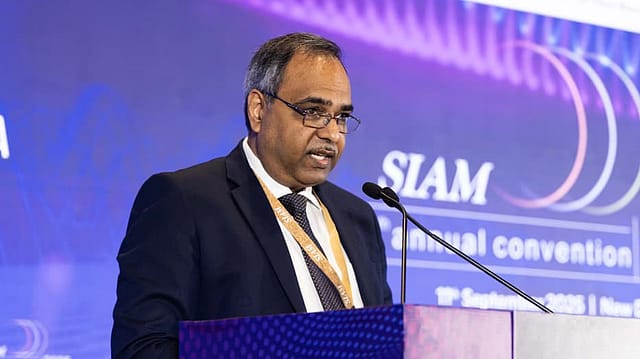
India’s automobile industry has cut its import dependence by more than ₹20,000 crore through localisation, with domestic sourcing of components such as engines, iron and steel helping strengthen supply chains even as vehicle sales and exports reach record levels, SIAM President Shailesh Chandra said.
"The reduction represents a 16.6% decline in automotive imports in FY25 compared with the FY20 baseline, "Chandra said at the 66th SIAM Annual Convention. The localisation drive has been led jointly by SIAM members and the Automotive Component Manufacturers Association of India (ACMA).
“The industry has achieved a reduction in the imports exceeding Rs. 20,000 crore,” added Chandra.
Record volumes raise the stakes for localisation
The import reduction assumes significance as India’s automotive industry continues to expand at scale. Passenger vehicle sales reached a record 4.6 million units in FY26, rising 7.9% while exports increased 17.5% to nearly one million units.
Two-wheeler domestic sales climbed 10.7% to a record 21.71 million units, while exports rose 23.4% to 5.18 million units. Three-wheeler sales increased 12.8% to around 8.4 lakh units, with exports jumping 50.1% to 4.6 lakh units.
Commercial vehicle sales also hit a record 10.80 lakh units, up 12.6%, while exports grew 17.4% to around 95,000 units.
Chandra said localisation was not only about reducing import dependence but was also linked to the industry’s sustainability and decarbonisation efforts. “Localisation forms an integral part of our approach to sustainable mobility and decarbonization through collaborative initiatives led by SIAM members and ACMA across categories, including engines and iron and steel,” he said.
EV adoption adds another layer to supply-chain shift
The industry’s localisation push is unfolding alongside a rapid change in vehicle technology and energy sources. Total EV registrations rose to 2.5 million units in FY26 from 1.97 million in FY25, a growth of nearly 25%, Chandra said.
He added that the share of EVs in new vehicle registrations continued to grow in double digits across passenger vehicles, two-wheelers and three-wheelers during FY26, supported in part by the PM E-Drive scheme.
The industry has also shifted to fully E20-compliant petrol vehicles from April 1, 2025, while automakers have begun commercial launches and demonstrations of flex-fuel vehicles.
Auto sector’s ₹22.7 lakh crore economic footprint
Beyond manufacturing and supply chains, Chandra said the automotive sector’s contribution to the Indian economy had crossed ₹22.7 lakh crore, accounting for about 15% of GST collections and supporting more than 30 million direct and indirect jobs.
SIAM is also supporting CNG infrastructure, LNG technology for long-haul heavy trucks and pilot deployment of green-hydrogen buses and trucks, while backing vehicle recycling and scrappage initiatives.
Chandra said SIAM would continue working with the government on the Automotive Mission Plan for 2025-2047, aimed at providing a long-term roadmap for the industry’s contribution to the ‘Viksit Bharat’ vision.