
Davos 2026: Gujarat to become first state to generate nuclear power via small reactors under SHANTI Bill, says Gujarat Deputy CM Sanghavi
ADVERTISEMENT
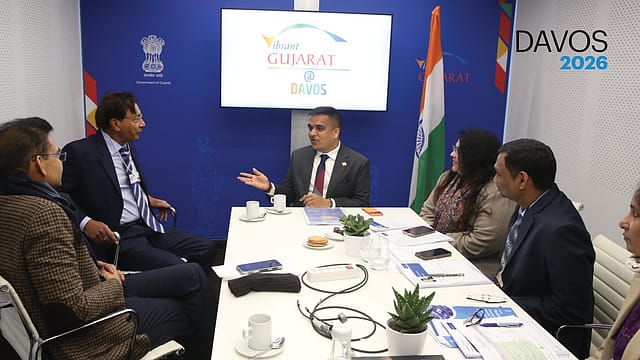
Gujarat Deputy Chief Minister and Industries Minister Harsh Sanghavi on Thursday announced that the state will become the first in India to produce nuclear energy through small reactors under the proposed Sustainable Harnessing and Advancement of Nuclear Energy for Transforming India (SHANTI) Bill, marking a significant milestone in India’s clean and future-ready energy transition.
Sanghavi outlined Gujarat’s investment road map, engagements with global technology leaders, and the state’s economic strengths while speaking to ANI on the sidelines of the World Economic Forum (WEF) Annual Meeting in Davos. He said Gujarat has held multiple high-level discussions with international companies focused on nuclear power technologies and investments over the past three days.
“In the last three days in Davos, we met over three global companies and held successful discussions on technologies and investments around nuclear power. I am very proud to share that Gujarat will be the first state to produce nuclear energy through small reactors,” Sanghavi said.
What is the SHANTI Bill?
The SHANTI Bill aims to open up the nuclear energy sector to joint ventures and private players, subject to stringent national security and safety safeguards. Addressing concerns around risk-sharing, Sanghavi said discussions are ongoing at the central level and greater clarity is expected soon. “But Gujarat will lead among Indian states in producing nuclear energy through small reactors and will be the first to do so,” he added.
The proposed legislation seeks to promote and develop nuclear energy and the use of ionising radiation across sectors such as power generation, healthcare, food, water, agriculture, industry, research, and environmental protection. It also envisages a robust regulatory framework to ensure the safe and secure utilisation of nuclear technologies.
Highlighting the state’s broader economic vision, Sanghavi said Gujarat arrived in Davos with a clear strategy to aggressively attract industries, nurture local enterprises into national champions in the first phase, and scale them into global leaders in the next phase through quality manufacturing and a strong, skill-based economy.
“This year, Davos has a different flavour of India. Since morning, there are queues of investors outside state pavilions. This reflects the rise of New India,” he said, crediting Prime Minister Narendra Modi for strengthening India’s global standing.
He noted that Gujarat is participating at Davos “in a big way” for the first time and has received a highly encouraging response from foreign investors after multiple high-level meetings across sectors.
Sanghavi also underlined Gujarat’s strengths as an investment destination, citing stable governance, policy continuity, fast execution, transparency and what he described as “maximum governance, minimum government.”
“An investor wants safety for capital and the right returns. Gujarat delivers both,” he said.
Gujarat's contribution to India's GDP
On economic fundamentals, Sanghavi said Gujarat contributes 8.3% to India’s GDP—the highest among states—and accounts for 18% of the country’s manufacturing output. He said 65% of the state’s energy comes from renewable sources, the highest in India, and that its 48 ports handle over 40% of the nation’s cargo movement.
The Deputy Chief Minister also noted that Gujarat hosts the largest number of companies in the country, including several Fortune 500 firms, and continues to scale new economic heights through initiatives such as Vibrant Gujarat, investor-friendly policies and long-term planning.
Earlier in Davos, Sanghavi had held a series of high-level meetings with global industrial leaders, as Gujarat intensified its push to attract fresh investments across both emerging and traditional sectors. He said the state is actively exploring new opportunities in areas such as artificial intelligence, defence manufacturing, textile parks, Global Capability Centres, and innovative financing models to power the next phase of industrial growth.