
Economic growth, welfare delivery, digital infra witnessed significant progress in last 12 years: FM Sitharaman
ADVERTISEMENT
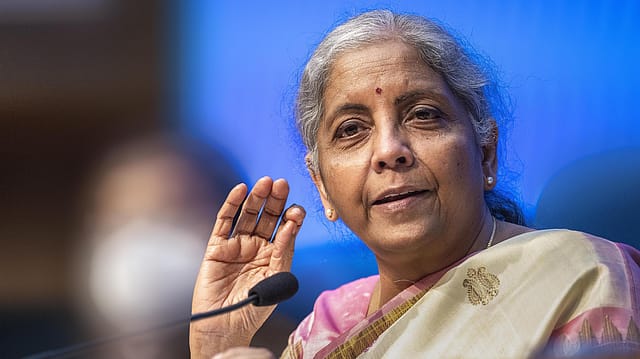
Union Finance Minister Nirmala Sitharaman said India has witnessed significant progress in welfare delivery, digital infrastructure and economic development over the last 12 years, while calling for continued efforts towards the goal of a developed India by 2047. Speaking at the Viksit Bharat Sankalp Samavesha event in Bengaluru, Sitharaman said the government's focus had been on ensuring that economic growth is accompanied by improvements in the lives of ordinary citizens. "We have not missed out on the human elements as much as the infrastructure elements," she said.
The finance minister noted that 25 crore Indians had come out of multidimensional poverty over the past decade, while access to sanitation, drinking water and cooking fuel had expanded significantly. She said 12 crore household toilets had been built, water connections had risen from 3.23 crore in 2019 to 15.85 crore today, and 10.5 crore free LPG connections had been provided under the Ujjwala scheme.
Sitharaman also highlighted the government's welfare coverage efforts, noting that 81 crore people receive free food grains under the PM Garib Kalyan Anna Yojana. "We are now in a phase where we are saying there should not be one eligible person who has not received it. Saturation is what we are working towards," she said.
Calling Bengaluru an innovation hub, she said Karnataka had emerged as a leader in sectors such as aerospace, defence manufacturing and biotechnology. She also noted that 23 lakh direct jobs had been created through 2.23 lakh recognised startups.
Digital infrastructure and formalisation have been transformative
Sitharaman described India's digital public infrastructure as a "revolution", highlighting the role played by Bengaluru in shaping the country's digital ecosystem.
"The street vendor in Shivajinagar and the techie in Whitefield are using the same rail through which each conducts business," she said. "That's the quality of digital public infrastructure spread which, with responsibility, I'm saying no other country has obtained in the world."
She noted that the JAM Trinity, which is Jan Dhan, Aadhaar and Mobile, had enabled the expansion of digital services, with 58 crore Jan Dhan accounts, 144 crore Aadhaar identities and 125 crore mobile connections supporting the ecosystem.
According to Sitharaman, UPI currently processes around 2,100 crore transactions every month, with a majority of person-to-merchant payments involving amounts below ₹500. The minister also highlighted what she called a "formalisation revolution" driven by GST and digitalisation. She said GST registrations had increased from 66.5 lakh entities when the tax regime was introduced in 2017 to 1.64 crore today. In addition, more than 31 crore unorganised workers have been registered on the e-Shram portal, while 57 crore Mudra loans worth over ₹40 lakh crore have been sanctioned, with 66% of the loans going to women.
The finance minister also highlighted measures aimed at the middle class, including changes in income tax exemptions, healthcare expansion and startup-led employment. "Today, if you earn up to ₹12.75 lakh, you do not have to pay income tax," she said.
Sitharaman said India had recorded 47 crore telemedicine consultations, while maternal mortality and malaria deaths had declined significantly.
Karnataka receives infrastructure push across roads, railways and renewable energy
Sitharaman also outlined several infrastructure projects in Karnataka, including the Bengaluru-Chennai Expressway, Bengaluru Ring Road and the Solapur-Chennai corridor. She said over 8,100 kilometres of National Highways had been constructed in Karnataka, while more than 2,000 kilometres of corridors had been approved under Bharatmala Phase I at a cost of ₹63,000 crore.
In the railway sector, she said Karnataka's annual railway allocation had increased from an average of ₹835 crore during the UPA period to ₹7,700 crore in the current financial year. According to the minister, 1,650 kilometres of new railway tracks have been laid in the state since 2014, while 96.5% of Karnataka's rail network has been electrified. Ten Vande Bharat trains have also been introduced in the state.
She further highlighted the Chennai-Bengaluru Industrial Corridor node at Tumakuru, the PM MITRA Mega Textile Park in Kalaburagi, and investments in renewable energy projects in Koppal and Gadag. "Karnataka is soon going to become a powerhouse of India's green transition," Sitharaman said, noting that the two districts would contribute 4.5 GW of renewable energy capacity.