
Global steelmakers line up ambitious ₹3 lakh crore worth of projects in India
ADVERTISEMENT
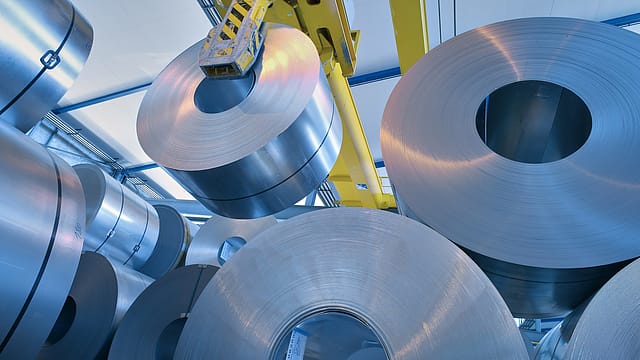
Global steelmakers are racing to deepen their footprint in India, lining up what industry analysts say will be at least ₹3 lakh crore in spending in the next 5–6 years that could reshape the country’s steel map. The rush—driven by robust domestic demand, policy push and the promise of lower per-capita steel consumption compared with mature markets—has seen foreign groups strike deals, pledge greenfield projects and form joint ventures with local steel producers to capture a fast-growing market.
Japan’s JFE Steel recently agreed to invest in a 50:50 joint venture with India’s JSW Steel to operate and expand the Bhushan Power & Steel (BPSL) assets in Odisha, committing roughly ₹15,750 crore in staged investments and targeting an uplift in crude steel output to 10 million tonnes (MT) by 2030 from 4.5 MT. The deal brings Japanese technology and product know-how together with JSW’s distribution strength.
JFE, which holds a 15% stake in JSW Steel, along with its Indian partner, earlier announced two joint ventures to build specialised electrical steel capacity of 3.5 lakh tonnes at JSW's Vijayanagar and Nashik facilities. It will require an investment of ₹5,485 crore.
ArcelorMittal-Nippon Steel (AMNS), which took over bankrupt Essar Steel's plant in Hazira for ₹42,000 crore in 2019, has large expansion plans on the cards. It is in the process of expanding Hazira capacity from 9 MT to 15 MT by 2026, with plans to reach 24 MT by 2030.
The company is spending $5.1 billion (nearly ₹46,000 crore) for upstream capacity expansion to 15 MT by 2026 from 9 MT, and $1 billion (₹9,000 crore) for ramping up manufacturing of patented value-added steel products for automotive, solar and wind energy, defence and infrastructure sectors. Another $1.6 billion (₹14,400 crore) will be spent on support facilities, taking the Phase 1 investment to $7.7 billion (nearly ₹70,000 crore), estimated to enhance AM/NS India’s EBITDA and investable cash flow 2.5 times.
The management plans a capex-rich Phase 2A expansion, which would see capacity rise to 18 MT by 2028 and 24 MT by 2030 (Phase 2B). AMNS is exploring two greenfield plants in Odisha for up to 24 MT capacity with a ₹1 lakh crore investment.
The multinational is also looking to invest in Andhra Pradesh for building a steel complex. Andhra Pradesh state Industries and Commerce Minister T.G. Bharat said in March that AMNS is in the process of establishing the plant at Nakkapalli in Anakapalli district with a total investment of ₹1,47,162 crore (₹61,780 crore in the first phase and ₹85,382 crore in the second) with a capacity of 17.8MT — 7.30 MT and 10.5MT in the first and second phases, respectively.
The JV has won the rights to mechanise and run the CQ-III berth at state-owned Paradip Port for handling 10 MT of dry bulk cargo on a captive basis for 30 years.
South Korean steelmaker POSCO is also exploring a multi-billion-dollar investment. In August, POSCO signed a non-binding Heads of Agreement (HoA) with JSW to jointly explore setting up a 6 MT integrated steel plant. It has been planned as a 50:50 joint venture to build the plant in Odisha with an investment of ₹35,000 crore.
India’s growth ambitions are central to the story. The domestic per capita steel consumption has hit the 100 kg mark recently, from 60 kg in 2017. The government's National Steel Policy 2017 aims to scale up finished steel per capita consumption to around 160 kg by 2030–31. The policy also aims for crude steel capacity of 300 MT in the same period. The crude capacity stands at 205 MT in FY25.
Domestic steel giants are also in aggressive expansion. Naveen Jindal, Chairman, Jindal Steel, recently said the country would require steel-making capacity of 500 MT by 2047 to meet rising demand from infrastructure, housing and automobiles.
Homegrown giants are also expanding and retooling their businesses even as foreign giants AMNS, JFE, POSCO and others place sizeable wagers. The headline figure for pledged foreign money will keep changing as new deals are signed, but the structural story is clear—India has become the principal growth theatre in global steel strategy.